





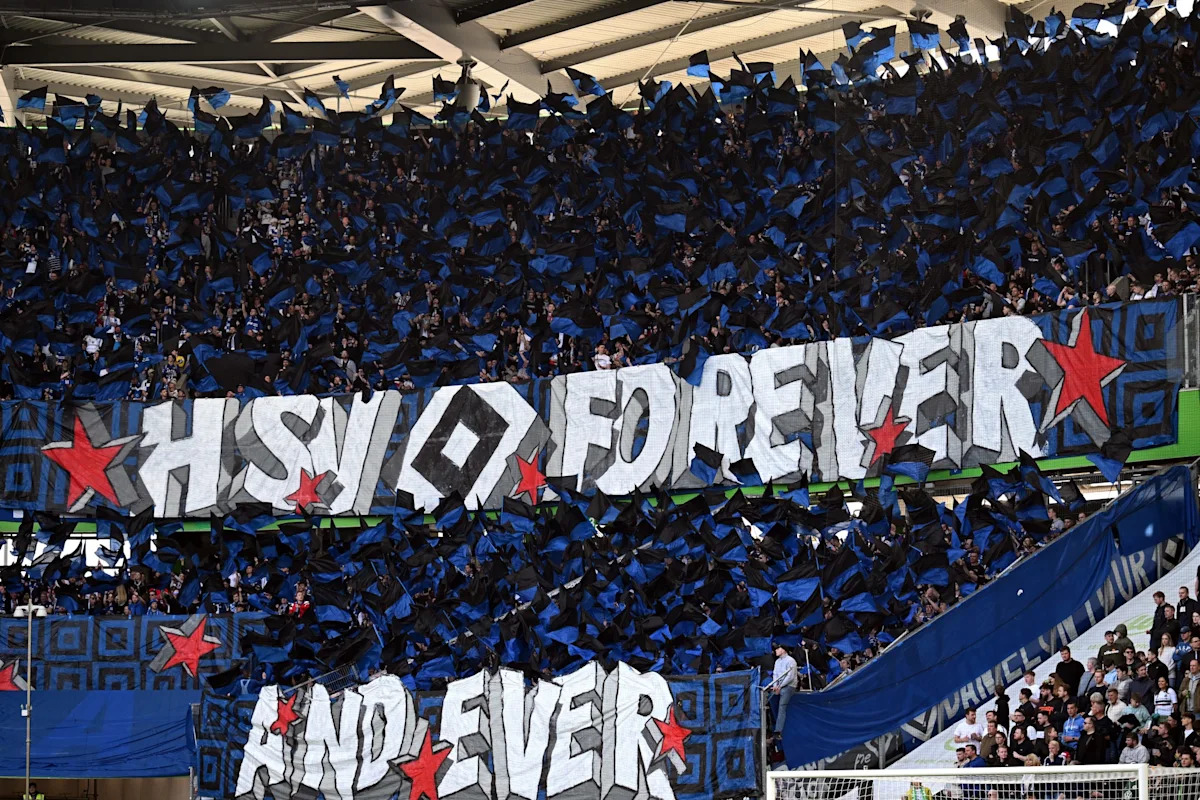
Our Get German Football News Bundesliga 2026/27 Tactical Preview series continues. The second “series within a series” concludes today with a look at the other tradition-rich club that avoided relegation last season, Hamburger SV. Hamburg’s fellow 2025/26 promotion pals 1. FC Köln received a largely positive prognosis in the most recent installment. HSV, by contrast, enter the start of competitive play with an incomplete and banged up roster. Last year’s version of Merlin Polzin’s Hanseaten finished in 13th place on 38 points, just three points off the standard 35-point Bundesliga “threshold standard” needed to guarantee safety. Whether or not they can do so again isn’t a foregone conclusion by any stretch of the imagination.
Last year, the promoted HSV survived in large part because late summer transfer window additions Albert Sambi Lokonga, Fabio Vieira and Luka Vuskovic changed the quality of the side altogether. Alas, we’ll leave the grieving over the two loanees to the sections below. Last season deserves to be remembered for some considerably more entertaining reasons. The Volkspark roof briefly proved less Bundesliga-ready than the team, Ransford-Yeboah Königsdörffer eventually informed his critics how little he cared about their opinions, and an especially ill-tempered trip to Mainz produced enough accusations and counter-accusations to keep everyone occupied long after the actual football had finished. By April, Nicolai Remberg found himself addressing the genuinely magnificent statistic that HSV had collected more red cards than Bundesliga victories.
Advertisement
Eight sendings-off. Seven wins. Welcome back to the top flight, boys.
Somehow, all of this (and the sordid Stefan Kuntz affair) ended up leading to a comfortable survival campaign.
Last year’s version of Polzin’s team weren’t especially elegant and frequently weren’t especially disciplined. They nevertheless became difficult to play against, developed a genuine personality, and learned quickly enough from the brutal opening weeks to stop looking like temporary Bundesliga guests. There was plenty of chaos. There was also considerably more competence underneath it than the chaos sometimes suggested. What we can expect this year remains something of a mystery, especially given the current unfinished state of the roster, all of the injuries incurred during pre-season, and the fact that…well…we’re still discussing a club that presently qualifies as a relative Bundesliga newbie despite all the historical grandeur.
Advertisement
“Dino” no more.
That moniker has long ceased to apply.
Major personnel shifts, Hamburg
Estimated Summer Transfer Balance = -€200,000
Hamburg’s summer began with the uncomfortable reality that two of the squad’s pivotal loanees – Luka Vuskovic and Fabio Vieira – returned to their Premier League clubs. Ouch. The younger Vuskovic brother is permanently settled in greener pastures while persistent efforts to re-acquire Vieira still haven’t produced anything yet. Former Köln and Wolfsburg mainstay Sebastiaan Bornauw has been brought in to compensate for Vuskovic’s absence. One doesn’t need to be a Bundesliga aficionado to figure out that such a move doesn’t qualify as a like-for-like replacement. The sheer amount of outgoing quality looks frightening on paper, particularly when one remembers how heavily Vuskovic and Vieira shaped last season. The former supplied presence, defensive authority and six goals from center-back. The latter gave HSV precisely the sort of technical difference-maker promoted sides generally struggle to acquire.
Advertisement
Four attackers – Robert Glatzel, Ransford Königsdörffer, Damion Downs and Philip Otele – are also no longer in the Hanseatic city-state. That doesn’t qualify as a legitimate tragedy as the quartet only produced a combined eight Bundesliga goals last season. The departures of William Mikelbrencis and Giorgi Gocholeishvili open up the right wingback slot. Albert Grønbaek’s loan from Rennes was converted into a permanent €4.7m transfer, while Martin Adeline arrived from Troyes for €4m and Kofi Amoako cost another €1.8m from Dynamo Dresden. Bilal Nadir joined from Marseille on a free. Adeline may prove the most tactically interesting of the new midfield arrivals as he’s an immediate candidate for the XI.
The lack of depth at the center forward position – the most glaring need entering training camp – remains a work in progress. Patson Daka arrived from Leicester City on a free. As of this filing, it looks to be the case that Terem Moffi’s procurement will be completed. Daka is already off to a flying start, backing up his ebullient early proclamations with plenty of action. The striker position nevertheless remains the most pressing need on this roster. There exist plenty of other unresolved issues. Warmed Omari’s shoulder injury leaves Bornauw immediately responsible for the competitive start. Miro Muheim is a confirmed out for the Pokal. Mario Vuskovic’s eventual return remains a later-season subplot rather than something HSV can presently build around.
The right wingback position also remains conspicuously thin behind Bakery Jatta. Hamburg’s transfer strategy consequently looks less glamorous than last summer’s collection of difference-makers, but perhaps more sustainable. Instead of borrowing extraordinary individual quality and hoping it carries the side, the club appears intent on building a deeper group around players such as Grønbaek, Capaldo, Remberg and Lokonga. Whether that proves enough to compensate for the loss of Luka Vuskovic and Vieira will define much of HSV’s second season back in the Bundesliga.
Bear in mind that – last year at this time – we were expressing the same grievances. Stefan Kuntz and the HSV administrative team then completed an absolute blockbuster end to the summer transfer window. We could witness this again. Just one problem. Kuntz is no longer there. Sporting director Claus Costa and newly appointed Board Member for Sport Kathleen Krüger must prove themselves this time around. The author largely thinks they can. Costa – on exceedingly short notice – did an amazing job during the January window. With the benefit of time and long-range planning, he can do even better.
Advertisement
We’ll need to mention the Fabio Baldé deal. Good God, what a coup! HSV managed to extract €7m from Strasbourg for a 21-year-old who remained some distance from establishing himself as a Bundesliga regular. That’s precisely the sort of transaction that affords Costa and Krüger a little more freedom during these final weeks. Jean-Luc Dompé’s situation creates another opening. The Frenchman entered camp needing to re-establish himself and instead effectively played his way out of Polzin’s sporting plans. Between the Baldé windfall and the willingness to move on from Dompé, HSV still possess both the financial room and the roster space to do something significant before the window closes. The question is whether Costa and Krüger can reproduce even a fraction of last summer’s late-window magic.
Notes from pre-season, Hamburg
Rapid Wien were already considerably further along in their preparation and only days away from Conference League qualification when HSV arrived for their first friendly of the summer. Polzin responded by treating the evening accordingly. Seventeen-year-old goalkeeper Lahti started; 16-year-old Louis Lemke was thrown in on the left. Martin Adeline received his first opportunity. Several established players were unavailable. HSV looked exactly like a team contesting its first summer friendly against one already preparing for competitive football. Three minutes in, the Austrians led. Nicolai Remberg had to repair one particularly poor buildup sequence before the visitors finally began waking up.
Once they did, the response was encouraging. Bakery Jatta crossed accurately from the right for Yussuf Poulsen to head in the equalizer before Capaldo helped launch another move that ended with Albert Grønbaek finishing from distance for 2-1. The turnaround lasted about ten minutes. Rapid equalized when a corner ricocheted bizarrely into the net off Ercan Kara’s back, then went ahead almost immediately when a mishit cross floated over the goalkeeper and Lemke, attempting to clear at the far post, could only turn the ball into his own net.
Advertisement
Not every preseason defensive sequence requires a tactical symposium. The second half was broken up by substitutions and produced little beyond one very good Warmed Omari pass that sent Rayan Philippe through on goal. Philippe could not finish, and HSV opened the summer with a 3-2 defeat. The more important result came one week later. Heidenheim, freshly relegated from the Bundesliga, provided a useful test at the end of the Austrian camp. Polzin set HSV up in the expected 3-4-2-1, again trusted Lemke on the left, and watched an extremely sleepy first half produce almost nothing.
Then Patson Daka came on.
The Zambian had only recently joined after leaving Leicester City and was already behind his new teammates in preparation. He required roughly two minutes to change the match. Daka attacked space behind the Heidenheim defense, was brought down by Frank Feller and allowed Grønbaek to convert the resulting penalty. Shortly after halftime, his pace opened the game again as he released Philippe for 2-0. Heidenheim pulled one back through a deflected long-range effort, but Daka was not finished. Grønbaek picked him out, and the newcomer made it 3-1.
Thirty-six minutes into his first appearance for HSV, Daka had effectively participated in all three goals.
Advertisement
There are worse introductions.
Grønbaek was also becoming equally difficult to ignore.
Everton offered the first Premier League benchmark and produced another defeat that looked considerably better than the scoreline. Polzin initially had HSV working from an organized midfield block, with Grønbaek functioning as the more attacking central midfielder. The opening half was cautious rather than spectacular, though the personnel changed almost immediately when Capaldo was forced off after only eight minutes. That gave 19-year-old Shafiq Nandja virtually an entire match on the right of the back three. The academy defender responded well.
Everton eventually led through Merlin Röhl shortly before halftime, but HSV changed the emphasis after the break and began looking much more deliberately for Daka’s runs. The adjustment paid off almost immediately. Grønbaek helped progress the move, Philippe supplied the final pass and Daka finished for 1-1. It was Daka’s second goal in as many appearances and perhaps an even more useful demonstration than the Heidenheim cameo. HSV were no longer simply benefiting from his speed accidentally; they were beginning to shape attacking sequences around it.
Advertisement
The game drifted toward a respectable draw before Jordan Torunarigha slid in to clear during stoppage time and inadvertently directed the ball into his own net. Lemke had now received major minutes in all three friendlies and, after the unfortunate own goal in Vienna, continued playing with remarkable assurance for a 16-year-old. Nandja had responded to an emergency introduction against Premier League opposition. Otto Stange also featured prominently.
Lille then stretched the experiment to 135 minutes. Three periods of 45 offered Polzin enough time to rotate almost everyone, though the exclusions were becoming revealing. Jean-Luc Dompé was no longer part of the sporting plan, while several younger players remained in the mix because of injuries elsewhere. Grønbaek again operated primarily from the left attacking half-space, exchanging positions at times with Martin Adeline. That fluidity probably tells us more about Polzin’s intentions than any static formation graphic could. The two players behind the striker are supposed to begin in spaces, not live in them.
The match itself began badly. Torunarigha misplaced a pass and Hákon Haraldsson punished HSV after only five minutes. Lille generally had the better of the middle section, while Grønbaek’s departure with a knee problem after 55 minutes provided the largest concern of the afternoon. The final period belonged more to HSV.
Rayan Philippe, already building an unexpectedly productive preseason, curled in a direct free kick from around 20 meters for 1-1. Then came one of the better small moments of camp. Otto Stange won a penalty, immediately grabbed the ball and showed no interest in relinquishing it. Miro Muheim attempted to summon Daka, presumably under the impression that the new first-choice striker might enjoy taking the kick. Stange was unconvinced. The Volkspark crowd appeared similarly unconvinced.
Advertisement
Daka eventually left him to it.
Stange scored.
Lille equalized late for 2-2, but the attacking hierarchy had become much more interesting than when preseason began. Philippe had now scored against Heidenheim, assisted against Everton and converted a free kick against Lille. Stange had demanded and scored a penalty. Daka had two goals and two assists in his first two appearances and remained influential even without scoring against the French side.
Meanwhile, Grønbaek’s knee injury initially threatened to interrupt the most impressive individual summer of all. It did not. The Dane recovered in time for HSV’s final friendly at Toulouse, where Polzin received another reminder that the solutions inside his squad did not always correspond neatly with the empty spaces on the transfer spreadsheet. Capaldo withdrew shortly before kickoff with muscular problems. Warmed Omari was unavailable for private reasons. So 18-year-old Jason Bissi-Mouelle started in the defensive three in the final dress rehearsal against Ligue 1 opposition.
Advertisement
Four minutes later, another academy player stole the attention. HSV recovered possession in Toulouse territory and found Stange to the left of the penalty area. The 19-year-old looked up and curled an excellent finish into the far upper corner. After scoring the penalty against Lille, he had now produced an even better goal in the Generalprobe. HSV played a strong first half. Sambi Lokonga and Lemke made important defensive interventions during Toulouse’s best spell, while Jatta struck the outside of the post and a remarkable seven-against-three break somehow failed to produce the second goal.
That miss became more irritating after halftime.
Toulouse increased the pace, played through HSV’s structure more cleanly and equalized when Santiago Hidalgo headed in a cross after an opening pass had broken the Hamburg spacing. Moments later the French side struck the post, with Sander Tangvik also required to make a good save after replacing Daniel Heuer Fernandes. The game then flattened under the weight of substitutions and appeared destined to finish level. Enter Grønbaek. Back from the knee scare, the Dane came off the bench for Adeline and, in stoppage time, collected a loose ball before curling another technically excellent finish into the far corner.
2-1 HSV.
Advertisement
A preseason that had begun with Grønbaek scoring in Vienna ended with Grønbaek winning the Generalprobe in Toulouse.
Winners from camp, Hamburg
Albert Grønbaek, AM
This one is about as obvious as it gets. The high-profile arrival from the January window did absolutely nothing to merit his permanent purchase from Rennes earlier this summer. Over the course of the pre-season, he’s done everything under the sun. Does the author really need to reiterate his achievements? Yes. HSV paid roughly €4.7m to keep the Dane after an injury-disrupted loan spell and then spent most of the summer watching him make that decision look increasingly clever. Grønbaek scored against Rapid Wien, converted the penalty and assisted Patson Daka against Heidenheim, repeatedly served as the connective piece between midfield and attack and recovered quickly from the knee scare sustained against Lille. He then came off the bench in the Generalprobe at Toulouse and scored the stoppage-time winner.
Advertisement
More important than the numbers was how many different jobs Merlin Polzin trusted him to perform. Grønbaek appeared in the attacking half-spaces, dropped deeper into central midfield and also worked from wider starting positions. Fabio Vieira may still require replacing in the strictest sense, but HSV already possess part of the answer. Grønbaek entered camp as a player whose permanent transfer needed justifying. He leaves it looking inconspicuously like the central figure around whom the new attacking structure will be built. The man is a damned monster. Lacerated knee or no, the 25-year-old is in for a monster Bundesliga campaign.
Patson Daka, CF
Another totally obvious choice. The author genuinely hates repeating himself, but must do so. There are worse ways to introduce yourself than effectively participating in all three goals within 23 minutes of your first appearance. Against Heidenheim, Daka won the penalty for the opener, released Rayan Philippe for the second and scored the third himself. He then struck again against Everton as HSV increasingly began designing attacks around precisely what the former Leicester striker offers best: pace, depth and runs behind the defensive line.
That’s the larger reason for the excitement. Daka hasn’t merely scored goals in friendlies; he’s already altered the way Polzin can build attacks. The Zambian gives HSV a genuine threat behind the last line, stretches defenses vertically and creates room underneath for Grønbaek and the other attacking midfielders to operate. We still need to see how all of this translates once Bundesliga defenders begin taking away the easy spaces, but the early evidence couldn’t be much more encouraging. The author has already made his feelings on Daka rather clear elsewhere. Fine. One more time.
Advertisement
A monstrous campaign is augured for him as well.
Otto Stange, CF
The summer really began in Wales for the January loan returnee. Stange returned to Hamburg having led Germany to the U19 European Championship final, finishing as the tournament’s joint-top scorer with four goals and earning selection to UEFA’s Team of the Tournament. The HSV striker struck twice against Denmark, scored again against hosts Wales and supplied the crucial equalizer in the semifinal victory over Ukraine. Stange still departed the tournament as one of its outstanding forwards, with UEFA specifically highlighting his pace in transition and ability to exploit space behind opposing defenses. That’s a considerably stronger starting point for a preseason “breakthrough” than looking lively against a few regional-league defenders.
He then proceeded to make the senior camp count. The 19-year-old remained involved long enough for his appearances to stop feeling ceremonial, won the penalty against Lille, refused to surrender the ball and converted it himself. In Toulouse, he followed that up by curling a superb opener into the far corner. Two goals in the serious closing tests, coming directly after a European Championship in which he had already demonstrated that his transition threat translates against elite players in his age group, make this more than a nice academy story. Stange spent the entire summer—from Wales through Toulouse—making it increasingly inconvenient for Polzin to treat him merely as one for the future.
Advertisement
Louis Lemke, LB
The Pokal fixture against Verl honestly can’t get here soon enough! With Muheim a confirmed out, Lemke will in all likelihood get the start. This didn’t begin with a 16-year-old randomly appearing against Rapid Wien. Lemke had already become the youngest Bundesliga player in HSV history against Freiburg in May at 16 years and 214 days, with Polzin stressing that the debut rewarded months of strong training rather than serving as a sentimental gesture. Muheim’s World Cup absence then opened the door wider. Lemke walked straight through it. Polzin kept playing him. And playing him. And playing him.
He accumulated the most preseason minutes of any HSV player, recovered immediately from the unfortunate own goal in Vienna and kept impressing physically, technically and tactically as the opposition improved. By mid-August, HSV abandoned plans to sign a Muheim backup because they did not want to block him. Polzin continues to emphasize careful and slow development, which is entirely sensible. The club quite reasonably wants to build him up carefully. Fine. “Carefully” remains a wonderfully flexible concept for a 16-year-old. The academy winner of the summer may be about to receive his reward.
Bakery Jatta, RWB
One year ago, Jatta looked finished at HSV. Polzin had effectively removed him from the winger hierarchy, the 28-year-old spent much of the Herzogenaurach camp running separately from the team and the club openly explored ways of moving him on. Jatta refused. Instead, he spotted the vacancy created by Giorgi Gocholeishvili’s tactical deficiencies and William Mikelbrencis’ persistent positional problems and reinvented himself as a right wingback. By the end of last season, the supposedly discarded winger had displaced both specialists and become the first-choice option whenever fit. Quite the story!
Advertisement
The irony is that HSV still spent this summer looking for someone to compete with him. Jatta remains defensively reliable, but his technical limitations become more obvious in a 3-4-2-1 that asks the wingbacks to provide much of the attacking width. Elias Baum consequently emerged as the preferred reinforcement target before Frankfurt complicated matters. Jatta, however, begins his eleventh HSV season in a position nobody expected him to occupy twelve months ago and with ten years at the club now behind him. His overall arc with the club is fascinating as he’s been with HSV through all the ups and downs.
Relegation. Promotion. Demotion. Revival.
Shafiq Nandja, CB
Nandja’s Everton assignment now looks considerably less like an emergency cameo and more like the latest step in an established progression. The 19-year-old had already made his Bundesliga debut against Freiburg in May after months of positive first-team training, then replaced the injured Capaldo after only eight minutes against Everton and proceeded to look remarkably composed against Premier League opposition. By the end of preparation, Nandja and Bissi-Mouelle had both moved ahead of Daniel Elfadli in the defensive hierarchy. That’s rather more than simply making the most of a few friendly minutes.
Advertisement
Jason Bissi-Mouelle, CB
Bissi-Mouelle’s summer deserves similar upgrading. His Toulouse start came because Capaldo and Omari were unavailable, but by then the 18-year-old had already pushed himself beyond emergency-cover status. Both he and Nandja have progressed significantly further than HSV expected. Starting the Generalprobe against Ligue 1 opposition and helping HSV win it therefore wasn’t the beginning of Bissi-Mouelle’s rise. It was confirmation that another academy defender had forced the senior depth chart to accommodate him. Another great story to emerge from this club is in the making.
Losers from camp, Hamburg
Jean-Luc Dompé, LW
This one requires no hedging whatsoever. Dompé entered summer already carrying baggage from the January suspension that followed his drink-driving arrest, and Polzin later made clear that the relationship never fully recovered. The problem was not simply the incident itself. The HSV coach felt Dompé showed too little internal recognition of what had happened, while the winger then returned from vacation with inadequate fitness levels for a team increasingly built around intensity. Nicolai Remberg, now captain, backed the club’s decision and summed up the footballing issue neatly: Dompé still possesses outrageous individual quality, but perhaps not enough of everything else for the way HSV now want to play. Harsh? Perhaps. Subtle? Not especially.
Advertisement
By August, the sporting verdict was definitive. Dompé had already drifted out of the picture during the Rückrunde, barely featured in preseason and was formally released from team duties so he could seek a new club. That makes this rather more than a camp in which somebody lost a positional battle. The old explosive winger no longer fits Polzin’s 3-4-2-1, no longer meets the physical standards being demanded and, most importantly, no longer appears to fit the collective culture being built around them. Four years, 113 competitive appearances, 18 goals and plenty of memorable moments later, the divorce papers are essentially on the table. Or, as Germans prefer to put it, “the tablecloth has been cut”.
Yussuf Poulsen, CF
Poulsen’s first HSV season never really got going thanks to five separate injury absences, leaving him with just one Bundesliga start in 15 appearances, and the club quite sensibly spent this summer reducing its dependence on him. The captaincy eventually passed to Nicolai Remberg. One might gently suggest that handing the armband to a player whose body was already treating availability as an optional extra probably wasn’t the most inspired bit of succession planning in the first place. None of this diminishes Poulsen’s experience or personality, and he did score against Rapid. It simply reflects reality, which is under no obligation to be kind to any of us.
Jordan Torunarigha, CB
German football enthusiasts, including this massive Jordan Torunarigha fan, aren’t especially happy about this. We all so wanted him to succeed in his return to the Bundesliga. Torunarigha is now classified as a loser for the second consecutive year. So is Poulsen. Damned reality always refusing to cooperate with our preconceived notions. Torunarigha ended last season looking considerably more comfortable in Polzin’s back three, but two of the strongest preseason tests produced exactly the sort of mistakes HSV can least afford. The larger problem is that the kids kept making his margin for error smaller. Torunarigha remains the likely left-sided starter rather than some doomed veteran. He simply spent camp discovering that expensive mistakes become considerably less charming when teenagers behind you keep refusing to make them.
Advertisement
Daniel Elfadli, CB
Elfadli entered last summer as a legitimate candidate for the central role in HSV’s back three before Luka Vuskovic arrived and changed everything. Twelve months later, the route back has become even more congested. Bissi-Mouelle and Nandja both developed substantially faster than the club anticipated, Bornauw now owns the central organizer role, Capaldo and Torunarigha flank him when healthy, and the two academy defenders are being deliberately developed behind them. That leaves Elfadli not merely outside the projected XI but increasingly outside the developmental logic of the squad. When two teenagers pass you on the depth chart quickly enough to influence the club’s transfer planning, the summer verdict rather writes itself.
Tactical scout, Hamburg
The forthcoming Pokal trip to SC Verl enables this writer to gleefully remind himself that actual competitive action is drawing nearer! Hell, yes! Pokal trips of this nature should, in theory, enable Bundesliga sides to settle comfortably into their preferred structures. German football history rather helpfully reminds us that they sometimes instead produce 90 minutes of existential dread. HSV should nevertheless be able to avoid that. Some injury concerns heading into the first-round fixture don’t leave one feeling nervous about the Bundesliga side’s prospects.
Advertisement
Omari definitely won’t be involved after the shoulder injury suffered against Lille, while Muheim’s adductor problems leave the left side looking increasingly likely to belong to 16-year-old Louis Lemke. Capaldo’s recent muscular issues constitute another question mark, though the Argentine should return to the right of the defensive three if cleared. Bornauw, having completed a full preseason with Leeds, has been recruited specifically to become the new organizing presence in the middle and should require precious little acclimatization time.
Lineup–HSV (PROJECTED)
Should Capaldo not be risked, Nandja represents the obvious replacement after his excellent summer. That sentence alone tells us something important about where this team now stands. Injuries forced Polzin to use Lemke, Nandja and Bissi-Mouelle extensively during preparation; the youngsters responded by making themselves legitimate competitive alternatives rather than emergency names scribbled onto the bench. Lemke in particular has done everything short of clearing out Muheim’s locker. His likely Pokal start represents both necessity and reward.
Advertisement
Bornauw’s arrival should meanwhile permit Torunarigha to return to the left-sided role in which he looked considerably more comfortable late last season, while Capaldo can resume the aggressive hybrid work that helped make him such an important piece of Polzin’s Rückrunde structure. The more interesting stuff begins further forward. Remberg and Sambi Lokonga give HSV the stable central axis around which virtually everything else can move. Remberg attacks duels, second balls and open space with characteristic enthusiasm; Lokonga supplies the calmer distribution beside him.
Ahead of them, the old winger-oriented attacking structure has largely given way to two creators beginning in the half-spaces. Grønbaek is the obvious centerpiece. Adeline looks the safest choice opposite him for now, though Philippe and Stange have spent the summer making Adeline’s place considerably less comfortable than anyone expected. Width consequently comes primarily from Jatta and Lemke, which remains one reason the unresolved right wingback position matters so much. Jatta can defend the role.
Then there is Daka. We probably needn’t write another love letter. Enough ink has already been spilled. His importance nevertheless extends well beyond two goals and two assists. The former Leicester striker gives HSV something last year’s attack often lacked: a forward who actively threatens the space behind a defense and thereby forces the entire opposing line backward. Grønbaek and whichever second creator Polzin selects should benefit enormously. Moffi, assuming that deal crosses the finish line, would supply another version of the same basic principle with considerably more physical presence.
So what does all of this mean once the serious Bundesliga business begins? At present, the author remains cautiously optimistic rather than enthusiastically convinced. There is considerably more structural clarity here than twelve months ago. Polzin knows how he wants to play. Remberg and Lokonga form a legitimate Bundesliga midfield. Grønbaek looks ready to become a genuine difference-maker. Daka appears capable of adding an entirely new dimension, while Lemke, Stange, Nandja and Bissi-Mouelle have supplied the sort of internal development that can save a club millions on the transfer market.
Advertisement
The counterweight remains equally obvious. Luka Vuskovic and Fabio Vieira were extraordinary players for a club in HSV’s position, not generic loanees easily replaced by committee. The defense still requires Bornauw to settle immediately. The right wingback situation remains unresolved. Several senior players have already carried physical problems through August. The striker room still needs finishing, and Costa and Krüger have yet to demonstrate that they can reproduce last summer’s spectacular deadline work without Stefan Kuntz around.
If the remaining business goes well, there is enough here to envision HSV establishing themselves a little more securely in the middle reaches of the bottom half. If it doesn’t, another season spent keeping one eye on the relegation line feels entirely plausible. That itself represents progress of a sort. Last summer, HSV first had to discover what kind of Bundesliga team they could become. This summer, they already know. Now they merely have to prove that the identity survives the loss of the exceptional individuals who helped create it.
It looks to be the case that the Bundesliga keeps this great club.
GGFN | Peter Weis
Read the full article here