





As we get into the heart of draft season and average draft position (ADP) starts to sort itself out, we’re going to see quite a few very close “ADP battles” at each position — pairs of players going back-to-back in draft consensus, who you’ll have to choose between when you’re on the clock. Rather than wait for that moment, we’re here to sort through some of those difficult decisions, specifically at the running back position.
We’ll hit the pros and cons for each player to help you form your own opinion, and then I’ll deliver my own verdict on the better pick.
Advertisement
Join or create a Yahoo Fantasy Football league for the 2026 NFL season
If you’ve got any other ADP battles you need resolved, hit me up on X (@MattOkada) and I’ll give you my thoughts (or maybe include them in a future article).
Christian McCaffrey vs. Jonathan Taylor
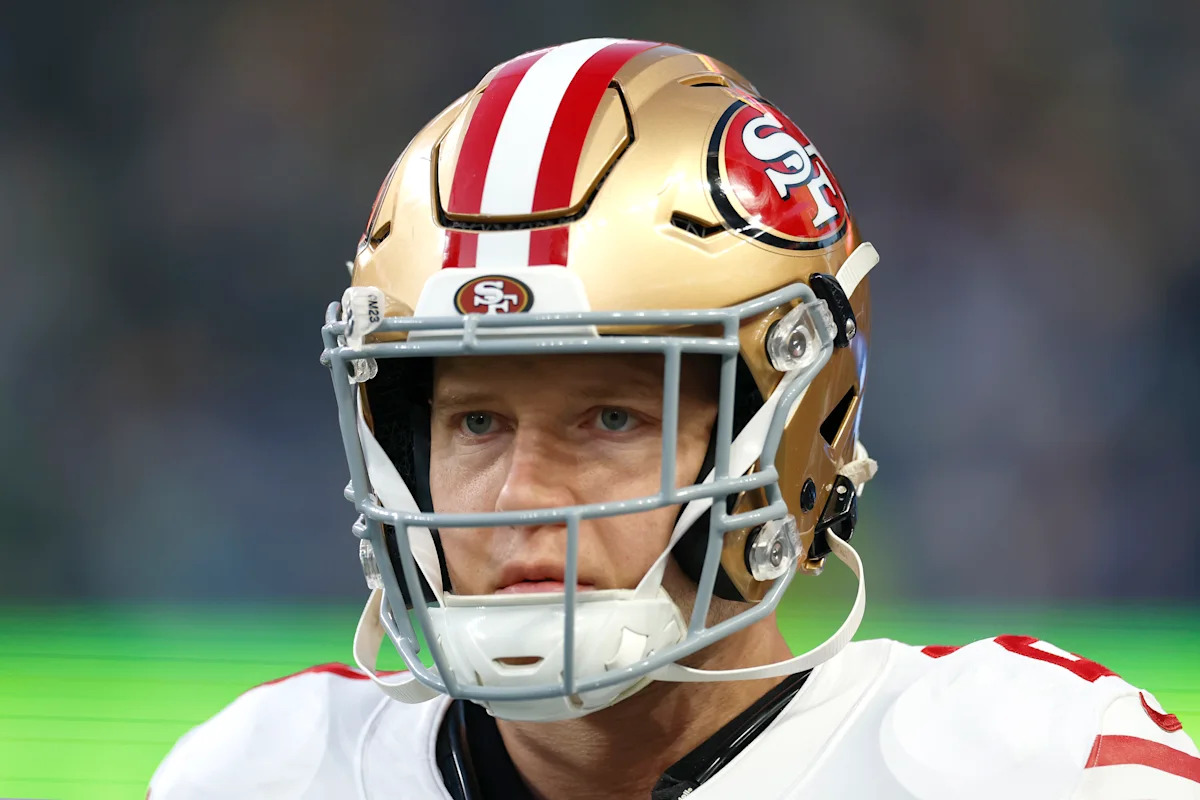
McCaffrey: It was Christian McCaffrey, not Jahmyr Gibbs or Bijan Robinson, who led all running backs in scoring last year (365.6 fantasy points). He also led the 49ers in targets (129), receptions (102) and receiving yards (924), and added seven touchdowns through the air as well. Between his rushing volume, touchdown prowess and one-of-one production as a receiver, he has basically always been the best back in fantasy if healthy. The concern in 2026 is that he’s 30 years old coming off 413 touches, which often translates to regression or injury. With an ADP particularly high in the first round, McCaffrey epitomizes high risk versus high reward.
Advertisement
Taylor: Annnnd it was Jonathan Taylor, not Gibbs or Robinson, who finished No. 2 behind McCaffrey last year, at 339.3 points. Surprising, I know. Taylor led the league in carries (323) and touchdowns (20), and came up just short of 2,000 total yards (1,963). But between the midseason drop-off in Indy’s offense and the Achilles injury to Daniel Jones, Taylor was far better for the first 10 weeks (25.9 PPG) than the final seven (just 11.5). Consequently, with Michael Pittman Jr. gone and Jones still recovering, the big question for 2026 is which version of the Colts we can expect to get.
VERDICT: It’s not usually wise to bet on an older back coming off 400+ touches, but McCaffrey feels like an exception for me, especially considering how much of his work comes through the air. I have them back-to-back in my rankings. Taylor is a bit safer, but I’m taking CMC here.
Ashton Jeanty vs. Omarion Hampton
Jeanty: In a generally abysmal situation last year — Vegas was statistically the worst offense in football — Ashton Jeanty averaged 12.8 fantasy points per game with more than 1,300 yards and double-digit touchdowns. The Raiders have made a concerted effort to fix the offensive line and the quarterback position, most notably by signing center Tyler Linderbaum and adding both Fernando Mendoza and Kirk Cousins. Having a fully healthy Brock Bowers shouldn’t hurt either. All of that figures to play in Jeanty’s favor, giving last year’s sixth overall pick an excellent path to improved efficiency and a far higher fantasy floor.
Advertisement
Subscribe to Fantasy Ultra to unlock our Strategy Lab, 150+ page Draft Playbook and more!
Hampton: With 13.3 fantasy PPG, Omarion Hampton was also notably decent despite difficult circumstances — namely a porous offensive line riddled with injury and a midseason ankle injury of his own (which held him out for eight games). Heading into 2026, his environment looks far better, with a healthier and significantly upgraded O-line, a high-end franchise quarterback in Justin Herbert, a new RB-friendly offensive coordinator in Mike McDaniel and better offensive assets all around. He was also analytically excellent as a rookie, forcing a missed tackle on 30.6% of his carries and logging an 11.3% explosive run rate — no qualified running back outpaced Hampton in both those metrics.
VERDICT: While Jeanty has the edge in draft capital — and sixth-overall-pick running backs are historically dominant — Hampton’s offense is far more trustworthy and explosive. I think the two are similar in talent — and have them back-to-back in my rankings (once again) — but I prefer Hampton’s environment enough to take him here.
Quinshon Judkins vs. Bhayshul Tuten
Judkins: Quinshon Judkins is a curious case: he was the 36th overall pick last year and was the clear bell-cow back for most of the season (despite missing three games with an ankle injury), averaging 16.4 carries per game (eighth in the league). However, his offense, and offensive line in particular, were absolutely horrid. No team averaged fewer rushing yards before contact (0.6) or allowed their rushers to be hit behind the line of scrimmage more often (49.2%) than Cleveland. The Browns completely reworked that O-line this offseason, and added some weaponry in the passing game, so they could be much better … but it’s an admittedly big “could.”
Advertisement
Tuten: In many ways, Tuten is the opposite case to Judkins: he was a Day 3 pick and a distant No. 2 behind Travis Etienne Jr. as a rookie, but he played in a top-10 offense that improved at the end of the year. With Etienne gone to Jacksonville, the door is open for Tuten’s ascension. However, the Jaguars also signed Chris Rodriguez Jr. in free agency, and so far in camp, the two seem to be competing for priority in a legitimate committee. Tuten’s fantasy outlook depends almost entirely on how consistently he will lead the backfield in Duval. If he sees 60-65% of the touches and the touchdowns, he’s probably an RB2. But if Rodriguez (and fellow sophomore LeQuint Allen Jr.) vulture even a slight majority of the production, Tuten could be a bust.
VERDICT: This is the first one that’s not close for me. I am one of the industry’s biggest Tuten detractors, believing that Rodriguez and Allen will essentially split the touches with Tuten and that C-Rod will be heavily preferred near the goal line. Even with some remaining reservations about Judkins’ situation, I have him ranked 10 spots higher than Tuten, just ahead of his ADP, while Tuten is currently my RB31.
Jaylen Warren vs. Rhamondre Stevenson
Warren: Jaylen Warren was one of the more surprising breakouts of the 2025 season, hitting career highs in touches (251), scrimmage yards (1,291) and touchdowns (eight), even while splitting work with Kenny Gainwell. This offseason, Pittsburgh replaced Gainwell with Rico Dowdle, who was also impressive last year, and is much more of a rusher and less of a receiver than Gainwell. As a result, projections and rankings for Warren — who was listed as the starter on the Steelers’ first depth chart — depend heavily on how you split the work with Dowdle. I have the former seeing 45% of the carries while logging a crucial 12% target share, which translates to a ceiling of 275 touches. That’s enough to crack RB2 territory.
Advertisement
Stevenson: Similar to Warren, Rhamondre Stevenson was surprisingly good in 2025, posting high-end efficiency while holding off second-round rookie TreVeyon Henderson for most of the season. Stevenson missed three regular-season games, which affected his season totals, but if you include the four postseason outings, Stevenson averaged 71.7 scrimmage yards per game and scored 10 touchdowns. Many were ready to write him off in light of Henderson’s theoretical 2026 takeover … but all the news out of Foxborough this offseason suggests the veteran is ahead of the youngster once again, and I’m squarely in that camp. I have Stevenson narrowly outcarrying Henderson in a close committee and outproducing him as a receiver by a sizeable margin.
VERDICT: This one’s very close, as Warren and Stevenson are in extremely similar situations as the tentative leaders of committee backfields. Yet again, I have them back-to-back in my rankings … but I’m going to narrowly side with the far better offense in New England. Stevenson is a quietly valuable RB2 in drafts and I predict he’ll leapfrog both Warren and Henderson in ADP this month.
Blake Corum vs. Kyle Monangai
Corum: Blake Corum has ended up pretty high on draft boards this summer thanks to a compelling six-game stretch to end the 2025 regular season. After playing distant second fiddle to Kyren Williams for most of the year, Corum finished with 405 rushing yards and five rushing touchdowns from Week 13 on. Projected to a full season, that would be 1,148 yards and 14 touchdowns. Notably, Williams was still the starter and plenty productive in his own right over that stretch, and he heavily outscored Corum in the Rams’ three-game postseason run. Still, Corum showed that he could offer a sort of David-Montgomery-in-Detroit value as the RB2 in the elite Los Angeles offense. And should Williams suffer an injury, Corum would likely be a league-winner.
Advertisement
Monangai: In many ways, Kyle Monangai presents a similar case to Corum’s: he’s the clear RB2 in an offense with high expectations who offers particular value near the goal line, and has RB1 upside as a backup. Monangai’s breakout stretch last year came during and shortly after D’Andre Swift’s midseason groin injury; from Weeks 9 through 13, Monangai rushed for 405 yards and four touchdowns (eerily similar to Corum’s end to the season). That said, after Swift returned to form, Monangai failed to score from Week 14 on and never topped 60 rushing yards over that span (including two playoff games). He too could offer Montgomery-esque upside — and plays for Ben Johnson, which makes that comp even more relevant — but it takes quite a bit of projection.
VERDICT: In both of the theoretical cases that matter, I prefer Corum to Monangai in this battle. If both were to become the RB1 in their offense due to injury, I think Corum would have the higher upside. But more realistically, if both are playing the RB2 role, I like Corum’s player profile and offense a bit more than Monangai’s.
Read the full article here