





Change can be hard to come by in the NHL. The cliche of the “200 hockey men” way of thinking is a cliche for a reason. The NHL is an old boys club, where men who are already connected to the inner circle in one way or another have a massive advantage over everyone else. Not only this, but this insular group also has a band of media allies eager to do their bidding and serve as mouthpieces and shields for them, all to get a little access. This media version of the old boys club has some degree of separation from the group that is actually inside the league, but they are, for the most part, hand-in-glove with one another. Granted this is also the case in many, many industries across the world, but at least as far as sports go, the NHL is among the worst in this regard.
The sons of former NHLers are making it to the league at a crazy rate. The same 35-40 men keep getting all the head coaching jobs. Front offices keep getting staffed with the same candidates too, although I do think there is a little more variety in GM hirings than head coach hirings. The hockey media keeps churning out new, interesting people every year, but the newbies are mostly kept to the fringes unless they toe the company line, so to speak. It’s all so incestuous, and while other sports are guilty of this to a certain degree as I mentioned, the NHL really does feel like they’re behind the rest of them.
Advertisement
But with the Carolina Hurricanes finally getting over the hump and winning their elusive championship in the Rod Brind’Amour era, a question has started to bounce around in my head: Are we, at long last, about to see the Moneyball revolution in the NHL that we have seen in other sports?
The Moneyball Revolution?
I suppose the first thing I should do is define what I mean by the “Moneyball revolution”. For those who don’t follow baseball, Moneyball is a reference to Michael Lewis’ 2003 book, Moneyball: The Art of Winning an Unfair Game. The book is about the 2002 Oakland Athletics, and more specifically, their general manager, Billy Beane. Oakland was one of the lowest-revenue teams in MLB back then, and with franchises like the Yankees and Red Sox buying all the best players, including Oakland’s own Jason Giambi and Johnny Damon, Beane and the A’s had to get creative in order to stay competitive. By moving away from traditional baseball thinking and embracing the sabermetrics pioneered by people such as Bill James, Beane and the Athletics were able to find value in places where nobody else in baseball was looking, helping them to yet another monster season in 2002, even if it did end disappointingly in the ALDS.
Granted, while the focus on the market inefficiency of on-base percentage and the diamonds in the rough such as Scott Hatteberg certainly helped, the team was also loaded with big time stars. You wouldn’t know it from watching the movie adaptation of the book, but the A’s also employed these guys named Barry Zito, Mark Mulder, and Tim Hudson back then. Not to mention Miguel Tejada and Eric Chavez. Those guys were pretty good! But I’m getting off on a tangent here. The point is, while the 2002 A’s had their homegrown stars, it was the Moneyball ethos that helped them build depth and give them those all-important edges that can push a team over the top.
Advertisement
As mentioned, those 2002 A’s didn’t win it all, but they perhaps did something even more important: they changed the game. In the wake of Oakland’s embrace of Moneyball, the rest of MLB started to embrace analytics. Now, almost a quarter century later, Major League Baseball is completely unrecognizable from how it was when Beane was signing the Hattebergs of the world. Nowadays, the standard operating procedure for MLB front offices is to hire analytics-minded GMs, build a massive analytics department, and incorporate advanced stats into every decision. Depending on who you talk to, this isn’t necessarily a good thing. But whether it’s good or bad is almost besides the point. The real point is that Moneyball changed the game forever.
Look around MLB today, and you would be hard pressed to find a general manager/president of baseball operations who was a former player or manager. It’s mostly longtime scouts with a specialty in analytics, or Ivy League guys with degrees in data science or something similar. In fact, one of the very few former player GMs, the Texas Rangers’ Chris Young, is a Princeton grad himself. As far as I can tell, only Buster Posey and Jerry Dipoto are leading men in an MLB front office that are former players without an accompanying high-level education. For better or worse, baseball is run by the nerds these days.
Eric Tulsky, Sunny Mehta, And The Value Of Iconoclasm
Thanks to Billy Beane and the Oakland Athletics, Major League Baseball has had it’s Moneyball revolution. But while analytics has certainly become more prominent in the NHL in recent years, it is still a far cry from what baseball has accomplished in this regard. Do that same test of NHL GMs/POHOs, and you will find that the vast majority of the league’s top decision makers were former players, even if only briefly. And that doesn’t even count legacy cases (or nepo-babies, depending on how cynical you’re feeling) such as Stan Bowman or Chris Patrick. Once again, the NHL is very insular and obsessed with not rocking the boat.
Advertisement
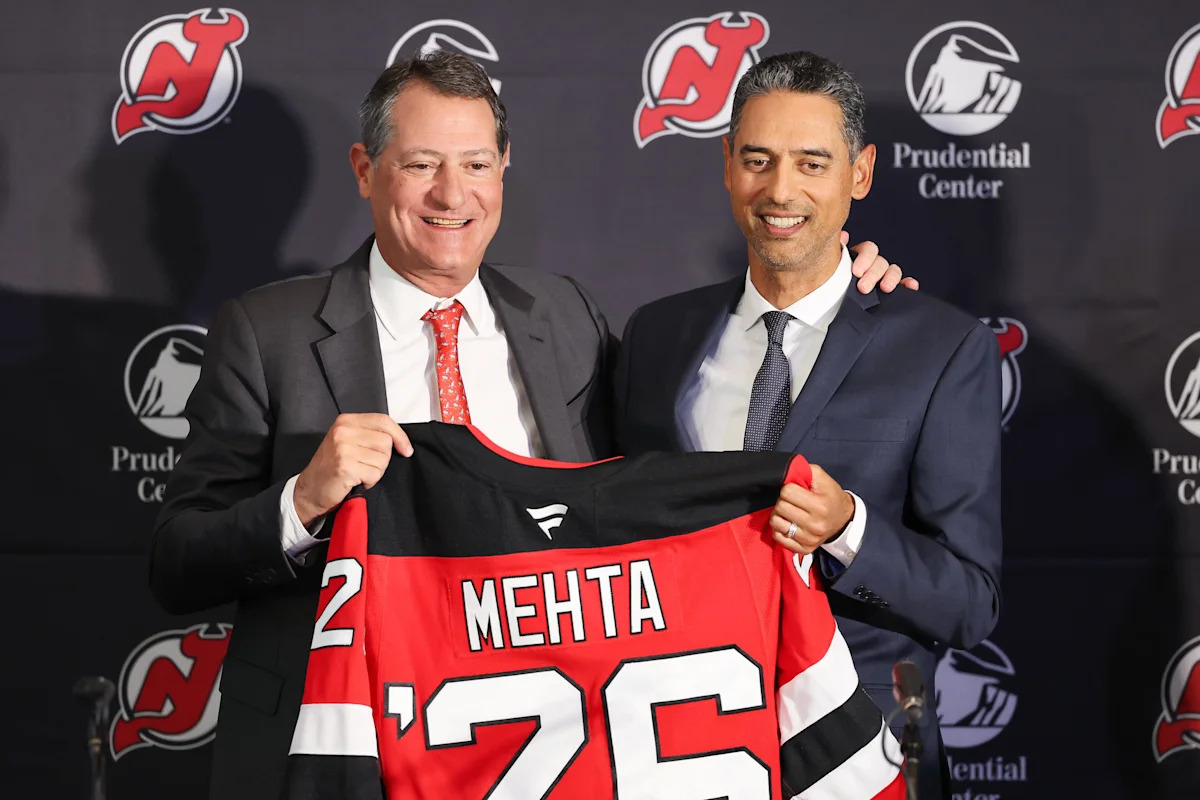
Despite this, the reason I wonder if the NHL is on the edge of an analytics upheaval is pretty simple: the recent 1-2 punch of Eric Tulsky winning the Stanley Cup, and our New Jersey Devils hiring Sunny Mehta as their own general manager.
We’ll start with Carolina. Tulsky’s origin story from blogger to GM is a familiar one at this point, so I won’t get into the finer details here. The broad strokes are that he is a brilliant man with degrees in chemistry and physics from Harvard University, who worked in nanotechnology for a decade, and then entered the world of hockey through writing about the NHL for SB Nation. He parlayed those credentials into part-time consulting/analyst work for a few NHL clubs, and then eventually a full-time role with the Carolina Hurricanes. While in Raleigh, he worked his way up from the analytics department to assistant GM to, finally, general manager in the summer of 2024. Two years later, he became the man who brought the Cup back to North Carolina.
Tulsky’s existence is almost a direct affront to the 200 hockey men that uphold NHL orthodoxy. I know I sound like a broken record, but it really does bear a lot of repeating: these men do NOT like outsiders coming in and changing things. The 200 hockey men are very, very, VERY concerned with making sure nobody rocks the boat, lest there be significant consequences. And yet, Tulsky was able to break through the firewall and reach the NHL mountaintop. Obviously there have been front offices in recent years that have relied significantly on analytics to build championship rosters, but they were usually fronted by much more traditional hockey men. Think Colorado with Joe Sakic. But Tulsky is the first person that truly embodies the Moneyball spirit to be the leading figure of a club that won the last game of their season in June.
And now, as Tulsky hoists the Cup, in comes Sunny Mehta. A native son of New Jersey, Mehta is cut from the same cloth as Tulsky as a brilliant outsider of sorts. Much like Tulsky, I won’t go deep into Mehta’s biography here since everyone is probably familiar with it. Suffice to say, Mehta’s unique path from musician to poker player to hockey analytics firebrand has landed him the top job with his childhood team, and with his hiring comes a heavy emphasis on analytics. Once again, this does not mean the New Jersey Devils organization was devoid of any sort of analytics prior to Mehta’s arrival. In fact, the franchise employs one of the bigger analytics departments in the league, running seven employees deep with Matt Cane at the top as Vice President, Hockey Analytics and Strategy according to the Devils front office directory.
Advertisement
That being said, that analytics department used to be led by Tom Fitzgerald, who was the epitome of the stale, cowardly hockey mind who was scared of taking even the tiniest risk in his later years as Devils GM. I’m not going to say that Fitzgerald made zero good moves, because that would be unfair and inaccurate. I’m also not going to say that he took zero risks either, because that also wouldn’t be true. But after the team’s magical 2022-23 season, Fitzgerald definitely became way more risk-averse. He was a conformist who was already inclined to lean into his hockey man instincts, and after the failures of 2023-24, he fully retreated into the safe, bland, traditional way of doing things in his last few seasons at the helm. The Devils might have had a relatively large analytics department, but with Fitzgerald running things, it was sort of like giving a trained jiu jitsu fighter a sniper rifle and expecting him to know how to use it.
By the end, Devils fans, myself included, were so unbelievably sick of Fitzgerald’s complete aversion to doing anything. We were desperate for change, and tons of us wanted the Devils to bring Mehta home. To be fair, it wasn’t just because he was an analytics guy. No, it was mostly because Mehta proved that his data-based approach was extremely effective in Florida, where he helped lead the Panthers to back-t0-back championships as Bill Zito’s assistant general manager. And it wasn’t just Devils fans who wanted him. Every team that was in the market for a new GM this offseason seemed to have Mehta at or near the top of their wish list. I seem to recall the Toronto Maple Leafs fanbase especially clamoring for him before he signed on with the Devils. Leafs fans were in a very similar situation as Devils fans, having suffered through the unbelievably stale, traditional tenure of Brad Treliving. They wanted a fresh mind with new ideas. They wanted winning analytics. They wanted Mehta.
So now Mehta has secured the top job in New Jersey. And before his team has played a single game with him at the wheel, he’s already shown a willingness to spit in the eye of the traditional way of doing things. Offer sheets are very rare in the NHL. We have seen a slight uptick in offer sheets in recent years, such as the Sebastian Aho-Jesperi Kotkaniemi saga from a few years back, and the dual St. Louis Blues offer sheets of 2024 for Dylan Hollaway and Philip Broberg. But by and large, they are still an underutilized tool, largely because traditional hockey lifers view them as some sort of significant breach of decorum. But Mehta didn’t care one bit about that, signing Utah’s Barrett Hayton to an offer sheet after Bill Armstrong backed out of a trade that would’ve sent Hayton to New Jersey at the draft. To be fair, this offer sheet failed, and even if it didn’t, it’s not like this alone would be proof that Mehta is doing a great job. But it’s just so refreshing to see a GM think outside the box while seeming to lean on his data to make smart player acquisition moves. Mehta didn’t care that there was decorum to uphold or that he was the new kid on the block. He came in and immediately tried to improve his club by whatever means necessary.
But of course, this was a slap in the face to the old ways of doing things. And as a result, a couple of those 200 hockey men found it necessary to wag their fingers at Mehta:
Meanwhile, those same media insiders laughed at Tulsky and the Hurricanes for shipping Mikko Rantanen out just a handful of games after they traded for him from the Colorado Avalanche during the 2024-25 season. But Tulsky didn’t care what the stuffy old hockey media thought, he did what was best for his team. Once he learned that he wouldn’t be able to sign Rantanen long-term, Tulsky pivoted, took the PR hit, and acquired a ton of draft capital and a player in Logan Stankoven that became absolutely indispensable to the Hurricanes run to a championship this spring.
Advertisement
This is the value of being an iconoclast. Like Beane with on-base percentage, Tulsky and Mehta are looking for market inefficiencies wherever they can find them, without worrying about decorum or tradition or being mocked by those in and around the game. Mind you, being different just for the sake of being different is not a great approach. There’s a difference between being an effective iconoclast and a shallow contrarian. It’s not enough to go against tradition, you have to actually have a plan. Tulsky did, and his reward was 16 playoff victories in 2026. Despite being brand new to the job, I feel confident in saying that Mehta has a solid plan. By his own admission, the roster still needs some work. But The Rock wasn’t built in a day after all, and I have faith that Mehta can play the long game well.
Time Will Tell
For as hostile as the NHL can be to change, the NHL is also a copycat league. This paradoxically makes the league one filled with people who don’t want anything to change, yet who constantly change some things in order to chase the latest winning trend. It happens with styles of play, it happens with which player archetypes are valued, and it happens with front office structure.
Before Eric Tulsky was promoted to GM in Carolina, there was another sort of shift taking place in front offices: the rise of the former agents. Entering this upcoming season, you could argue that the two best general managers in the league are Bill Zito and Kent Hughes, two former player agents. In Edmonton, Jeff Jackson, another former agent, is the CEO and President of Hockey Operations. This isn’t anywhere close to the level of upheaval as the arrival of the analytics nerds, as agents occupy some of the same space in the inner circle as those 200 hockey men. But it’s at least a little different than normal.
Advertisement
So the NHL was already on its way to changing who runs things, and Tulsky was the first one to successfully kick in the door as a true outsider. I use the word “successfully” very deliberately there, as I would argue the then-Arizona Coyotes hiring John Chayka was an analytics-oriented move that predated Tulsky. The problem was, that hire didn’t work out all that much, and Chayka was fired and left the game before returning this offseason in Toronto. But whereas Chayka didn’t really have much of a track record to justify his hiring, Tulsky did, and he backed it up by winning a championship. Now Mehta comes in with a pretty sparkling resume of his own. I’m not going to say that a Moneyball revolution is riding on whether Mehta sinks or swims. That would be reductive and shortsighted, especially considering the analytics movement didn’t die with Chayka. But I will say this: If Mehta succeeds in the same way Tulsky did, I think even the 200 hockey men are going to be way more inclined to believe in analytics. For now, they have the luxury of viewing Tulsky as a one-off anomaly since no one else with his type of background has achieved anything in the NHL. But if Mehta succeeds, people would be forced to see this as a viable, repeatable, dependable option, not just a passing fad or a lucky outlier.
For now, I don’t think Devils fans, myself included, care all that much about leading a revolution in how the game of hockey is managed. We just want to win. Still, it might be worth at least a passing thought on what Mehta’s hire means in the larger context of hockey history. If Mehta really does go on to become a general manager who, dare I say, brings some Stanley Cups to New Jersey and builds himself a hall of fame career as a builder, I think there’s a real possibility that his hiring is looked back on as the spark that ignited the Moneyball revolution in the NHL. And wouldn’t that just be the coolest thing ever to know that it was our guy who revolutionized the game we all know and love?
Read the full article here