





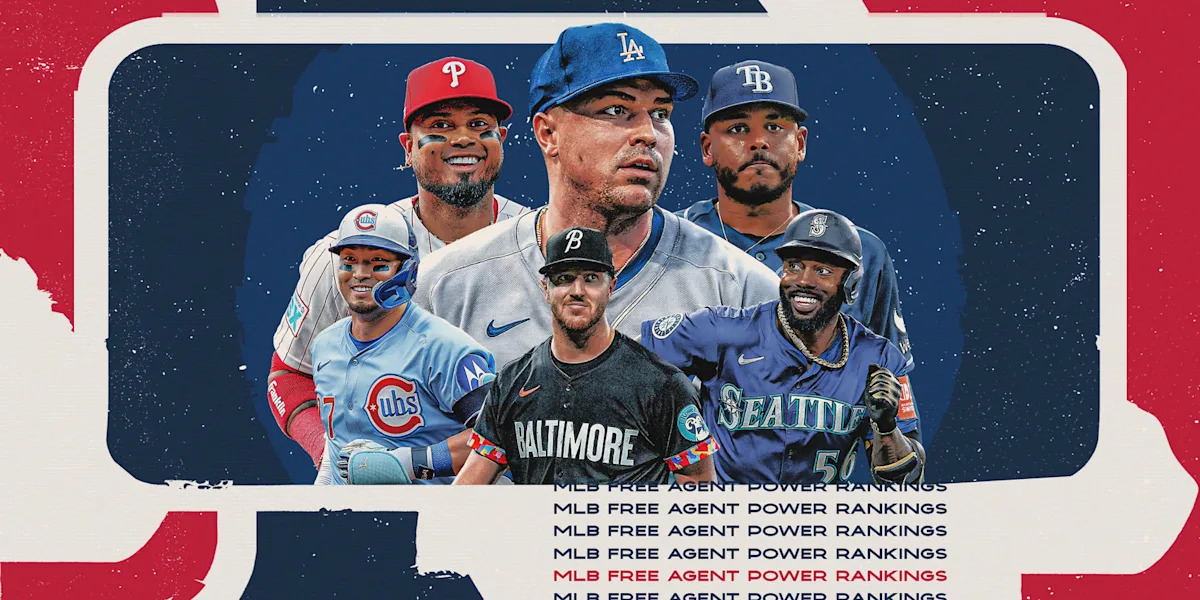
It would be the understatement of the millennium to call this an underwhelming free-agent class.
Last winter, nine players — Kyle Tucker, Dylan Cease, Alex Bregman, Cody Bellinger, Pete Alonso, Kyle Schwarber, Ranger Suárez, Bo Bichette and Framber Valdez — signed contracts worth more than $100 million. Mariners first baseman Josh Naylor ended up a tick below that at $92.5 million.
Advertisement
The upcoming offseason brings a far weaker market. New Dodger Tarik Skubal is a lock to exceed $100 million, but he might be the only one. And that has absolutely nothing to do with the upcoming labor fiasco; these players just aren’t that good.
And yet, we persevere. Here are our latest free-agent rankings.
Notes: Whenever you see a number, a slash and another number, that’s a reference to contract years and total earnings. For instance, the shorthand for Bryce Harper’s 11-year, $330 million deal would be “11/330.” Ages listed below are for the 2027 season.
Previous rankings: May edition | June edition
1. Tarik Skubal, Dodgers SP, age 30 (previous rank: 1)
Skubal is a Dodger now, in case you haven’t heard. That swap could have major ramifications for the rest of this season and beyond, if L.A. completes its three-peat. But for Skubal the free agent, moving west doesn’t move the needle too much, beyond the increased chances that he signs an extension. Detroit was never shelling out the big bucks to keep its ace around. The deep-pocketed Dodgers might try to make it worth Skubal’s while to forgo the chaos of free agency.
Advertisement
The most important thing for The Skubal Estate is that the big man is back, healthy and looking like himself. Until further notice, it’s fair to put the bone-chip, loose-body affair behind him.
Frankly, we don’t feel good putting anybody at No. 2 on these rankings. This was supposed to be Freddy Peralta’s spot, but the new Ray has pitched so poorly that we had no choice but to sink him down the list a bit.
And so, Suzuki ends up here pretty much by default. The Japanese outfielder has the best underlying metrics of any impending free-agent hitter. He has rebounded from a slow May and is set to finish with an OPS above .800 for the fourth consecutive season. His popularity back in Japan could also help boost his market. Most crucially, Suzuki has improved as a defender, something that certainly does not apply to the next character.
Advertisement
Arozarena’s offensive consistency is commendable and should land him a nice payday, but his outfield play has backslid precipitously enough to raise concerns. Randy’s routes have never been crisp, but a decline in footspeed has made things even hairier out in the grass. His bat is legit and would fit in the top half of any big-league lineup, but the defensive shortcomings push him below Suzuki for now.
4. Freddy Peralta, Rays SP, 31 (2)
Peralta, despite his season of woe, remains the likeliest free agent after Skubal to snag a $100 million deal. A change of scenery could do him well, as could the Rays’ pitching expertise. Peralta’s first start with Tampa Bay went awfully, though the evils of Coors Field deserve some blame for that. He has thrown poorly enough, for long enough that we had to sink him on our list, but we can’t completely quit this cat.
Advertisement
This ranking is, in part, a show of faith in Tampa Bay’s pitching development group to get the gregarious righty back on track. With the Rays hurtling toward October, Peralta is primed to play a major role over the next few months. That could either restore his value or send him deeper into the abyss.
With Freddy Peralta having moved himself down the list, No. 2 on these rankings is up for grabs.
(Taylor Wilhelm/Yahoo Sports)
Boy, that’s a lot of second basemen. Depending on your preferences, you could shuffle this quartet in any number of ways. We’ve got Arraez atop the list because he has (1) gotten more lithe and athletic, (2) reemerged as a viable defender at second, (3) rediscovered the best version of his contact-oriented self and (4) is about to command far more screentime in Philly than he was getting in San Francisco.
Advertisement
Lowe has cooled off a bit over the past six weeks, but he continues to hit for power. His defensive strides are almost as striking as Arraez’s; the 32-year-old has gone from minus-10 OAA in 2025 to plus-7 this season. Torres is easily the worst glovesmith of this group, but he has the most bankable offensive track record. It’s interesting that no true contender called the Tigers about Gleyber during Detroit’s deadline sell-off. Injuries have made this a stop-start season for the former Yank, but he has performed when healthy.
The same cannot be said for Chisholm, who has been one of this campaign’s more disappointing characters. After a 30-30 2025, this was shaping up to be a potential breakout season for the effervescent Bahamian. Instead, he has been pure mediocrity at the dish. Batting average isn’t everything, but Jazz’s .217 mark isn’t going to secure him the gargantuan contract he was hoping for.
Jeffers has been merely good (.757 OPS) instead of great since returning from a hamate issue on July 10. But let’s give the Twins’ backstop some grace. Players often take longer to return to prime form after experiencing hand issues. That’s probably truer for a catcher.
Advertisement
With the Twins shockingly close to a playoff spot, Jeffers ended up staying in town at the deadline. That might make him a strong candidate to receive a qualifying offer. But given the dearth of catching and power on the market, this dude could be in line to make a nice payday this winter.
10. Ian Happ, Cubs OF, 32 (6)
11. Taylor Ward, Mariners OF, 33 (10)
Happ has trailed off significantly over the past few months, a schneid backed up by his underlying metrics. The longtime Cub is whiffing more, striking out more and squaring the ball up far less. On the surface, there doesn’t seem to be an age-related decline issue; Happ’s footspeed is better than it was last year, his outfield throws are stronger, and his bat speed is quicker. But after four straight seasons with an OPS+ between 117 and 120, Happ is tracking much closer to league-average production.
Advertisement
Ward is a conundrum wrapped in an enigma deep-fried in a puzzle. He has just seven home runs this year after clocking 36 in 2025, but he’s also walking more than a fit, eco-conscious commuter. The Mariners scooped him up from Baltimore at the deadline for a relatively underwhelming package, a sign that Ward’s value might not be particularly bank-breaking this winter. Still, in a weak hitter market, he should secure a multiyear deal.
Call this the tier of pitchers who could get a bigger contract than Peralta but probably won’t. After a banged-up 2025, King has stayed quite healthy this year. The affable righty is on pace to surpass 170 innings for just the second time in his career. Unfortunately, the results have been merely OK. King’s strikeout rate has plummeted from 27.7% in 2024 to 21.2% this season. With that in mind, there’s a chance he forgoes his opt-out and banks the $28 million guaranteed to him for next season.
Advertisement
Just thinking about Rogers, one of the streakiest starters in recent memory, is an exhausting endeavor. Over his first 10 starts this season, the New Mexican southpaw posted a 6.84 ERA with similarly unencouraging peripherals. But over his past 11 starts, Rogers has been one of the best arms in the sport, delivering a 2.28 ERA with the peripherals to match. Oscillating between unstartable and untouchable is quite the schtick, but Rogers has shown enough this year to earn himself a nice contract.
Mize was sent to San Diego at the deadline, putting an end to the former No. 1 pick’s tenure in Detroit. Lower-body injuries have stunted his season somewhat, but he has generally performed when called upon. His under-the-hood numbers (2.58 FIP, 6.1 BB%) paint an even rosier picture. He’s not the ace the Tigers hoped he’d be when they took him with the first pick in 2018, but Mize has developed into a reliable mid-rotation option. That said, his first outing with the Padres left a lot to be desired.
15. Adrian Morejon, Padres RP, 28 (36)
16. David Bednar, Yankees RP, 32 (19)
We’ve been criminally under-ranking Morejon, so perhaps this is an overcorrection. But sheesh, this guy is nails. By fWAR, he has been the third-most valuable reliever in MLB this season. His baseball savant page is redder than the Nile after plague No. 1. Morejon is overshadowed somewhat because he isn’t even the best bullpen arm on his own team — shouts out Mason Miller — but this guy is everything you want in a reliever. And given his youth, he should secure a surprisingly long contract for a non-starter.
Advertisement
Bednar has surrendered just two earned runs in his past 25 outings, and both of them came in the same appearance on July 28. He’s a fascinating character, a closer with an overtly kind disposition who kills ’em with kindness instead of raw rage. New York’s bullpen passivity at the deadline can be attributed, at least in part, to the team’s faith in Bednar. He’s squarely one of the best relievers in the sport.
Paredes has continued hitting, and if he played for any other team, we’d expect that very reasonable $13 million option to be picked up. But the Astros have an overcrowding problem in their infield with Carlos Correa expected back from injury for 2027. There are certainly ways for them to shoehorn Paredes onto the roster, as they did this season, but we’ll lean toward him reaching free agency. If that happens, he’ll be a hot commodity. Few hitters are better at pulling the ball in the air.
Advertisement
Varsho and Grisham remain grouped together as center fielders with intriguing yet volatile sticks. Varsho, dealt to Houston at the deadline, continues to rank above Grisham on the strength of his defense. Grisham’s recent offensive nosedive doesn’t help his case, either.
Bauers crawls his way into the top 20 because, well, he just keeps hitting. The Brewers’ first baseman ranks in the 90th percentile or better in xwOBA, average exit velo, hard-hit rate, bat speed, chase rate and walk rate. It took a while for the former top prospect to find himself in The Show, and he can still be neutralized somewhat by left-handed pitching, but Bauers’ 2026 breakout is looking more and more legit.
In speaking to people around the sport, there was a general consensus that we’d been slightly overranking older arms and underranking younger ones. And so, we adapt. May is the encapsulation of that dynamic, a youthful, capable flamethrower whom teams still think they can get more out of. The Brewers will be the next team to give it a shot. We think he gets a multiyear contract this winter.
Advertisement
Soroka should, too, even though he has been sidelined since June 19. His improvements this year — added a cutter, stopped walking people, increased chase — look sticky enough to believe in. Gray has been a huge part of Boston’s resurgence and should get rewarded with a hefty short-term deal as a result.
Holmes was sent to the Cubs at the deadline for a real-deal prospect despite not having pitched in the bigs since mid-May. How he looks after his impending return will determine just how big of a score he snatches this winter. Gausman was also sent to the Cubs last week, but his numbers have declined quite significantly over the past few months. We still feel splendid about starting him in a playoff game this October, but we have some doubts about giving him more than one year on the open market. There’s also a chance he decides to hang ’em up this winter.
The next 25
Read the full article here