





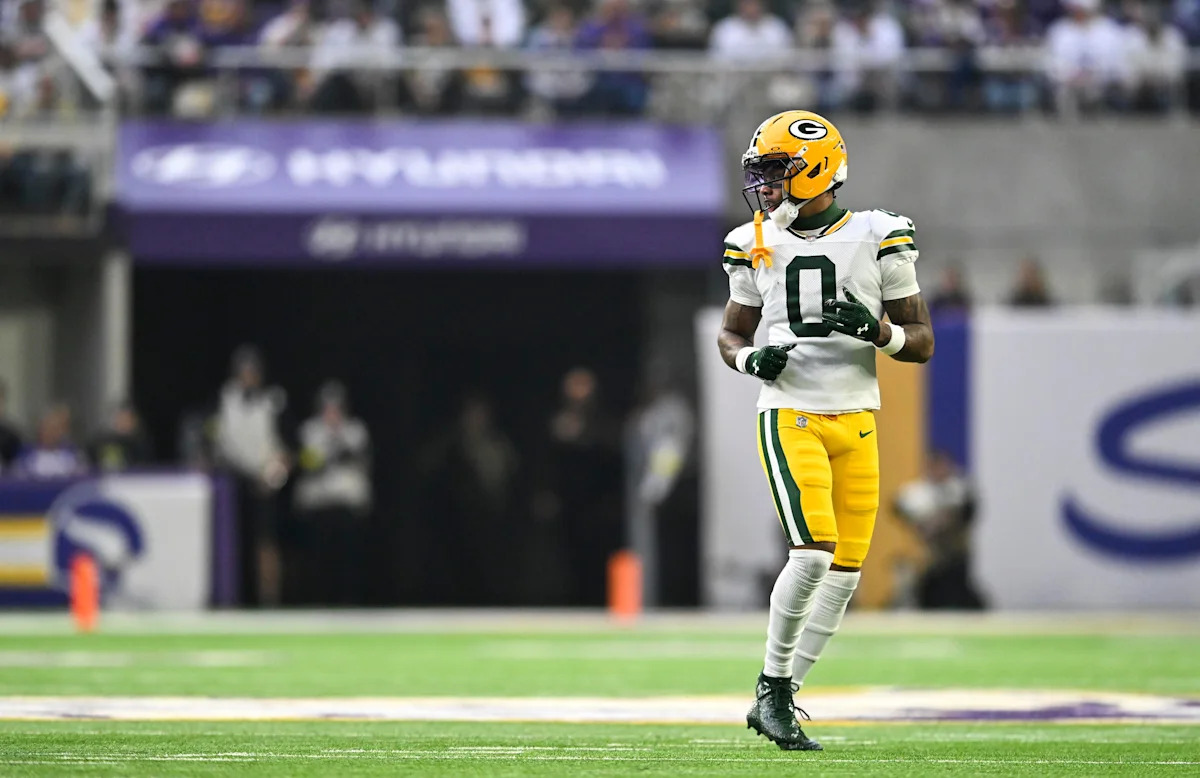
Over the weekend, as the Green Bay Packers started to settle into the groove of training camp, quarterback Jordan Love raised a bit of a hubbub during an interview with NFL Network’s Stacey Dales when he said that receiver Matthew Golden was “locked down over there at X.”
I’m sure the vast majority of you already have a picture in your head of an X receiver, but we’ll spend a minute with that first. Traditionally, the prototypical X receiver has been someone like Andre Johnson or DeAndre Hopkins: a big-bodied, sure-handed receiver who is good in contested-catch situations. On the other side would be the Z receiver, who would be someone like DeSean Jackson. In his excellent book The New Thinking Man’s Guide to Pro Football, Paul Zimmerman (aka Dr. Z) bucketed them in two categories: “possession” and “flyers”. That feels right. Your X receiver is your on-the-ball, isolated receiver who is asked to win one-on-ones.
Advertisement
While football has changed and evolved over the years, those tags – X and Z – are still used, and, in the minds of many, those classifications are still gospel. They can still hold true to a certain extent, but they’re not hard-and-fast rules. In this Packers offense in the LaFleur era, you can think of Romeo Doubs in that X role. Going back a little earlier in his tenure, it was Davante Adams.
With that in mind, we’re going to view Matthew Golden through the lens of some pages from the 2019 Packers Playbook (I know, I know. It’s pretty outdated by now from a play perspective, but it still outlines the core philosophy and formations that are still very much in use.) We’ll start with a definition of skill positions:
As is laid out here, the Y (Tight End) determines the strength of the formation, while the X is “Predominantly the Weak Side Receiver”. That is to say, aligned on the other side of the formation from the Tight End. You can likely see this in your head when the Packers go into a 3×1 or Quads formation; there was Romeo Doubs or Dontayvion Wicks as the X, all alone on the backside.

There’s a term that’s been floating out there over the past couple of years of “the sacrificial X”. I truly despise the term, but if you look at formations like this, I get it. Out of a formation like this, you could have the “concept” side and the “one-on-one” side.
Advertisement
To me, this diagram is a perfect example of what that kind of thing would look like. This is a concept called All Go that was a big part of their playbook when Davante Adams was at X. It’s a flood concept to the right side, while the X receiver is isolated backside.

The QB would read the coverage over the X, then read the concept. It would be a pre-snap & immediate post-snap read. If the coverage was favorable for the X, it’s an immediate throw. If there’s nothing there, the QB barely gives him a glance before moving to the concept.
When the idea of an X receiver comes up, this is what tends to spring to mind. That’s certainly part of the role, but it’s not the entire role. Defining a WR as an X, Z or F doesn’t mean they’re always doing the same thing.
Advertisement
Here’s Bin RT, a bunch formation. There is the X, once again, all alone on the weakside.

Just below Bin RT, we’ll find Box RT. It’s the same bunch formation, with a key difference: the X is now part of the bunch.

You’ll find some of this in their 2×2 formations as well. Deuce RT finds the X as the outside receiver on the weak side.

Just below that, you’ll find Dixie RT, where X is the slot.

Motion, of course, changes the picture and further blurs the lines. Here’s Coco Bow out of Bunch RT Tight. The X starts as the isolated receiver in a 3×1 formation, but the motion turns it into a 2×2 set with the X running a corner route.

If you want an even clearer look, here is a page from the Tree concept. There are four versions of it. In the top two versions, the X is running the Basic from the top of a two-man stack. In the third diagram, he’s the under man in the stack, running the Shallow Cross and working as the Hot receiver in a blitz situation. In the fourth diagram, the concept has been flipped, and he’s the run-off Alert receiver, running a go route.

Picture this page and the call, and then imagine what it’s like if you’re swapping receiver tags. Say Golden is the X in the top right diagram, but the Z in the bottom right. Think of the additional mental processing that would likely occur. Having defined receiver tags doesn’t mean that receiver is always going to be doing the same thing.
Advertisement
In this offense, you want the X to be able to win off the line and have sure hands, but that’s not the only thing he’s going to be asked to do. He likely won’t be the guy called on to be the insert blocker the majority of the time (that will likely be Christian Watson as the Z), but there are times that’s exactly what he’ll be asked to do.
By paring down the receiver room this offseason, it has allowed for clarity in receiver roles, which should allow for a smoother operation. It doesn’t mean boxing yourself in: it means more clarity in communication, which is never a bad thing.
Albums listened to: Starflyer 59 – Disappointed EP; Shearwater – The New World; The Swell Season – Forward
Read the full article here