





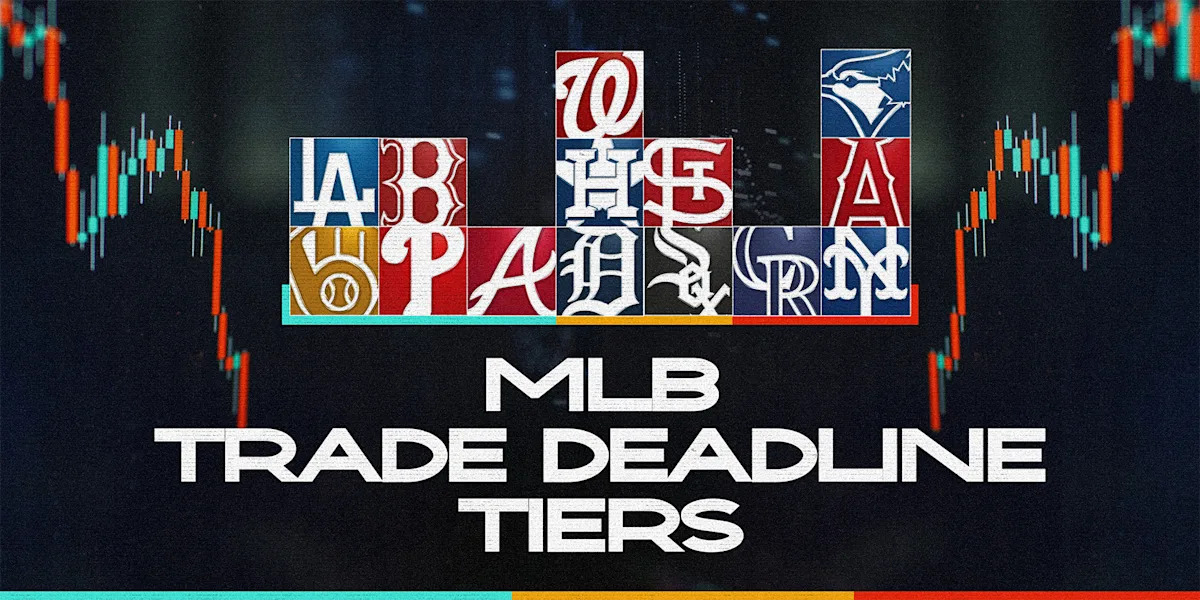
Tick tock. No matter how much major-league front offices would prefer to procrastinate, time is running out for them to make major upgrades to their rosters via trade before the deadline arrives at 6 p.m. ET Monday.
To be fair, these vacillating executives do have more time than ever to determine their deadline strategies. For years, the deadline fell on July 31, but now the league can place the deadline on any day between July 28 and August 3 to avoid conflicting with games. And this year, the stopping point for swaps comes on the latest possible date. This means teams this season will play more games before the deadline than ever before — roughly 112 games, which is five to 10 more on average than when the deadline was always July 31 — giving them more information to determine their plan but also fewer games on the other side to chase down a playoff spot.
Advertisement
Recent history indicates that the bulk of the transactions will not take place until the final 48-72 hours before Monday’s deadline. But teams need to decide soon whether their goal is to upgrade the major-league team, make moves focused on the future or something in between. With five days until the deadline, here’s a breakdown of where all 30 clubs stand, from the projected buyers to the expected offloaders.
Jump to a team by clicking on the links below:
The legitimate contenders
Los Angeles Dodgers, Atlanta Braves, New York Yankees, Philadelphia Phillies, Boston Red Sox, Chicago Cubs
Let’s begin with the two-time defending champs. The 2026 Dodgers club has hummed along without too many hiccups but also hasn’t dominated to the degree many expected, based on their unprecedented amount of star power. Injuries, to no one’s surprise, have hampered Los Angeles’ ability to flatly overwhelm the competition, and so have lackluster seasons at the plate from proven stars such as Mookie Betts and Kyle Tucker. With one of the most loaded farm systems in the league, the Dodgers have the ammo to make any trade they want. What they believe they need in their pursuit of a three-peat will be revealed in the coming days and likely hinges on how confident they are that their starting staff will be healthy enough to carry them through October.
Advertisement
Atlanta is back in the mix among the inner-circle of contenders after an uncharacteristic down year in 2025. A vastly improved farm system bolstered this month by an exciting and deep draft class should give president of baseball operations Alex Anthoupolos the pieces to round out a roster that looks formidable at the top but lacks the depth of a typical World Series hopeful. Adding impact starting pitching to pair with Chris Sale should be a priority, while shortstop and left field are weak spots potentially worth addressing.
The Yankees have survived but hardly thrived with Aaron Judge on the shelf since the end of May due to a rib fracture, and now another All-Star outfielder in Cody Bellinger just landed on the injured list due to a hamstring strain. The terrific rotation is approaching full strength with Max Fried back in the fold, but the Yankees suddenly look quite thin offensively with Judge’s return timeline still uncertain. The bullpen also looks light on paper but has largely been effective, so it’ll be interesting to see whether general manager Brian Cashman prioritizes adding a bat (or two or three) over relievers, or if he’s aggressive enough to improve both areas.
The Phillies stumbled out of the gate, fired well-regarded manager Rob Thomson at the end of April and then rallied in May and June to ensure their season wouldn’t go to waste. But the offense has struggled again in July, and the pitching staff is notably top-heavy, which should prompt president of baseball operations Dave Dombrowski to exhibit his usual aggressiveness and give his roster a boost before the deadline.
Advertisement
That the Red Sox have played their way into this top tier of buyers is an astonishing achievement. This is the same team that fired longtime skipper Alex Cora on April 26 and then continued to play poorly for another two months, sinking as low as 29-43 on June 18, with playoff odds falling below 10%, according to FanGraphs. But Boston has been brilliant since bottoming out, flying up the standings while the rest of the American League continues to underwhelm. Even more relevant for the purposes of this exercise, the Red Sox have already added, flipping a promising young arm in Connelly Early to Washington for an immediate lineup upgrade in breakout bat Curtis Mead. It’s actions over words this time of year, and president of baseball operations Craig Breslow executed the first aggressive “buy” move of the deadline. The question now is what else the Sox can get done, especially with Garrett Crochet and Roman Anthony seemingly not close to returning from injury.
Rounding out this tier of buyers are the Cubs, who are in strong position to return to the postseason but are at risk of letting the rival Brewers run away with the NL Central for the fourth consecutive season. Few contenders have as urgent of a need as Chicago faces on the mound due to a slew of injuries, but with a championship-level position-player group headlined by MVP candidate Pete Crow-Armstrong, president of baseball operations Jed Hoyer owes it to his team and the Cubs’ fan base to be aggressive in pursuing upgrades — or at least fixes — for the pitching staff.
Not in their DNA to go for it, but they should
Milwaukee Brewers, Tampa Bay Rays
These organizations are praised throughout the industry for their ability to compete without the payrolls of their large-market counterparts, but rarely in their history have they acted with the aggressiveness required to outbid the competition at deadline time.
Advertisement
The Brewers are cruising through another regular season and might not have to sweat much to claim a fourth consecutive NL Central title. After finishing fourth in the AL East each of the past two seasons, the Rays have reemerged as a force atop the American League, thanks to the superstar ascent of Junior Caminero and a standout starting rotation. These teams boast the two best home records in MLB, perhaps adding motivation to chase down the top overall seed in their respective leagues to ensure home-field advantage throughout the October bracket.
Such an advantage proved moot for Milwaukee last year, but the Brewers should still be emboldened to pursue any edge they can, considering the quality of the other NL contenders. The Rays, meanwhile, will have to fend off the Yankees to win the AL East for the first time since 2021, but they don’t look to have too many other obstacles in a weak American League. If there was ever a time for these two franchises still seeking their first World Series titles to leverage their stockpile of prospects for midseason upgrades, this is it. Let’s see if these forward-thinking front offices throw caution to the wind for once and take some big swings.
All eyes on you
Detroit Tigers
You know the deal. A miserable first couple of months looked to have Detroit barreling toward the unenviable task of trading ace Tarik Skubal before he reaches free agency this winter, but the Tigers have played well enough since then to hang around the periphery of the American League wild-card mix. Detroit’s improved play has tempered the Skubal trade buzz to some degree, but it remains the talk of the industry.
Advertisement
And the vibes shift daily. Every win breathes new life into a Tigers club desperate for one more chance to chase a World Series with Skubal. Every loss amplifies the tantalizing possibility of Skubal changing threads this summer, with nearly every buyer mentioned above expected to inquire about the southpaw in the coming days.
Because of his expiring contract and the fact that he underwent elbow surgery just a few months ago, Skubal won’t fetch the kind of gargantuan trade return that, say, Juan Soto did in 2022. But that doesn’t mean a Skubal trade wouldn’t be one of the more seismic transactions in recent memory. It’s hard to envision anything at this deadline that could usurp the significance of Skubal staying or going. One way or another, we’ll have a resolution soon.
Let’s have some fun
Pittsburgh Pirates, Chicago White Sox
Pittsburgh owns the National League’s longest playoff drought, which dates to 2015, when the 98-win Pirates were blanked 4-0 at home by the Cubs in the NL wild-card game (remember those?). Chicago is just two years removed from one of the most humiliating seasons in baseball history, a 121-loss catastrophe reflecting a franchise years away from contention.
Advertisement
Yet here are the White Sox and Pirates, each with winning records and playoff odds in excess of 40%, each exhibiting traits of Actually Good Baseball Teams that should make them no-doubt buyers. For both clubs, adding pitching to support a stellar lineup is paramount. Pittsburgh’s woeful bullpen has undermined its revamped and resplendent offense and talented rotation. The White Sox haven’t been that bad on the mound but lack the impact arms typically associated with October-bound clubs.
On the whole, expect Pittsburgh to act more urgently than Chicago, as there’s more pressure on its front office to finally win after meandering for years, whereas the Sox look to be at the outset of an exciting era on the South Side and thus might be hesitant to spend future assets for short-term solutions.
Front offices have just a few more days to finalize their plans ahead of Monday’s trade deadline
(Mallory Bielecki/Yahoo Sports)
Someone’s gotta win the AL West
Texas Rangers, Seattle Mariners, Houston Astros
By taking three of four against the Mariners over the weekend, the Rangers secured the season series tiebreaker between the clubs, which could prove vital if they remain neck-and-neck all the way to the finish line. Texas hasn’t played like any sort of juggernaut but at least has the makings of a balanced ballclub, with an improved lineup, some high-end starting pitching and a dependable bullpen. The Rangers’ front office was bold over the winter in sending a huge prospect package to land MacKenzie Gore from Washington; would they have a similar appetite for a blockbuster this summer?
Advertisement
Seattle has clung to a positive run differential for longer than most AL teams but has little else to hang its hat on through four months of play and has a compelling case as the most disappointing team in the league — at least among those whose chances of playing in October haven’t completely gone kaput. It’s hard to fathom how poorly the Mariners have played, considering the quality of the roster on paper, but the talent intact could — and arguably should — motivate the front office to add significant offense or bullpen help, even if it costs some of their starting pitching surplus. This team hasn’t exactly earned the level of deadline splash that Seattle made three of the past four years — with Luis Castillo, Randy Arozarena and then Josh Naylor and Eugenio Suarez — but with this roster and in this year’s American League, going backward should not be an option, especially for the only franchise that has never been to the World Series.
The Astros have recovered from a 20-31 start to stay in the wild-card mix and the uninspiring AL West race. And with general manager Dana Brown in the last year of his contract, there’s no reason to expect him to make moves focused on a future he might not be around to oversee. Even if the roster has several veterans who could be worth dangling in trade talks, owner Jim Crane is far more likely to green-light transactions that increase the team’s odds of returning to the postseason rather than improving the long-term outlook. Adding pitching and outfield help are musts for the Astros.
“Sell” is not in our vocabulary
San Diego Padres
During his tenure as Padres president of baseball operations, AJ Preller has sent out a staggering amount of high-end minor-league talent in exchange for major-league stars, but have we finally arrived at a point where it makes sense for him to consider the opposite approach? Perhaps, with San Diego hovering around .500 and miles behind the rival Dodgers, but it’s still safer to assume that Preller will get creative in adding to his roster before contemplating any substantial sell moves, such as moving closer Mason Miller, who just arrived at last year’s deadline.
Advertisement
With San Diego’s offense heating up significantly in recent weeks and the Miller-led bullpen stifling opposing hitters, you could talk yourself into the Padres as a semi-dangerous playoff team if they can add a starting pitcher or two. It won’t be easy with a thinned-out farm system, but Preller has found a way under similar circumstances before, so let’s not be surprised if he pulls it off again. That said, if he does choose to deal from the major-league roster, cashing in on premium lefty reliever Adrian Morejon — a pending free agent — feels more likely than a Miller blockbuster.
The messy middle, AL edition
Cleveland Guardians, Minnesota Twins, Baltimore Orioles
A season-high five-game skid that included being swept in Tampa last weekend has pushed Cleveland down into the mud that is the AL wild-card mix, though the upstart White Sox are still within striking distance in the AL Central and the Guardians shouldn’t punt on the possibility of a third straight division title (Cleveland has the easiest strength of schedule remaining in MLB). That said, the Guardians have thus far failed to capitalize on the misfortunes of the rival Tigers and haven’t put themselves in a strong enough position to be no-doubt buyers. As usual for Cleveland, offensive upgrades are needed, badly.
Advertisement
Meanwhile in Minnesota, a season that many expected to trend toward a continuation of last year’s drastic deadline sell-off has yet to materialize, complicating Cleveland’s (and Chicago’s and Detroit’s) path even further. Teams are surely calling about the availability of Joe Ryan and Ryan Jeffers, among others, but the Twins seem to be holding off on any major subtractions – for now.
Baltimore does not have the benefit of a weak division to tempt it into pursuing a late charge, but perhaps that’s a good thing. The Orioles should have a clearer sense of what they’re aiming for down the stretch and whether it’s worth the squeeze of buying at the deadline — or if trading expiring contracts such as Taylor Ward and Trevor Rogers is a more prudent move. That said, it has been another disappointing and disjointed season in Birdland, so adding instead of subtracting might be the course of action to appease a fan base growing short on patience.
The messy middle, NL edition
Arizona Diamondbacks, Washington Nationals, St. Louis Cardinals, Miami Marlins
Considering the state of the franchise and the investment in the major-league roster, Arizona has by far the most pressure of this quartet to win now. And with a whopping 10 pitchers on the injured list, it’s no secret that the Snakes need an arm or two to stay afloat until other key arms get healthy. Do they have the prospect capital to outbid the heavyweight contenders for an impact starter, or will they have to settle for more modest help? Are they even good enough to catch lightning in a bottle, like they did in 2023? The D-backs will upgrade in some form, but it’s hard to count on them emerging as one of the deadline winners, considering the circumstances.
Advertisement
As for the three others in this tier, none entered the season with the postseason as a realistic goal, and if they do decide to make meaningful additions, they are in all likelihood battling for the third NL wild-card spot. Is that lottery ticket into the bracket worth sacrificing important long-term pieces? It’s hard to argue it is, considering the quality of contenders that occupy the top of the NL. This could lead to major leaguers being offloaded from these rosters, but don’t expect a total teardown; Washington, St. Louis and Miami have all played well enough this season to suggest they’re closer to contention than presumed when the season began. That said, each team has shorter-term assets that clubs with an urgent desire to win now are certain to inquire about — Foster Griffin, Lars Nootbaar, Sandy Alcantara, to name a few — which could make for some interesting decisions before the deadline.
How did we get here?
New York Mets, Toronto Blue Jays
The Mets spent the offseason overhauling their roster to a stunning degree, and their monumental payroll and ample star power fueled an optimistic outlook for 2026. Unfortunately, all the new pieces failed to fit together before the season went completely off the rails, costing manager Carlos Mendoza his job and forcing president of baseball operations David Stearns into what will likely be another serious roster shakeup at the deadline.
Advertisement
Pending free agents Freddy Peralta, Tyrone Taylor and Clay Holmes should all have suitors. Luke Weaver has excelled in relief and is under club control for next season. Luis Robert Jr. represents an intriguing buy-low option for the bevy of teams seeking right-handed bats. There’s no ambiguity here: The Mets will move a lot of players in the coming days and hope to acquire talent that can help them get back on track in 2027. A team spending this much should not be doing anything resembling a rebuild.
The Blue Jays carried the momentum from their magical postseason run into a riveting winter spent adding aggressively in the forms of Dylan Cease, Kazuma Okamoto and Tyler Rogers – all of whom have delivered in their debut seasons for Toronto. But roughly everything else has gone wrong for the reigning AL champs, putting the Blue Jays in the unthinkable position of needing to trade away a number of players before they reach free agency this winter: Kevin Gausman, Daulton Varsho, George Springer and Shane Bieber could all be on the move soon. Perhaps a last gasp over the next week changes things — this is not as clear-cut a situation as the Mets’ — but we’re certainly trending toward a somber sell-off for Toronto.
New regimes facing reality
Colorado Rockies, Los Angeles Angels
The Angels are awful and well on their way to extending the majors’ longest playoff drought to a dozen years. The Rockies aren’t nearly as bad as last year, when they racked up 119 losses, but they’re still in danger of losing 100 games for a fourth consecutive season, which no team has done since the 1962-65 Mets. The good news: Both teams now have new heads of baseball operations who appear willing to grapple with the dire state of affairs and handle the deadline accordingly.
Advertisement
John Mozeliak, who won a whole lot during a lengthy tenure leading the St. Louis Cardinals’ front office, took over from Perry Minasian last month and has not been shy about the Angels’ organizational shortcomings, appearing open to moving valuable trade chips such as Reid Detmers, Jose Soriano and Zach Neto with an eye toward building a more sustainable future. Questions remain about whether Mozeliak has full autonomy or if owner Arte Moreno will remain an impediment to organizational progress, but Mozeliak has at least said the right things about his willingness to keep the bigger picture in mind.
While the Angels pre-Mozeliak have repeatedly chased short-term solutions that turned out to be fruitless, Colorado has barely participated in the broader marketplace, acting as an isolated black box for years as the franchise fell behind the rest of the league. Last offseason, the Rockies gave the keys to the fascinating tandem of Paul DePodesta and Josh Byrnes, each of whom arrived with a promising combination of experience and creativity to help the Rockies modernize and consider all avenues of improvement, including flipping major-league pieces for long-term assets.
Who is and isn’t traded at this deadline matters less than the internal overhauls needed for both organizations to compete in the modern major leagues. But executing savvy deadline deals as sellers can represent massive steps in the right direction. These teams seem to at least have the proper leadership in place to consider such deals.
Bad ballclubs open for business
Cincinnati Reds, San Francisco Giants, Athletics, Kansas City Royals
Maybe the Reds belong at the bottom of the messy middle tier; they just won three consecutive road series and aren’t that far out of the wild-card mix. But even if its record isn’t as bad as the other teams in this tier, Cincinnati rates so poorly in most metrics on both sides of the ball and faces the toughest remaining schedule in MLB, a combo that cements its status as a surefire seller. Rentals on the move should include right-handed starter Brady Singer, lefty reliever Brock Burke and catcher Tyler Stephenson. A rejuvenated JJ Bleday could also appeal to a club needing outfield help.
Advertisement
It has been a bad year for the current and former Bay Area baseball tenants. Buster Posey has made a bunch of bold moves as new head of baseball ops for the Giants, but they’ve yet to translate to wins, meaning San Francisco has no choice but to unload expiring contracts such as All-Star Luis Arraez and veteran lefty Robbie Ray and might even consider some larger deals involving players under club control (Casey Schmitt? Heliot Ramos? Jung Hoo Lee? Matt Chapman? Rafael Devers?!).
The A’s looked to be on an upward trajectory entering 2026, but injuries in the lineup and continued struggles on the mound have torpedoed their season. Worse yet, they don’t have much to offer in trades, so it could be a quiet deadline in Sacramento even if this team has all the marks of an obvious seller.
Lastly, the Royals are somewhere between the Giants and A’s. They have expiring contracts to move (Lane Thomas, Matt Strahm, John Schreiber) but not much that could fetch a return a la Arraez or even Ray. That said, All-Star Michael Wacha (owed $14M in 2027, club option for $14M in 2028) could be targeted by teams seeking rotation reinforcements.
Read the full article here