





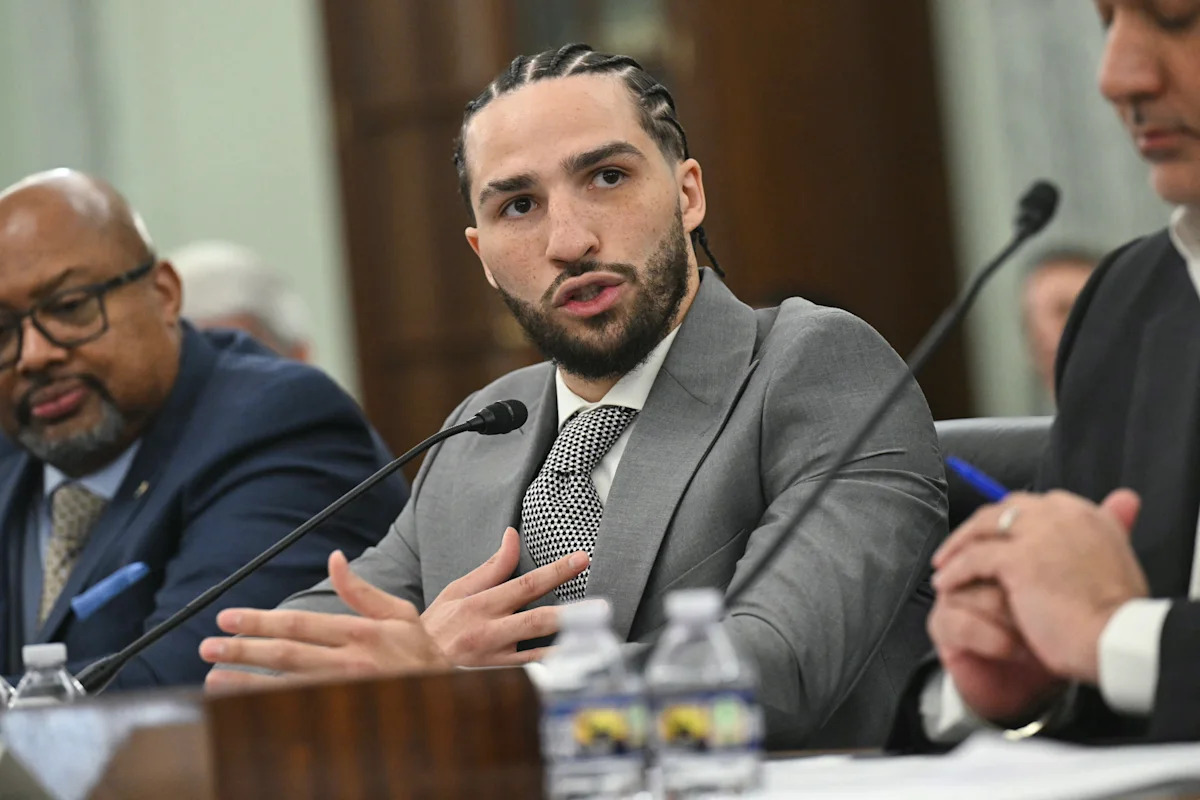
Nico Ali Walsh, the grandson of the legendary Muhammad Ali, is one of the few current boxers to speak out against the controversial TKO-backed Muhammad Ali American Boxing Revival Act. He has emerged as the act’s most prominent detractor, even opposing it in U.S. Senate hearings and working to stop it from going through in its current form.
The proposed piece of legislation, supported by TKO — the UFC and WWE’s parent company — and Zuffa Boxing, comfortably passed the U.S. House of Representatives in March. Its journey through the U.S. Senate, however, appears to be a more arduous one.
Advertisement
“I may be naive in saying this, but when [TKO] first reached out, I thought, ‘You know what? They’re trying to come to an agreement,'” Walsh said Tuesday on Uncrowned’s “The Ariel Helwani Show.”
“That was my initial thought because the truth is, with these senator calls, we’ve been winning. Our side, my side — the side of sticking up for the current Ali Act — we’ve been winning. We’ve been doing great.”
TKO executive Nick Khan and Walsh met this past weekend around Zuffa Boxing 9 in New York to discuss changes Walsh thinks the act needs before it passes in the U.S. Senate.
Advertisement
Walsh says the meeting came about as a result of his success in calls with U.S. senators, which he believes prompted Khan to reach out and try to find some middle ground.
“These senators have been agreeing with us,” Walsh said. “They know the Revival Act is not going to pass as it stands. I feel like because of the impact we’ve had and the success we’ve had just in the last couple of weeks, I feel like that’s why [TKO] reached out.
“That call that we had with the senators [on July 20] was amazing,” Walsh continued. “It was that one where we were informed that [the Ali Revival Act] was not going to pass as it is proposed. After that call, I said, ‘You know what? This is a huge win for us.’
“The Revival Act is not going to pass as the Revival Act. It’s going to pass as something, of course. That was a huge win for us, so now we were able to implement changes that we thought were necessary to better the sport of boxing and to, of course, protect the fighters.”
Advertisement
Much of the criticism directed at the Ali Revival Act has arisen because many within boxing believe that TKO — the parent company of UFC, which dominates MMA — is attempting to create a monopsony through Zuffa Boxing.
If the bill passes, TKO would be able to operate as a unified boxing organization (UBO), where it could implement a UFC-type model in the sport, staging its own events, awarding its own belts, and operating a rankings system.
Some prominent figures in boxing, such as former six-division champion and promoter Oscar De La Hoya, believe that Zuffa will eventually monopolize the sport to emulate UFC’s profit margins — where reportedly just 18% of event revenue goes to fighters.
Advertisement
Critics believe the proposed legislation — in its current form — would be instrumental in helping TKO get to that point.
“In layman’s terms, financial transparency is absolutely essential,” Walsh said of the changes that need to be made to the current draft of the Ali Revival Act. “That’s UBO disclosures, that’s fighter pay — you’ve got to be able to show [the fighters] what money is being made.
“So financial transparency, free agency, length of contract, rankings transparency — those four are really the main ones that we really stuck to in the meeting. If they listen to those four, we’ll be in a way better position, and fighters will be able to keep a lot of the rights that they have under the current Ali Act.”
Nico Ali Walsh (center right) and Nick Khan (far right) testify during a Senate Committee hearing.
(SAUL LOEB via Getty Images)
Walsh is understandably wary of UFC fighter contracts — which have been heavily challenged in antitrust lawsuits — making their way into boxing. Elements of that include “sunset” clauses, where if a fighter wins a title or refuses proposed bouts, the promotion can extend or freeze the contract duration to keep the fighter tied to its roster. “Champion” clauses also allow deals to be naturally extended when fighters win or hold titles, potentially delaying or denying them free agency.
Advertisement
Zuffa Boxing’s fighter contracts have already been the subject of criticism for containing clauses similar to UFC contracts, such as giving the promoter the exclusive right to select opponents rather than opponents being mutually agreed upon — and the repercussions if fighters turn down bouts.
Walsh believes Khan is receptive to his proposed changes. He expects a revised version of the Ali Revival Act to be drafted soon, including some of his proposed changes.
“Next, the Senate is going to put together a bill with the comments from both of our sides, and they’re going to come out with a revised version — and that’s huge,” Walsh concluded.
Read the full article here