





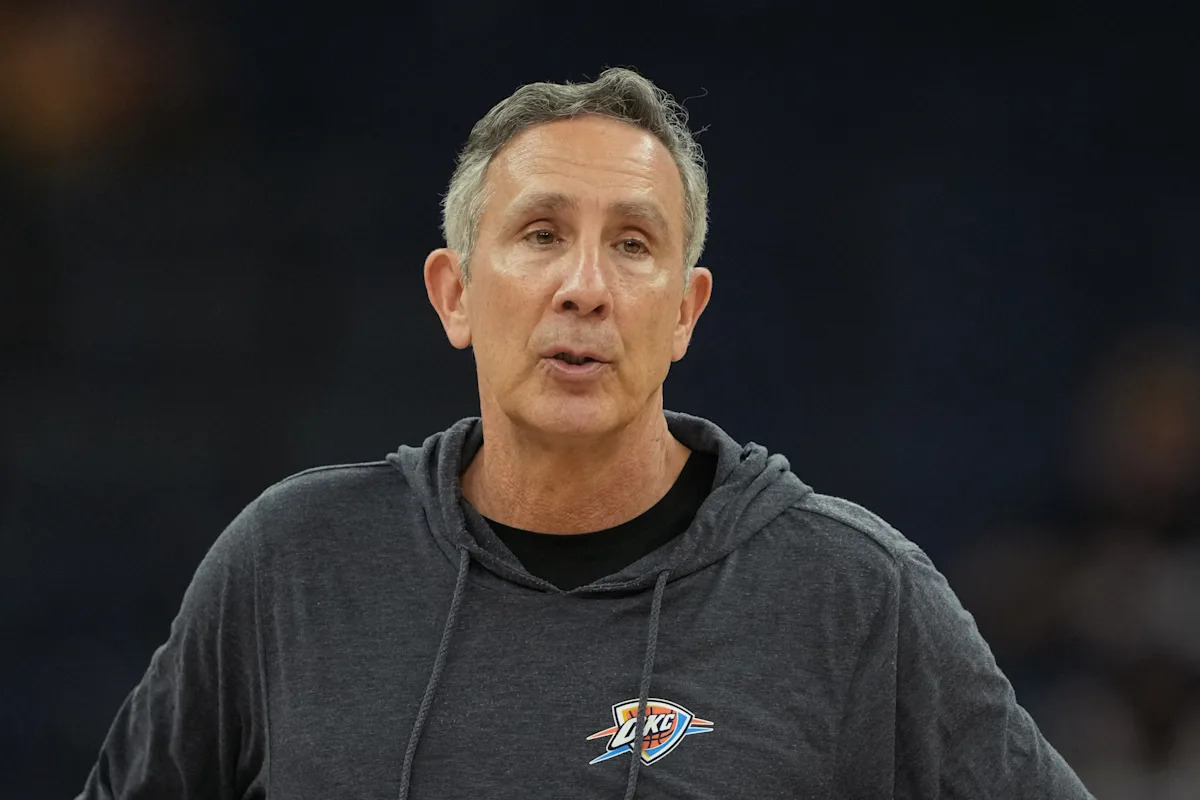
The Houston Rockets are hiring longtime NBA assistant Chip Engelland, one of the league’s most respected and decorated shooting specialists, to join Ime Udoka’s coaching staff, according to ESPN’s Shams Charania.
Engelland, 65, played at Duke in the late 1970s and early 1980s before plying his trade overseas in the Philippines and in the now-defunct Continental Basketball Association for several years. A knockdown shooter at the collegiate and pro levels, he entered the NBA’s coaching ranks in 1999 as a shooting consultant for the Detroit Pistons under Alvin Gentry, beginning his career working with young superstar Grant Hill. In Hill’s first five pro seasons, he went a combined 22-for-121, or 18.2%, from 3-point range. The season Engelland got to Detroit, he shot 34-for-98, 34.7%, from deep. After that season, Hill signed with the Orlando Magic in free agency; he wouldn’t make more than 34 triples in a season for the next nine years. (Injuries, of course, certainly played a role in that.)
Advertisement
Three years after breaking into the league, Engelland joined Jeff Bzdelik’s staff with the Nuggets as their director of player development, beginning a life as a full-fledged NBA assistant that has now spanned 23 seasons. After two years in Denver, though, Engelland got the call that would come to define that career — the chance to join Gregg Popovich with the San Antonio Spurs, where he’d become the “secret weapon” whose work building and refining the shots of player after player, year over year, underscored so many of the player development success stories that helped fuel a perennial title contender that won two NBA championships during his tenure.
Chip Engelland has helped a long list of NBA players improve their shooting. (Darren Yamashita-Imagn Images)
(IMAGN IMAGES via Reuters Connect / REUTERS)
Under Engelland’s tutelage, Tony Parker blossomed from a lightning-quick driver with a shaky jumper into one of the NBA’s most bankable midrange shooters — a transformation, as Chris Ballard detailed in his 2010 book “The Art of a Beautiful Game,” began with a subtle shift in hand placement:
In Parker’s case, the first thing Engelland noticed was that while his form was exemplary on his one-handed runners and teardrops, Parker held the ball differently on his jump shot. Rather than keeping his right hand under the ball, Parker had it slightly higher up. So, beginning with training camp in the fall of 2005, Engelland reconstructed Parker’s shot, moving his right hand down, his right thumb out to widen his grip, slowing down his motion and even changing his release point.
Eventually Parker’s J began to improve; he was applying more backspin, and his line drives were turning into baby Parabolas. Parker ended the 2005-06 season shooting 54.8% […] not only did Parker become better in the paint, but his jumpers indeed fell more often; in 2004-05, Parker shot 34.5% on shots outside the paint, whereas in 2005-06, post-Engelland, that rose to 39.7%.
Engelland played a significant role in building Kawhi Leonard from a defense-first collection of tools into an All-Star, All-NBA selection and MVP of the 2014 NBA Finals — a series that saw San Antonio scorch the Big Three Miami Heat to the tune of a 119.2 offensive rating on pristine team-wide shooting splits: 52.8% from the field, 46.6% from 3-point range and 74.6% from the free-throw line.
Advertisement
“Let me put it this way,” one NBA coach told San Antonio Express-News columnist Buck Harvey back in 2014. “They wouldn’t have won the title without him.”
Later, Engelland helped Dejounte Murray make the same sort of midrange maturation that Parker did, contributing to the level-up as a scorer that earned the 6-foot-5 combo guard an All-Star nod and, eventually, a nine-figure contract. Over the years, he teamed with fellow Spurs player development guru Chad Forcier to help players of all stripes — from youngsters like George Hill, Danny Green, Cory Joseph, Derrick White, Patty Mills and Keldon Johnson to veterans like Richard Jefferson, Marco Belinelli and DeMar DeRozan — smooth out their strokes and find success in ways both big and small.
“He is a great teacher,” Popovich told reporters in 2022. “He understands every facet of shooting. He has a knack for knowing what to point to as far as improvement is concerned. He can figure out common denominator-wise what needs to be improved. His sequential approach to it is always accurate. He doesn’t skip steps and the players always become more confident working with him. They don’t become confused.”
Advertisement
Unless, of course, Engelland wanted them to be a little confused.
Steve Kerr had actually grown up watching Engelland star at Pacific Palisades High School in California, before eventually becoming a star there himself. Kerr described to Ballard how Engelland helped him solve a problem that plagued him as his career wore on:
Increasingly, Kerr found himself in difficult shooting situations. He’d play 20 minutes one night, then six the next, depending on matchups. Some nights, he’d get up four shots, other nights it would be two. Sometimes he’d sit two games, then be expected to come in cold […] and hit a big shot. How could one prepare for such erratic opportunities?
Engelland had a solution. He told Kerr to meet him on the bench at the practice gym. Once there, the two men sat and talked for five minutes. Then, suddenly, Engelland leaped up, ball in hand.
“Start running the wing,” he ordered Kerr. “Now!”
Startled, Kerr jumped up and followed. Engelland dribbled madly, leading a fast break. When he got to the top of the key, he fed Kerr on the wing for a three-pointer. Then the two promptly returned to the bench, where they sat and talked for five more minutes. Then they did it again, and again. “In 30 minutes, I’d only shoot six shots,” Kerr says. “Psychologically, it was awesome, because then the next game, I was like, ‘Hey, I just did this.'”
Engelland’s methods continued to bear fruit, year after year; over 17 seasons, he became “the keeper of the Spurs Way,” an extension of Popovich who helped uphold the Spurs’ culture. It came as some surprise, then, when he left San Antonio in 2022 and joined the Oklahoma City Thunder, led by former Spurs executive Sam Presti, who had assembled a ton of young talent that could benefit from the attention of the NBA’s preeminent shot doctor.
After Engelland’s arrival, a slew of Thunder players — including two-time MVP Shai Gilgeous-Alexander, All-Stars/All-NBA selections Jalen Williams and Chet Holmgren, Luguentz Dort and former OKC guard Josh Giddey — made notable improvements from beyond the arc, helping raise the ceiling of the offense and team as a whole. In the two years before hiring Engelland, the Thunder ranked 29th and 30th in team 3-point shooting accuracy. During his four years in Oklahoma City, they finished 17th, first, sixth and ninth — a leap that helped propel the Thunder to perennial title contention and the 2025 NBA championship.
“I think Chip is a really special talent and a special person,” Presti said after hiring Engelland in 2022. “He, like anyone that is highly skilled, sees things for what they can be and not for what they are. I think he does an excellent job of building relationships that allow people to improve.”
Advertisement
After consecutive 52-win campaigns that have sputtered to a finish in the first round of the postseason, Houston is banking on Engelland sparking a similar sort of improvement.
While the Rockets have finished 12th and seventh in the NBA in offensive efficiency in the two seasons since hiring Udoka — who got his coaching start alongside Engelland under Popovich in San Antonio — they’ve done so largely by prioritizing offensive rebounding and pounding the paint. The only Rockets rotation players to shoot above league-average from midrange and 3-point land last season were Kevin Durant, Reed Sheppard and Jabari Smith Jr.; with Durant limited or absent during their playoff series against the Los Angeles Lakers, Houston struggled mightily to score, eventually bowing out to LeBron James and Co. in six games.
Advertisement
Greater shooting development from multiple young players — most notably Amen Thompson, Alperen Şengün and the just-extended Tari Eason — would be a massive boon to a Rockets team that enters the 2026-27 season intent on challenging the Spurs and Thunder for Western Conference supremacy. The Rockets hope that Engelland can help them get there, replicating the contributions he’s made throughout a quarter-century in the league by building belief and better habits one step at a time.
“Technique is the first thing,” Engelland told Graydon Gordian of Spurs blog 48 Minutes of Hell in a rare interview back in 2010. “They see results. They get better. Their technique improves. They practice. They’re patient. Once the technique gets better, the mind has to grow with it. That takes longer. The ball tells the truth. If they see the ball going in more than they did before, they start believing in it more. I’m pretty enthusiastic and positive, but you can’t cheat the ball.”
Read the full article here