





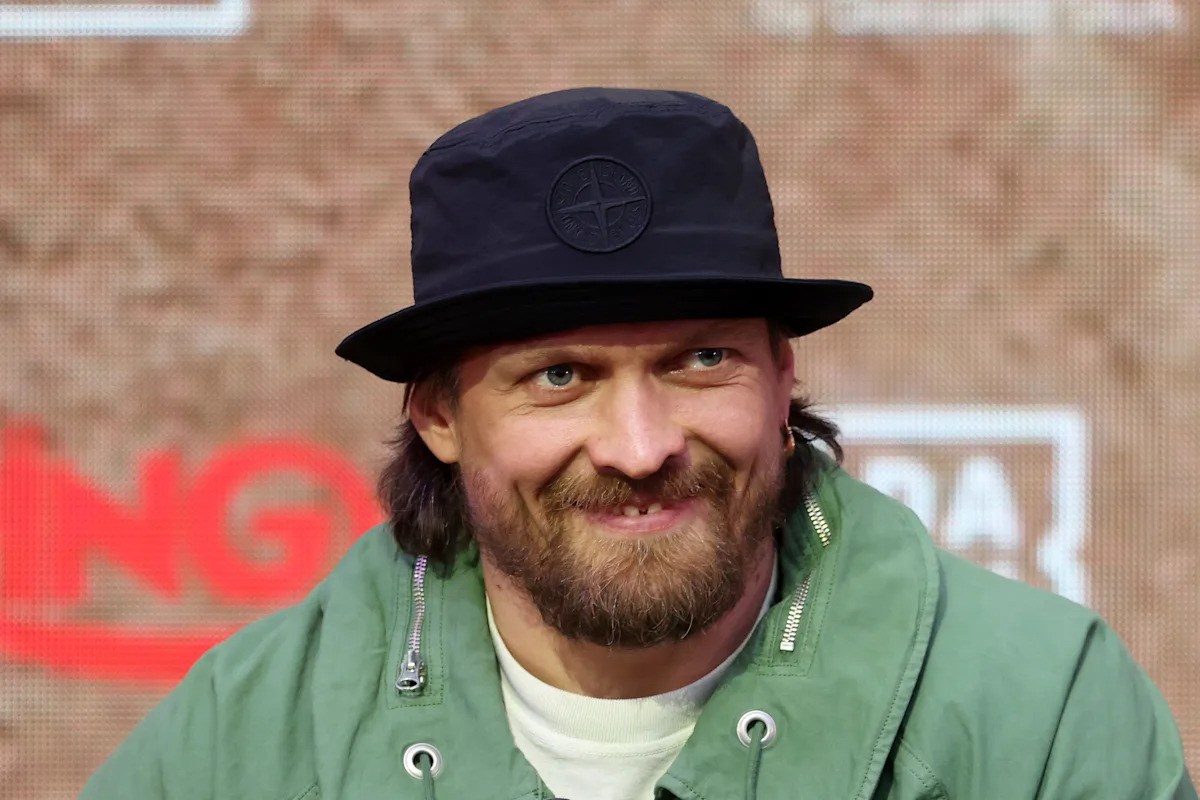
In “Obsession,” the year’s most talked-about horror film, a friend-zoned young man snaps a One-Wish Willow in the hope of forcing a young woman to fall in love with him. Soon enough, despite the young woman’s earlier indifference, she is infatuated with the young man and their friends are shocked, unsure how the young man has suddenly become the apple of this young woman’s eye — that is, her obsession.
The end of the film is a commentary on coercion and codependency. The young man’s dream swiftly descends into a nightmare and, without wishing to spoil things, nobody lives happily ever after. Its message is therefore both clear and obvious: be careful what you wish for.
Advertisement
In boxing, a sport with horror-film tropes, there are no One-Wish Willows, but there are cautionary tales. Quite often, in fact, boxers are reminded to be careful what they wish for, having spoken out of turn, bitten off more they can chew, or received something not earned or deserved — a title shot, say, or a lucrative payday. This granted wish, or gift, can be the result of either a good manager, a phony ranking, or a desire on the part of a champion to have a relatively risk-free title defense. Whatever its origin, the outcome is usually the same. Usually, the fight goes the way we expect it to go. Usually, but not always, the undeserving fighter is left hurt, humbled, and full of regret.
Yet, in the spirit of the horror film, they all go back for more. Even though we, the audience, know what waits on the other side of the door, and even though we yell at them not to do it, fighters tend to still push it open. They are, by design and nature, risk-takers and dreamers. They go where most wouldn’t dare to go. They believe when they shouldn’t.
In the case of Deontay Wilder, the former WBC heavyweight champion, there is still reason to believe. Though he turned 40 in October, Wilder is these days fueled by two cliches: the first, “Age is just a number”; the second, “The last thing to go is a fighter’s punch.” These sentiments alone are enough to justify Wilder, the sport’s hardest puncher, carrying on, throwing more punches. Added to that, he is winning again, having outlasted Derek Chisora, a heavyweight of similar vintage, in April. That win, a 12-round decision, fixed some of the reputational damage of a 2-4 run in his previous six fights and gave Wilder hope of one last title shot. All he needed, perhaps, was another significant win against a man of better stock than Chisora and he could quite conceivably again fight for a heavyweight title.
Deontay Wilder has won back-to-back fights since his late-career slump.
(Adam Davy – PA Images via Getty Images)
Or, better yet, one of the champions could do Wilder a favor — grant him a wish.
Advertisement
Oleksandr Usyk, for instance, who himself turns 40 in January, knows more than most what it is to suffer and persevere. He is also acutely aware of the fact he has effectively cleaned out the heavyweight division and must now decide whether to quit while ahead or risk picking off members of the next generation who await his retirement.
With Wilder, the Ukrainian has a happy medium. He has a heavyweight he has not yet beaten and a heavyweight unlikely to bring to any potential fight the vim and vivacity of a 20-something upstart. Usyk has, in that sense, found a man after his own heart. A man suddenly easy to love. A man to whom he feels strangely drawn.
“Now I do what I want to do,” Usyk said at the WBC convention in Bangkok last December. “I want fight with Deontay [Wilder]. He’s a dangerous guy. It’s a [WBC] world champion for a lot of time [five years]. It’s a guy who for the last 10 or 15 years was a very, very great champion.”
Despite that respect, and what appears to be a connection, Usyk and Wilder failed to agree to a fight in April, so Usyk moved on. He heard another snap! He granted another wish. This one involved Rico Verhoeven, a Dutch kickboxer, who was gifted the opportunity to challenge for Usyk’s WBC heavyweight title against the aptly surreal and incongruous backdrop of the Egyptian pyramids. There, in Giza, Usyk’s generosity almost backfired, with an 11th-round stoppage of Verhoeven sparing his blushes on a night when his kindness was taken for a weakness. In fact, to the dismay of both Usyk and his audience, what started as a comedy — the “Silliest Fight of the Year!” — soon became a horror, one with limited appeal as far as any sequel goes.
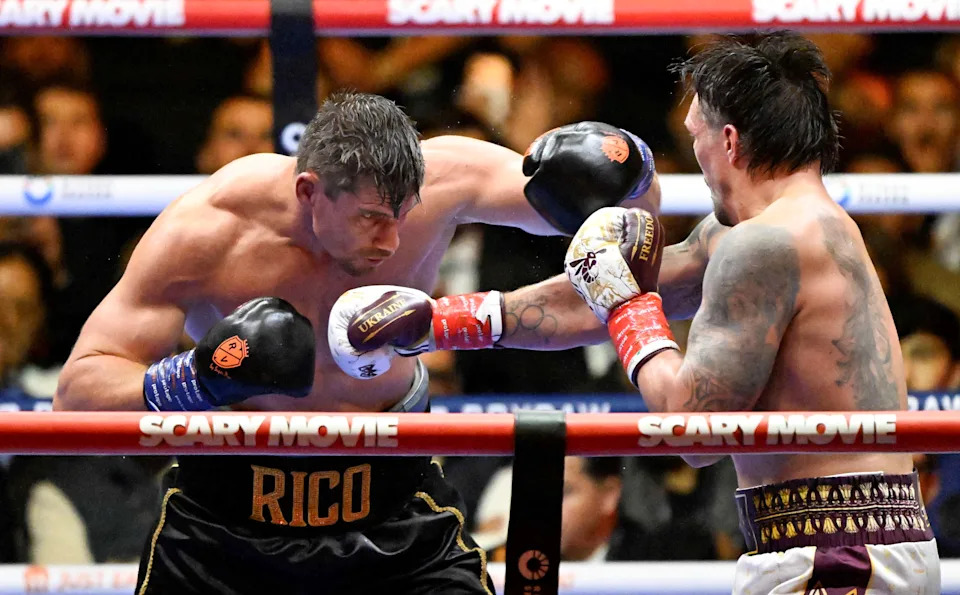
Oleksandr Usyk (R) never suffered the upset of a lifetime against Rico Verhoeven.
(KHALED DESOUKI via Getty Images)
Since that night, Usyk has announced his relinquishing of not only his WBC heavyweight title, but the other ones as well — WBA and IBF. Like a man allotting his prized assets before the inevitable, he is slowly but surely edging toward the exit door, concerned only with getting his goodbye right and preserving his legacy.
Advertisement
That is where Deontay Wilder, at age 40, enters the discussion — again. Wilder, in truth, has never been far from Usyk’s mind. He has for quite a while been an opponent the completist in Usyk has imagined and wanted for his last fight. Beat Wilder, after all, and Usyk can say with some conviction that he has beaten the lot. Even better, should he beat Wilder, the missing piece, Usyk might finally be able to say goodbye.
“Usyk has already stated that he sees Deontay Wilder as the opponent for his last dance,” Usyk’s team director, Sergey Lapin, told BBC Sport. “There is considerable interest surrounding this possibility at the moment, but no concrete agreements have been reached. A fight of this level requires more than just the right names. It also requires the right partner, the right venue, the right broadcast platform, and an event of the appropriate scale.”
Wilder being the “right name” for Usyk only strengthens the belief that a fighter’s name is truly the last thing to go. Try as they might to convince themselves otherwise, a fighter’s name far and away outlives their punch power, as well their delusion and desire to prove everybody wrong. It is, for many of them, the thing that facilitates unlikely wishes and lands them in situations from which they perhaps need protecting.
“If the terms were right, Deontay would welcome the chance to fight Usyk,” Shelly Finkel, Wilder’s manager, recently informed Sky Sports. “Usyk is a great champion and it would be an honor to fight him.”
If Wilder is indeed considered the right name for Usyk in 2026, Agit Kabayel, Usyk’s former WBC mandatory challenger, was evidently the wrong name. Unlike Wilder, a man seven years Kabayel’s senior, the unbeaten German seemingly lacked the requisite profile or credentials to have Usyk stick around and grant him his wish. Instead, Usyk opted to dump the WBC title and wrestle back control and power in a state of nakedness.
Now, with no belts to weigh him down, Usyk has carte blanche to pick his preferred foil and will not be beholden to rankings or any outside pressure. He can, if sufficiently moved, even cast Deontay Wilder — 3-4 in his past seven fights — in the lead role. Think Tarantino reviving Travolta. He can write the script, plot the scenes, and use what we already know about him to complete Wilder’s character arc. They can then, together, concoct the perfect ending, happy or otherwise.
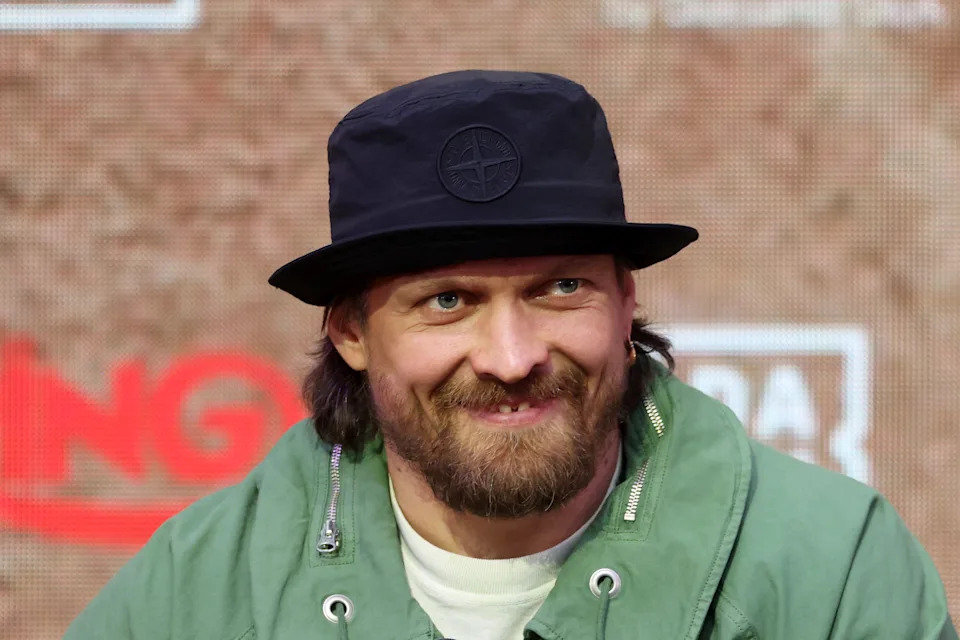
Now beltless, Oleksandr Usyk can plot out his final act to his heart’s desire.
(Richard Pelham via Getty Images)
In Act One, Wilder was inspired, a master of improvisation. At the age of 22, he drew on the pain of his daughter’s spina bifida to win, with limited experience and untaught moves, a bronze medal at the 2008 Olympics. That was his inciting incident, so to speak, and Wilder, without learning his lines, was a total revelation. Born was the “Bronze Bomber,” America’s next heavyweight hope.
Advertisement
Some said Wilder’s success in Beijing that summer owed more to athleticism than technique, but that only fed the feeling that he was a natural. Besides, once he had turned professional, also in 2008, any technical deficiencies in Wilder’s game were soon mitigated by his uncanny ability to end fights with just one punch; something we saw to the tune of 32 straight knockout wins.
The first time Wilder went the distance, in fact, was the night he won the WBC heavyweight title against Bermane Stiverne in 2015. “I think I answered a lot of questions tonight,” he said in the ring afterward. “I already knew it. I knew we could do 12 rounds. We knew we could take a punch and give it. All the hard work is done in camp. When you get in here, you’re supposed to have fun. Did we have fun? We really did.”
For a while that’s what it was for Wilder: fun. He had questions to answer, but he answered them unequivocally, often with a smile on his face and with a single right hand. There were of course doubts as to whether he could keep smiling and landing as he stepped up, but that was of no concern to Wilder. He just kept throwing — sometimes blindly, sometimes off-balance, sometimes from a losing position — and believing in the prophecies written by his right hand.
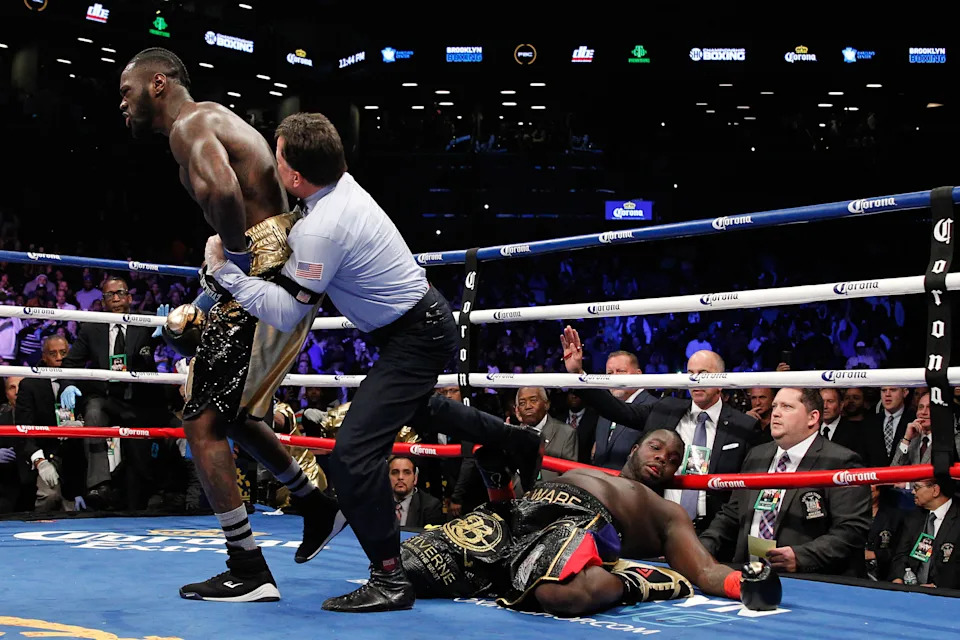
Bermane Stiverne (right) lasted less than a round in his 2017 rematch against Deontay Wilder.
(Icon Sportswire via Getty Images)
In Act 2, things got tougher for Wilder, like many predicted. As WBC champion, he was mixing now with a better caliber of opposition and this, as it should, begat great drama and difficulty. Against Luis Ortiz in 2018, for example, Wilder found himself losing rounds, plenty of them, before upending the Cuban with a scything right hand in Round 10, as he was apt to do.
Advertisement
Now, in spite of his flaws, Wilder was a man less targeted than feared. Now not only was he ending mismatches in devastating style, but he also had the ability to end fights in which he was struggling against opponents who seemed to have his measure. This meant that no fighter in the presence of Wilder could ever get comfortable or feel safe, irrespective of how well they were doing or how bad they were making him look. Any fight with Wilder was therefore one fraught with danger and perhaps even ill-advised. Who, after all, would actively chase a fight with a man so heavy-handed?
Until someone figured Wilder out, or stood up to him, the ground on which he walked was deemed something of a minefield. In fact, it was only Tyson Fury and his uniquely nimble feet who appeared capable of breaching Wilder’s territory and leaving unscathed. He did that the first time they met in 2018, when he rose from a heavy knockdown in Round 12 to draw with Wilder, before later marching Wilder down and punching through him, not once but twice, to show that, yes, it could be done.
If the Fury trilogy signaled the end of Act 2, it’s fair to say Act 3 has been the chronicle of Deontay Wilder’s fall from grace. In short: not so fun. There have been wins, three of them, but in none of those wins has Wilder looked anything like the intimidating, scary force of old. Even in the most Wilder-like win of Act 3, a first-round demolition of Robert Helenius in 2022, he contrived to undermine much of his good work when he revealed at the post-fight press conference the extent to which he had softened with experience.
Advertisement
“I always have concern for all fighters,” a tearful Wilder said that night in New York. “This is not a sport. A sport is something you play. You don’t play this. We risk our lives for you guys’ entertainment.”
That comment didn’t just explain Wilder’s state of mind, it also explained his form in a post-fun world. Indeed, after hearing him philosophize in this way, no longer was it a surprise to see him fail to pull the trigger against Joseph Parker in his next fight, nor a shock to see Zhilei Zhang welcome Wilder’s crude attacks in order to then counter with smart shots from his southpaw stance and stop him in five rounds in 2024.
It was obvious now. Wilder didn’t think the same as he used to and therefore didn’t fight the same as he used to. All he had left, as a former champion, was his punch power and his name; the latter to get fights, the former to give him a slim chance of winning them.
For Wilder, it was enough, at least to continue. His career couldn’t end on two defeats, he decided, so he vowed to ensure it didn’t. This led to a routine win against Tyrrell Herndon, a relative unknown, in 2025, followed by the win against Derek Chisora in a so-called “Last Dance” — for Chisora, that is — in April. That win, an ideal note on which to go out, didn’t just satisfy Wilder’s ego, it spurred him on. It opened doors to rooms the audience were begging him not to enter and it gave him a false sense of triumph and relevance. Back in the habit, Wilder now understood that for men of a certain age, winning and losing can often mean the same thing. One alerts you to the inevitable; the other merely prolongs it.
Advertisement
Yet, even if they know this, seldom will a fighter acknowledge it — the danger, the cycle, the hiding to nothing. After beating Chisora, for instance, Wilder proved again that for a boxer it is easier to offer advice to others than to act on their own: “I was telling him [Chisora] in the ring as I started seeing his eye and temple swell, ‘Bro, you’ve got to live for your kids. I don’t want to hurt you too much longer.’
“I started having fun in there because I saw my brother getting hurt. I saw him winking his eyes a little bit.
“That’s what boxing’s all about. Too many lives have been lost in this ring. When it’s over, nobody gives a damn about us. No matter what they say, nobody gives a f*** about us. So us fighters have to look out for each other. Tonight, I looked out for Derek. I didn’t want to go too hard on him. I want him to live for his kids.”
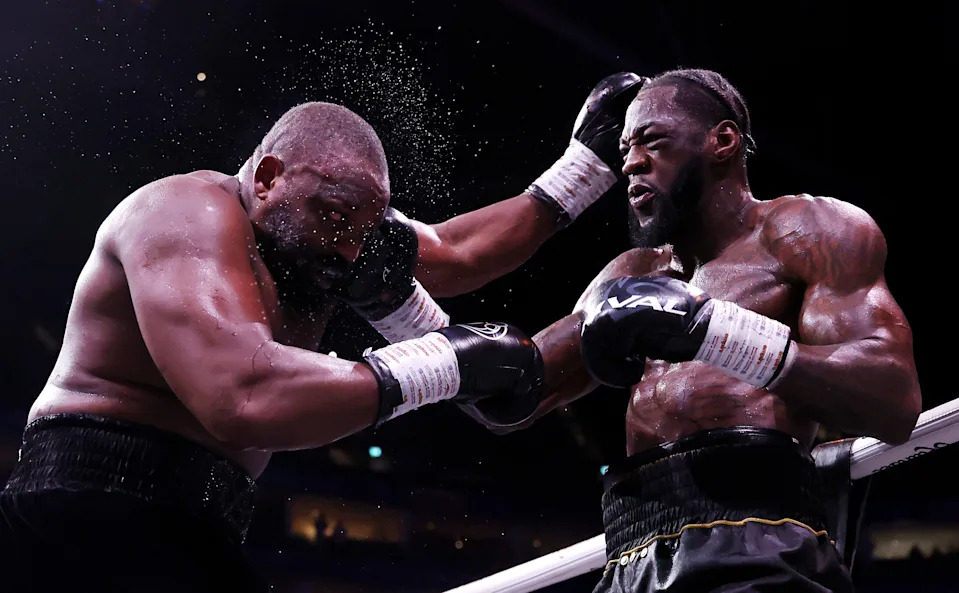
Deontay Wilder vs. Derek Chisora was a brutal heavyweight slugfest.
(Richard Pelham via Getty Images)
Of course, had this been a Hollywood film, the credits would have rolled that night, with Wilder back to having “fun”. But unfortunately, “fun” is a relative term — one that still equates to damage — and this is no film. It is instead boxing, where endings are never neat, or well-timed, and where most participants are bad actors unable to discern fiction from reality.
Advertisement
That’s possibly why Wilder, now 45-4-1 (43 KOs), saw that victory over Chisora as nothing more than the impetus to go in search of another one and keep punching. Sure enough, just as reality had begun to invade and influence his thinking, winning had given him a reason to dream. Or simply delay.
As for Usyk, both director and genie, he likely has a different kind of denouement in mind for Wilder. With his expert timing, he has targeted the American at the very point at which Wilder is most vulnerable and needy. He has seen a man as much endangered as enhanced by recent form and a man clearly desperate, only not in that same dangerous way of old. Rather, Usyk, 25-0 (16 KOs), now sees a man desperate to keep going, desperate to keep believing, and desperate to prove both history and the doubters wrong.
He sees not the “Bronze Bomber” when checking him out, but “One-wish” Wilder; a former heavyweight champion whose threat has diminished and whose future hinges on the generosity and perhaps cruelty of others. “Your wish,” Usyk might say this year, “is my command.”
Read the full article here