





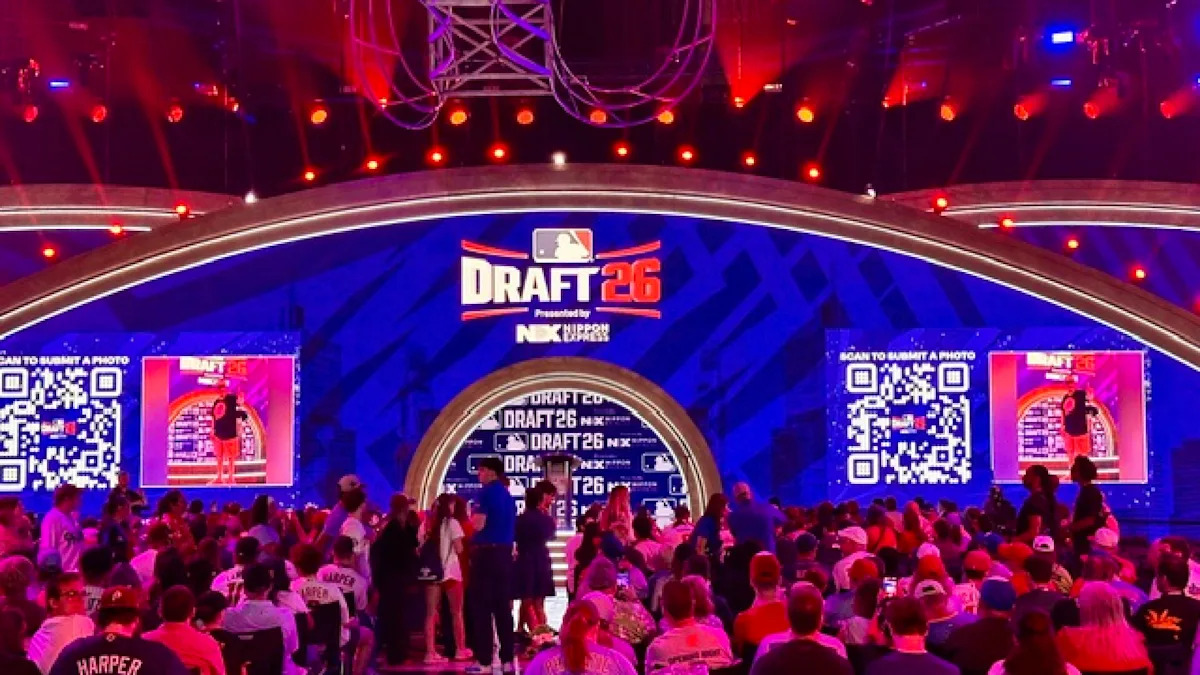
Just three days before the best players in Major League Baseball take the field for the 2026 MLB All-Star Game, the future stars got the spotlight at the 2026 MLB Draft.
The draft is now 20 rounds, spanning both Saturday and Sunday in Philadelphia. While Major League Baseball has proposed changes to the format and eligibility of the MLB Draft, right now, American high school players and college players who are three years removed from high school are eligible to be drafted. While the players drafted on Saturday in the first round of the MLB Draft may not have the name recognition of guys taken in the NBA or NFL Draft, they have every bit the chance to make a near-immediate impact on their organizations, as Chase Burns and Nick Kurtz did for the Reds and Athletics, respectively, about a year after being selected.
Advertisement
So who were the picks I was most impressed, confused, or intrigued by?
Fastballs: First-Round Picks We Loved
Roch Cholowsky – SS, Chicago White Sox (1st overall)
I know it feels silly to put the first overall pick here, but I think this is more about what the pick says about the White Sox’s frame of mind. There is a pretty compelling case that Grady Emerson (who eventually went second) has a higher ceiling than Cholowsky as a prospect. A high school senior, Emerson is farther along as a player at his age than Cholowsky was, and there aren’t many flaws in his game. However, Cholowsky, after three seasons at UCLA, is certainly closer to being MLB-ready. With the White Sox contending for a playoff spot in 2026, they opted to pick the player who was most likely to help them in the next two or three years. To me, that’s a vote of confidence not just in what the White Sox are building for the future but in what they have right now. I love that the White Sox are looking to be better now (or in 2027) and not just in the future.
Advertisement
Jackson Flora – SP, San Francisco Giants (4th overall)
The consensus best pitching prospect in the draft going to a team with glaring needs in the rotation is obviously something that we should support. Flora figures to rise through the minors quickly, and I talked with Jim Callis of MLB Pipeline this week about why Flora is the most advanced pitcher in the 2026 MLB Draft.
Gio Rojas – SP, Texas Rangers (16th overall)
Many people thought Rojas was the best high school pitcher in the draft, and MLB Pipeline had him as the 8th-ranked prospect in the draft, but he somehow fell to 16th. A lanky left-hander, Rojas can hit 98 mph with his four-seamer and has shown a slider that can consistently miss bats. His low arm slot and whippy delivery have led many people to compare him to Chris Sale, and there is a ton of talent in his arm. If he can improve his changeup to be a solid offering against righties, he has as high a ceiling as any starter in this draft.
Advertisement
Tegan Kuhns – SP, St. Louis Cardinals (32nd overall)
MLB Pipeline had Kuhns as the 25th-ranked prospect on their big board, but many scouts and pitching analysts I trust are much higher on him. He has an upper 90s four-seam fastball with elite vertical movement and extension. He obviously fell because his breaking balls are inconsistent, but he has shown the ability to throw his curveball for strikes, and more than a few people think he can develop a plus slider if he changes his grip. I liked this pick at this spot.
Hunter Dietz – SP, New York Yankees (35th overall)
In that same video above where I talked to Jim Callis about Jackson Flora, he mentioned that Dietz was being overlooked too much. He has a 95 mph four-seamer with top-tier vertical break and a strong bullet slider that ate up righties and lefties in college. He has a fine curveball, but I’d love to see him develop his changeup more. The Yankees have proven themselves to be a strong pitching development organization, so this is a great fit for Dietz.
Advertisement
Curveballs: First-Round Picks that Surprised Us
Derek Curiel – OF, Pittsburgh Pirates (5th overall)
The Curiel pick was the first real surprise of the draft, and not because he’s a bad player, but just because the selection felt a little high for a player who is more of a high-floor than high-ceiling pick. Many scouts seem to believe he has one of, if not the, best hit tools in the draft and is a solid defender in the outfield who can run a bit as well. The issue is that none of that is elite, and he doesn’t have the profile of a 20-home-run bat at the next level. There are no real flaws here, but how high is the ceiling? Then again, the last three players the Pirates selected with their first pick are Paul Skenes, Konnor Griffin, and Seth Hernandez, so it’s probably time to give them the benefit of the doubt.
Zion Rose – OF, Kansas City Royals (6th overall)
Much like with Curiel, Rose is a good player, so the surprise was more about the draft slot. MLB Pipeline had him as the 30th-best player in this draft, and there was not a lot of hype surrounding Rose as a top-ten pick before he hit .417 for Louisville this year. He is a physical hitter with advanced bat-to-ball skills, so there is certainly an intriguing offensive profile. However, he also tends to chase pitches outside of the zone, hits more groundballs than you’d like to see, and doesn’t have the profile of anything more than an average defender in left field.
Advertisement
Jake Schaffner – SS, Boston Red Sox (20th pick)
This was one of the bigger head-scratchers since Schaffner was ranked as the 75th overall prospect on the MLB Pipeline big board. There were some reports before the draft that the Red Sox were looking to draft underslot college players, so this would seem to fit that mold. He’s a lefty contact hitter who will spray line drives from gap to gap and fly down the line. He was among the NCAA leaders in triples and is a reliable infielder who will likely need to move to second base because of fringy arm strength. There are certainly valuable things that Schaffner brings to the table, but it was a surprise to see him selected this high
Cade Townsend – SP, Chicago Cubs (23rd overall)
Townsend was 35th on the MLB Pipeline big board, so this wasn’t a total surprise, but it did feel like some other pitchers may have been a better fit here. Townsend had a 3.94 ERA in 14 starts this year for Ole Miss and has a below-average four-seamer. He threw tons of sliders and cutters in college and may never have a four-seamer that can be relied on in the big leagues. There are certainly plenty of MLB pitchers who fit that same mold, but it’s a really risky one.
Advertisement
Splitters: First-Round Picks That are Exciting but Risky
Jacob Lombard – SS, Miami Marlins (14th overall)
The younger brother of Yankees’ prospect George Lombard Jr., Jacob Lombard was expected to be a top ten pick, and MLB Pipeline had him as a top-five player in this draft. Many people, including Jim Callis of MLB Pipeline, believe that Jacob has more raw power and speed than his brother and could potentially be a 30/30 threat at the next level. There are essentially no questions about his defense and power upside; however, depending on what scouting reports you read, there is some question about his contact profile against upper-level pitching. His swing can get steep, which means that he will swing and miss at elevated fastballs, something professional pitchers will continuously challenge him with.
Justin Lebron – SS, Cincinnati Reds (18th pick)
Lebron was the 9th-ranked prospect on MLB Pipeline’s Big Board, so slipping to 18 was a bit of a surprise. He has plus raw power, good speed, and a high ceiling as a defender. Overall, his upside is perhaps as high as any player in this draft. However, he hit just .277 this season at Alabama, which is not what you usually see from top prospects. He will often chase pitches outside of the zone and has struggled against really good breaking pitches, which is why he hit just .229 in SEC games this season. That questionable hit tool makes him a prospect with one of the bigger ranges of outcomes in this year’s draft.
Advertisement
Liam Peterson – SP, Cleveland Guardians (19th)
Peterson was a two-way player in high school before going to the University of Florida and becoming a pitcher-only. In terms of pure stuff, he’s up there with any pitcher in this draft. Standing 6’5,” Peterson can run it up to 98-99 mph on his four-seamer and has a plus slider for two-strike counts. Some scouts think the shape of his curve will make that pitch his best secondary. However, command has been a bit of an issue in the past and will need to be addressed if Peterson is going to make good on his potential.
Carson Wiggins – SP, New York Mets (27th overall)
Wiggins was the 88th-ranked prospect on MLB Pipeline’s big board, so, in that sense, this was one of the biggest reaches in the first round. The Arkansas product has a triple-digit fastball and a plus slider. However, he also suffered an elbow injury that forced him to have internal brace surgery and miss the entire 2026 season. He threw some bullpens before the draft and clearly impressed the Mets, but he remains a huge question mark coming off the surgery and limited college innings.
Read the full article here