





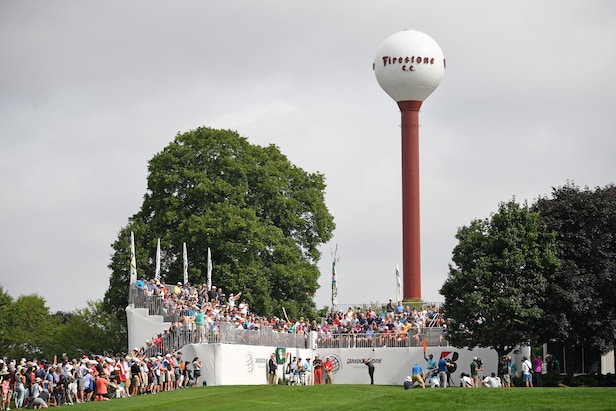
AKRON, Ohio — There are only so many ways to express disappointment, regret or sympathy—subtly different emotions triggered by a loss that is at once significant and yet wholly routine in the business of sports overall and the paradigm shifts in professional golf. An era ends this week at a golf institution whose fame long ago outgrew this midwestern city of fading industrial might.
Firestone Country Club, founded by the man whose company became the global hub for tire manufacturing, has hosted a professional golf tournament since 1954. Some years it hosted more than one, and in 1974 it was the site of three televised golf events, which has never happened before or since. When the PGA Tour was created in 1968 in its split from the PGA of America, tour representatives had the option of retaining the Ryder Cup or the World Series of Golf at Firestone’s vaunted South Course. It chose the latter, eschewing the cash-draining biennial match-play exhibition in favor of a popular televised event with cache and potential anchored at an iconic venue.
Advertisement
So it’s with considerable irony that the tour is pulling up stakes after 72 years. This week’s Kaulig Companies Championship, a “major” event on the PGA Tour Champions that is more commonly known as the Senior Players Championship, will be the swan song for professional golf at Firestone, at least for the foreseeable future. The club doesn’t want to see its run end. But other constituencies are no longer dedicated to a tradition that once was so strong that a permanent media center and interview room were constructed on property.
The tour announced on May 26 that it is moving the event next year to Newport Beach Country Club in California, which since 1995 has hosted a popular PGA Tour Champions event now known as the Hoag Classic. The event will be renamed the Hoag Senior Players Championship, restoring its original identity. By coincidence, Newport Beach recently was in the news when a riot erupted and resulted in more than 400 arrests after thousands of teenagers and young adults blocked streets and looted stores.
“It’s a real shame that we’re leaving here,” said Davis Love III, who returns to Firestone for the first time since 2022. “I can’t believe it’s going away when you think of how many years the tour has played here and what’s happened at Firestone. It’s too bad.”
It’s more than too bad. The operative word is sad, conjured repeatedly. “Yeah, it is sad that it’s going to go off the calendar, at least for now,” said Stewart Cink, who won the WGC-Bridgestone Invitational on the South Course in 2004. “We don’t know about the future, but for now it’s going off. Yeah, it’s been a part of the game for a long, long time. I know walking through that clubhouse you see all the old newspaper articles about winners from way back from before our times. It’s cool. Not many places can boast that kind of pedigree. And the golf course is so great and fun to play. Everybody knows it so well. It’s hallowed ground in our game.”
515030150
Gary Player, Arnold Palmer and Jack Nicklaus walk at Firestone during a practice round in 1962.
Advertisement
Bettmann
Firestone is the place where Jack Nicklaus played in his first tour event, the 1958 Rubber City Open, and went on to win there seven times, including the 1975 PGA Championship. It’s where Arnold Palmer won three times and personally christened the outstretched par-5 16th hole on the South Course as “The Monster.” And it’s the place that Tiger Woods practically made his own by winning there eight times in a 14-year span and, of course, drawing enormous and raucous crowds that are but an echo today.
• • •
Entrepreneur and businessman Harvey S. Firestone, an Ohio native who counted Henry Ford and Thomas Edison among his closest friends, commissioned the purchase of land for the club in 1924, and the first of its three courses, the South Course designed by English professional Bert Way, opened in 1929. The club was built exclusively for Firestone employees, and in the beginning the property was essentially a large park that included gardens and a skeet shooting range that eventually gave way to the North Course.
Advertisement
The 1954 Rubber City Open at Firestone actually was the fourth edition of the tournament that previously was contested mostly among members of the Akron Golf Professionals Association. Among the founders of the event was Denny Shute, the head professional at nearby Portage Country Club who won consecutive PGA Championship titles in 1936-37 and also captured the 1933 Open Championship. The tournament moved from now-defunct Breathnach Country Club to Firestone when it was added to the national PGA schedule in ’54.
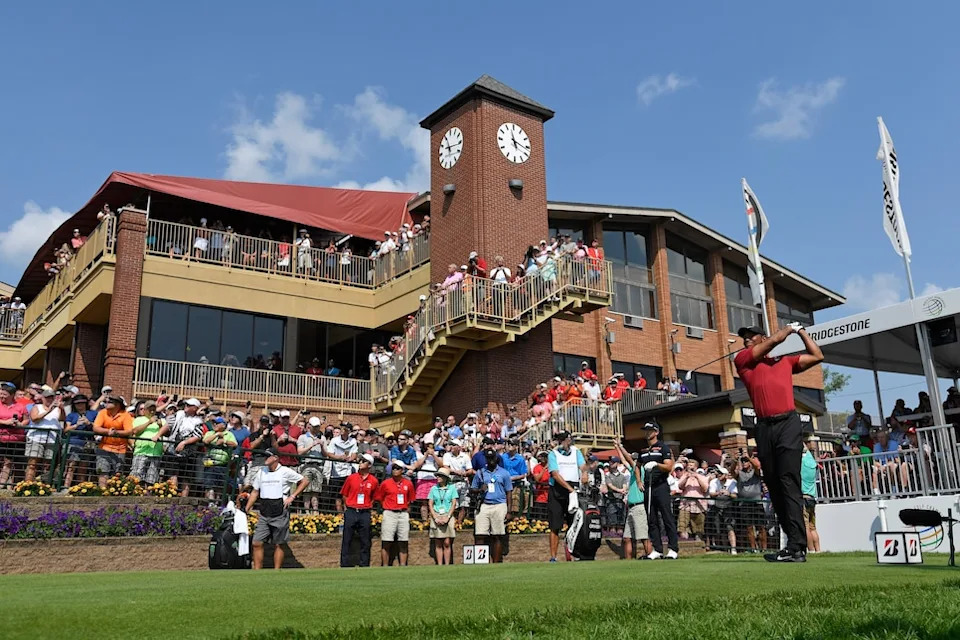
1011677748
Tiger Woods tees off on the first hole during the final round of the 2018 WGC-Bridgestone Invitational at Firestone.
Chris Condon
Advertisement
Thus began Firestone’s long association with the tour. The Rubber City Open only ran until 1959 before Robert Trent Jones redesigned the South Course for the 1960 PGA Championship, toughening the layout to 7,165 yards and creating the now-famed 16th hole where Palmer’s hopes of a third major that year were dashed when he suffered a triple bogey in the third round. Jay Hebert won it while Arnie finished five shots back.
The PGA returned twice more in 1966 and ’75, won, respectively, by Al Geiberger and Nicklaus. Through the years, Firestone has played host to the World Series of Golf, which began as an unofficial event featuring the winners of the four major championships then became a regular tour event in 1976, the American Golf Classic and the made-for-TV CBS Golf Classic, before welcoming one of the four World Golf Championships created in 1999, the Bridgestone Invitational.
After the 2018 edition, won by Justin Thomas, the WGC event was moved to TPC Southwind in Memphis in deference to FedEx, which has underwritten the lucrative FedEx Cup since 2007. But Firestone’s streak remained intact when the Senior Players moved in. Likewise, the streak was saved in 2002 when the South Course hosted the Senior PGA Championship when the tour took the WGC event to Sahalee Country Club in Washington for one year—after which players voiced their preference for Firestone.
There could not have been a better endorsement.
Advertisement
“The sentiment that I remember hearing when I first started playing here … was that if for whatever reason if the PGA Championship or the U.S. Open needed a flash quick venue, this place would be ready in 48 hours. I think that’s very accurate,” said Zach Johnson, returning to Firestone for the first time since 2017. “It is a major championship-style golf course. The integrity of this place has not wavered one bit.”
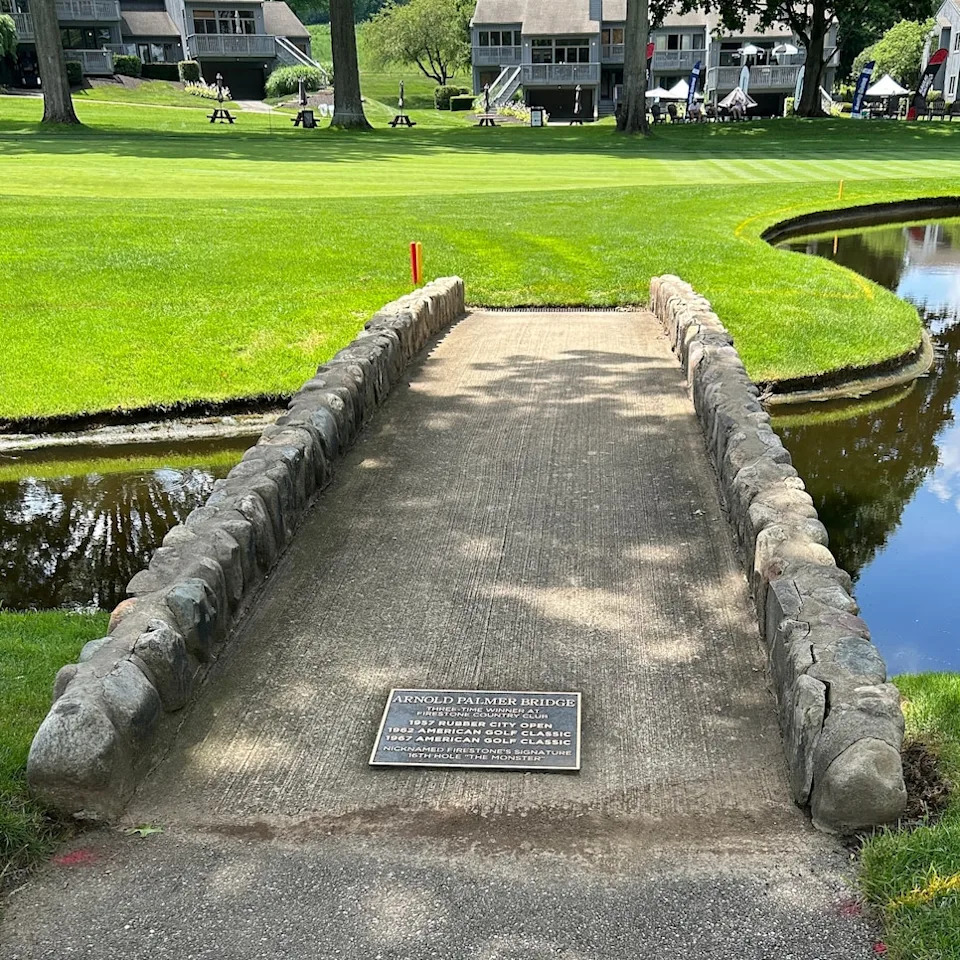
/content/dam/images/golfdigest/fullset/firestone-arnie-bridge.jpeg
A plaque honoring Arnold Palmer’s accomplishments at Firestone adorns the bridge on the 16th hole, which Palmer dubbed “The Monster.”
“Firestone is an institution in professional golf,” said Roger Maltbie, who won the 1985 World Series of Golf on the South Course, the last of his five PGA Tour titles. “Whatever the reasons are for the tour leaving, you won’t find a better test of golf in terms of just straight up asking you to knuckle down on every golf shot.”
Advertisement
And you likely won’t find anyone with even a passing knowledge of golf who sees the iconic water tower that hovers over the brick clubhouse on their television screen and doesn’t recognize it and know where the tour is playing. Because it has hosted multiple events over a number of years, it is believed that no club has appeared on television more than Firestone. This week’s Kaulig Companies Championship will be the 96th tournament here.
“I don’t think Corey Pavin is going to remember this, but I was in fourth or fifth grade, and I was at the World Series of Golf, and he gave me a bunker lesson,” said Ryan Armour, an Akron native, who this week is playing his first professional event at Firestone after receiving a sponsor’s exemption. “It’s been pretty cool to grow up and be at the World Series of Golf. Firestone has history, and I really hope the Akron community and northeast Ohio can come through and make sure professional golf’s there.”
• • •
Where the, um, rubber meets the road hastening the tour’s departure from Firestone is how much air has gone out of the public support. There is no need to cite attendance figures when anyone with two eyes and 10 fingers can figure out that senior golf hasn’t had the same drawing power that PGA Tour players enjoyed—even though many players in this week’s field competed in World Series and WGC events. Obvious proof of crowd scarcity was the elimination a few years ago of grandstands around the 18th green that were full during the halcyon years when Woods was showing up annually and winning almost as often.
Advertisement
“I remember last year I was in contention on Saturday playing in the second- or third-to-last group coming down 16 and 18, and it was empty, and I’m thinking, ‘This is on TV and just looks really bad,’” Steve Flesch said.
One tour player said he walked into an area restaurant last year and was recognized by a couple of customers who wondered what he was doing in town. “They didn’t know the tournament was going on. That’s how bad the promotion had gotten.”
Within the walls of the clubhouse, perception is different. The 1,000-plus members remain all in with their support of a tournament. Any tournament. Leadership currently is exploring all avenues, including a potential LPGA event.
“You ask any member, and they would say they want a tournament here,” said Dick Robbins, who has been a Firestone member since he was eight, got his first job at the club when he was 15 and now serves as director of member services as well as club historian. “This news does not sit well. We’re very disappointed. It’s been 72 consecutive years of professional golf, great golf, and it’s difficult thinking that it’s not going to continue. It was sad saying goodbye to those [regular tour] players in 2018, and I was telling Mike Weir yesterday that this is going to be a lot worse.”
Advertisement
The news of the “firing” of Firestone came at a time when PGA Tour CEO Brian Rolapp has undertaken the process—with the help of Woods and others—of reconstructing its competitive model and schedule. Dominoes will fall. And already have fallen. The Rocket Classic in Detroit is in its final year. The tour has eliminated both stops in Hawaii, the Sentry and the longer-running Sony Open in Hawaii, that began in 1928 as the Hawaiian Open and has been permanently on the schedule since 1971 at Waialae Country Club in Honolulu. (Sony will sponsor a senior event at Waialae beginning next year.)
In the wider world of golf, moving the Senior Players to California means little. But abandoning Firestone has real-world consequences in Summit County and the surrounding area.
“We learned the news and immediately thought about how do we continue to put $2.2 million into our community every year,” said Danielle Robertson Thompson, executive director of the Northern Ohio Golf Charities Foundation, which benefits not only from events at Firestone, but also its Ambassador of Golf program, which this year honors John Daly. “This directly impacts every nonprofit organization in Northeast Ohio. It’s a huge, huge loss.”
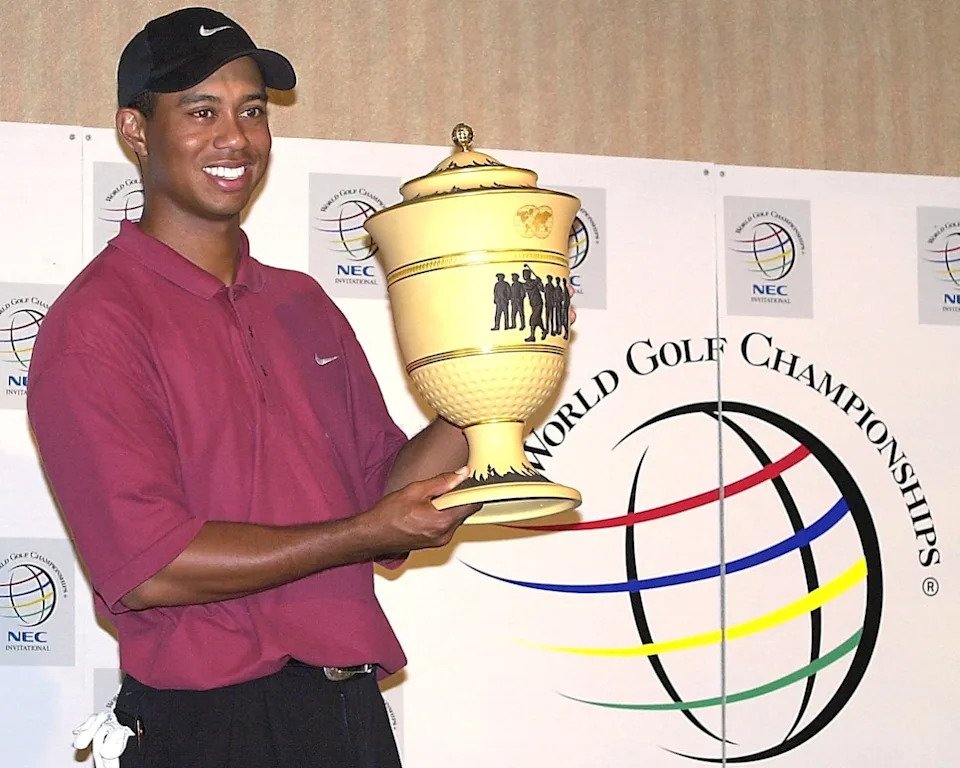
1180080936
Tiger Woods holds the trophy after winning the 2021 WGC-NEC Invitational.
Advertisement
DAVID MAXWELL
Finger pointing has ensued as to who delivered the death blow. Matt Kaulig, the executive chairman of the Kaulig companies, pinned the blame on the tour in a May 29 Akron Beacon Journal story. “We don’t want to see it go away,” he was quoted as saying. “I think it’s a big deal for Akron.” Kaulig added that the decision was “100 percent the PGA just really moving the tournament.”
Miller Brady, president of PGA Tour Champions, countered that, “We’re being painted as the bad guy here, but that’s not really fair. If Kaulig Companies had renewed its sponsorship, we would not be leaving Firestone, and we’d be focusing on the future and trying to make it better.”
Kaulig Companies declined an extension two years ago that would have kept the tournament at Firestone through at least 2028 or later. Kaulig representatives did not respond to phone call and email requests for comment.
Advertisement
“What does it take to have a successful tournament? It takes a great golf course, which Firestone has,” Brady continued. “It takes a title sponsor. And it takes community support. This event is just not being supported by the community, whether it’s corporate support or spectators, promotional awareness. If we have a major tournament, you want a buzz and players to feel appreciated. I mean, this is a head-scratcher. The combination of the title sponsor not renewing and the lack of community support really caused us to take a hard look at what we are doing with this tournament.”
“It’s kind of a sign of the times,” Cink said. “It just hasn’t really been a successful market for us. We just have struggled there, trying to give the tournament life. It’s just a business thing, unfortunately.”
“It’s a major championship. We need the crowds. We know on the Champions Tour, if we go to the right market, we get quite big crowds,” said Padraig Harrington, who after winning the U.S. Senior Open on Sunday in Columbus opted to play in the Scottish Open rather than venture 120 miles north to the Kaulig. “Players want to play in front of the crowds. It’s going to where Hoag was, Newport Beach. They already get big crowds. It’s a festival week. At Firestone we just weren’t getting the big crowds, which is unfortunate because it is a great golf course. But if you want to call it a major, it needs to have people turning up. The players are disappointed, yes, but it’s circumstantial.”
When the final putt drops on Sunday, there will be no final farewell gesture by the club or tournament officials, no moment of reflection. No fanfare. It will simply end. David Utlak, the interim tournament director, confirmed that there is “nothing specific planned. We’re focused on just making it the best event possible. So that’s kind of how we’re looking at it is just not a specific ceremony, but just a week-long celebration of the event.”
Advertisement
Which is nice but misses a larger point. Golf at Firestone never has been about celebrating one event but celebrating the game, embracing it, enjoying the greats of the sport marching through to leave their imprint, create a memory. It has been a mainstay in the professional game—a symbol of the game’s traditions as opposed to a tradition in and of itself. It has marked the time as well as any golf course in America.
Traditions die hard. But some just die.
Read the full article here