






The Calgary Flames have completed a single trade on the American Independence Day holiday, swapping future Hall of Fame defensemen on July 4, 1994.
In arguably one of the biggest blockbuster trades of the decade, the Flames dealt former Conn Smythe Trophy winner Al MacInnis to the St. Louis Blues in exchange for Phil Housley, who is the highest scoring American-born defender of all-time.
Advertisement
Here’s a deep dive into one of the trades to alter the trajectories of both franchises.
As the 15th overall pick in the 1981 Draft, MacInnis debuted in the 1981-82 campaign and, by 1983, was an NHL regular. By 1986, he was getting votes for the Norris Trophy as the league’s best defenseman, finishing third in 1989 and was runner-up in 1990 and 1991.
Soon, MacInnis, who had a fierce slap shot that often clocked in at 90 to 100 mph, became a 20-goal scorer and routinely collected over 70 points a year starting in 1986. That was also the same year Calgary reached the Stanley Cup Final for the first time in franchise history. He finished as the playoff leader with 15 assists, while collecting 19 points in 21 games and a plus-10 rating, although the Flames lost to the Montreal Canadiens in five games.
When the two met again in a rematch in the 1989 Stanley Cup Final, MacInnis led all players with 24 assists and 31 points to earn the Conn Smythe Trophy as MVP.
Advertisement
Two years later, in 1990-91, MacInnis put together his greatest statistical season, with 28 goals, 75 assists, and 103 points, although he finished third in Norris Trophy voting. Immediately following that amazing campaign, he dipped down to 77 points, and in his final season with the Flames, he had 28 goals and 82 points in 74 games.
In 1994, the Blues signed MacInnis to an offer sheet for an extra million dollars more than the Flames had offered him. Considering Calgary hadn’t advanced past the first round since their championship victory, it was time for a change, which led to MacInnis departing the club, where he remains the highest scoring defenseman with 822 points in 803 games.
Housley Quietly Builds Hall of Fame Career
Meanwhile, in Buffalo, Housley was the club’s top pick in the 1982 Draft, getting selected sixth overall. He’d debut later that season, and unlike MacInnis, would make an immediate impact, finishing second in Calder Trophy voting, while earning All-Rookie Honors. In his second season, 1983-84, he scored a career-high 31 goals in 75 games.
Advertisement
Over eight years with the Sabres, Housley collected 558 points in 608 games thanks to 178 goals and 380 assists. He was a top-10 finalist for the Norris Trophy five times. On June 16, 1990, Buffalo acquired future Hall of Famer Dale Hawerchuk from the Winnipeg Jets in exchange for Housley, Scott Arniel, and Jeff Parker. Moreover, the two draft picks included in the deal would turn into Keith Tkachuk (Winnipeg) and Brad May (Buffalo).
© James Guillory-Imagn Images
Housley would play three seasons in Winnipeg, collecting another 64 goals and 259 points in just 232 games. In 1992-93, he recorded a career-high 97 points in 80 games, with a personal best 79 assists.
Shortly after a great campaign, the Jets traded Housley to the Blues for Nelson Emerson and Stephane Quintal. Unfortunately, his only season in St. Louis was cut short because of a back injury, as he finished with just 22 points in 26 games. When MacInnis signed his offer sheet, Housley came to Calgary.
Advertisement
From 1994 until he retired in 2004, MacInnis patrolled the blueline in St. Louis, finally winning the Norris Trophy in 1999. In addition, he helped the Blues qualify for the playoffs in nine seasons, just missing the cut in his final year, 2003-04. Despite never skating in the Stanley Cup Final again, MacInnis came close in 1997, losing to the eventual champion, the Detroit Red Wings, in Game 7 of the Western Conference Final.
© Scott Rovak-Imagn Images
In 613 games, he would score 127 goals and 452 points to finish his legendary career with 1,274 points in 1,416 games. MacInnis played in 12 All-Star Games and named to the NHL’s post-season All-Star teams on seven occasions. As a member of the league’s 100th Anniversary Team, he would enter the Hockey Hall of Fame in 2007.
Advertisement
Meanwhile, Housley’s path to hockey immortality took many detours. He played a season and a half with the Flames before a deal sent him to the New Jersey Devils on Feb. 26, 1996. He stayed there for 22 games before signing with the Washington Capitals and eventually playing in the 1998 Stanley Cup Final, which the Red Wings swept.
Following that defeat, Housley came back to Calgary as a waiver pickup, where he played from 1998 to 2001 before the Chicago Blackhawks picked him up on waivers. Two years later, they would deal him to the Toronto Maple Leafs, where he dressed for one regular-season game and three playoff games before retiring.
When Housley hung up his skates, he was the highest-scoring American-born player of all time with 1,232 points in 1,495 games, thanks to 338 goals and 894 assists. Since his retirement, his totals have been surpassed only by Patrick Kane (1,400), Brett Hull (1,391), and Mike Modano (1,374).
What About the Draft Picks?
The deal between the Flames and Blues included two draft picks, a second-round pick in 1996 and 1997, which Calgary used to select Steve Begin and John Tripp. As the 40th overall pick, Begin would have a 13-year NHL career, including six with the Flames, who tallied 56 goals and 108 points in 524 games.
Advertisement
Initially drafted by the Colorado Avalanche at the 1995 Draft, Tripp re-entered the draft, where the Flames took him 42nd overall in 1997. He never dressed for the club; instead, he made his NHL debut with the New York Rangers and later suited up for the Los Angeles Kings. In 43 games, he scored two goals and nine points.
Historical Perspective
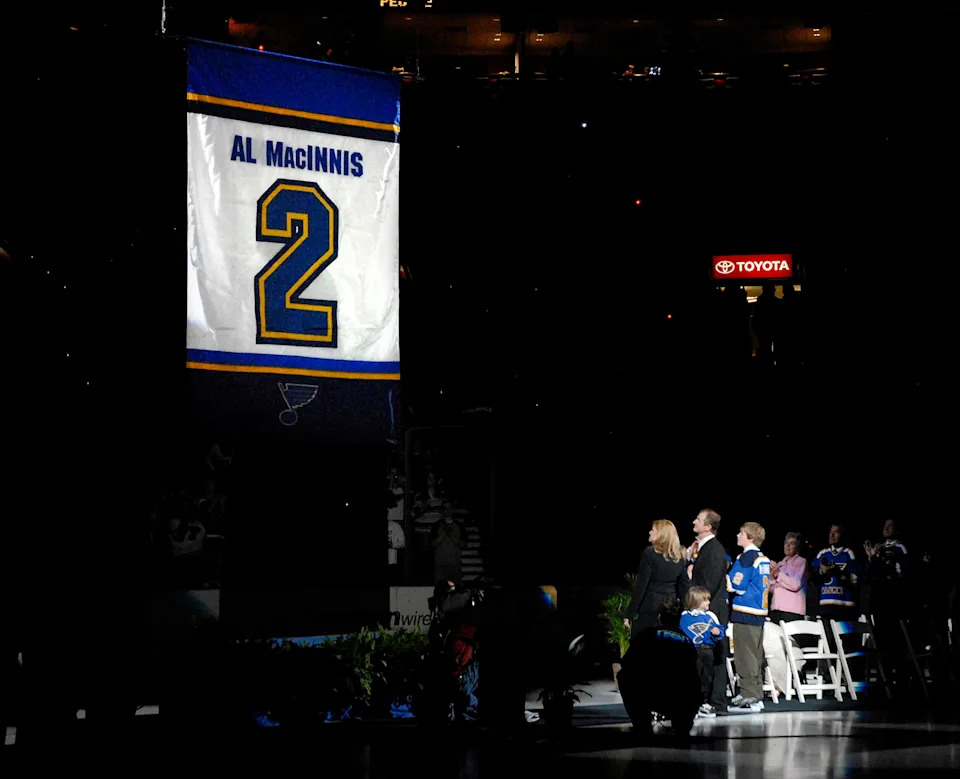
It goes without saying that the MacInnis for Housley trade is one of the most memorable trades in both franchises’ history. Although Housley didn’t have the same impact in Calgary as MacInnis did, it goes without saying that his two stints with the Flames had a significant impact on his path to the Hall of Fame. Meanwhile, in St. Louis, MacInnis carved out an untouched legacy that led to his jersey retirement in 2006.
Read the full article here