






Mexico’s Estadio Azteca has long been one of soccer’s most intimidating venues. On Sunday, unbeaten Mexico will try to use that home-field advantage — and the altitude of Mexico City — to end England’s World Cup run.
Sitting 7,220 feet (2,240m) above sea level in Mexico’s capital city, the 87,523 capacity stadium holds a mythical presence among soccer fans. England arrives Friday, just two days before kickoff, hoping to adjust to the thin air, a hostile crowd and an opponent yet to concede a goal at the World Cup.
Advertisement
The stadium is also steeped in English soccer folklore.
It was here, of course, where Argentina’s Diego Maradona punched the ball past England goalkeeper Peter Shilton at Mexico ’86, before dancing his way through their entire team to double their lead, eventually advancing as 2-1 winners.
The “Hand of God” and the “Goal of the Century” — separated by just four minutes — have been lasered into the memories of English soccer fans, even those who were born in subsequent decades after, all still scarred by memories of their parents, grandparents and thousands of YouTube highlights at the press of their thumbs.
England hasn’t played at the Azteca since that 1986 World Cup, when a 3-0 victory over Paraguay in the Round of 16 preceded Maradona’s unforgettable quarterfinal masterpiece four days later.
Advertisement
“It was not only English people,” Thomas Tuchel explained, remembering watching Mexico ’86 as a 12-year-old boy in Germany. “Even me. I didn’t have a connection to English football in those days but even I know this moment. I remember, of course, the World Cup of Maradona. The two goals against England. The one dribbling and the one … yeah, which would never stand these days.”
(Joseph Raines/Yahoo Sports)
This return to the Azteca has been in English plans since the World Cup schedule was announced. Winning Group L was considered the bare minimum for Tuchel. His reward following a 2-1 win over DR Congo? A Round of 16 showdown with the co-hosts.
“It will reward us,” Tuchel said, smiling mischievously. “We will get it back. Karma will come back for us. We will turn it around.”
Advertisement
Tuchel is clever and experienced enough not to believe in fate, karma and buzzwords alike when it comes to soccer. His press conferences since becoming England manager have been charming and wholesome; England fans are still experiencing the honeymoon period of his management style. He gets you on his side without needing to overload you too much in terms of detail and preparation.
That’s his and his team’s job behind the scenes, and they have their work cut out preparing for a match on Sunday that will test the physiology and psychology of his squad to the maximum.
England altered their travel plans, arriving in Mexico City two days before kickoff rather than the day before, as they have done throughout the tournament.
Under FIFA regulations, teams must be in the host city at least one day before a match, although they are permitted to arrive earlier if they wish. England’s Football Association believe the extra time could prove valuable given the unique challenge posed by the venue.
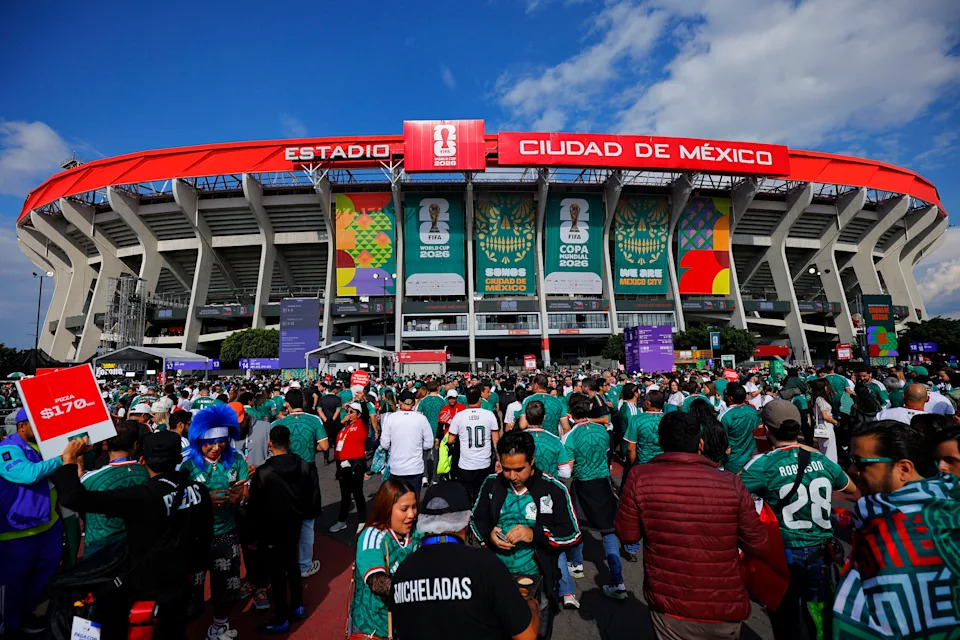
Azteca Stadium awaits England for a clash vs. Mexico on Sunday.
(Jam Media via Getty Images)
The Azteca falls within FIFA’s moderate-altitude category, where the thinner air can affect both physical performance and the flight of the ball.
Advertisement
Tuchel admitted there is no perfect solution.
“We will go one night earlier. It makes sense. The ball will fly differently. It will fly maybe 5 yards more. We just need the experience,” he explained.
Tuchel added that sports science generally recommends either arriving around 10 days in advance to fully acclimatize or as close to kickoff as possible to minimize the effects of altitude.
“The recommendation is you either go 10 days before — which is too long for us — or last minute, which is not allowed,” he said. “We have spoken to teams who do it and they say they travel very, very late on match day if they don’t have time to adapt. We have to find a mixture in between. It will be a disadvantage.”
Advertisement
The challenge extends well beyond the altitude.
Mexico has been perfect so far at the World Cup, winning four, scoring eight and conceding zero. El Tri also own an impeccable home record inside the Azteca — 70 wins from 89 games, with 17 draws and only two defeats.
The “disadvantage” Tuchel paints, however, is supported by scientific research. A 2007 study of more than 1,400 South American soccer matches found that when teams were based at similar altitudes, the home side won around 53% of the time. As the altitude gap between the teams increased, so too did the home-field advantage, with higher-altitude teams winning up to 82.5% of matches in the most extreme cases.
Advertisement
The researchers also estimated that every 3,281 feet (1,000m) of altitude was worth roughly half a goal to the higher-altitude home team on average — a reminder of the challenge England faces in Mexico City.
Despite this big home advantage, the betting lines are remarkably tight. England sits as the -125 favorite to advance into the quarterfinals at the time of writing, with Mexico the +120 dog.
England’s preparation in the run-up to this World Cup was focused mainly on adapting to the heat — rather than altitude — that was expected across the tournament. But with two matches contested inside air-conditioned stadia and two played in the familiar drizzling rain of Boston and New Jersey, the impact of harsh foreign weather hasn’t yet been discovered in active competition.
Sunday will change that, and Tuchel’s ability as a reactive and intuitive coach has the chance to bear the biggest of fruits as England head into the relative unknown.
Advertisement
With injury concerns at right-back, a switch to a 3-4-3 formation — one that saw him reap success at Chelsea — could be in the cards at some point during the scheduled 90 minutes of play. A slower, less intense game will better suit the lungs of the traveling away side. Pressing will be harder. Recoveries will take longer. Tuchel’s Premier League blueprint simply won’t be possible through the entirety of the fixture.
Soccer is life in Mexico. You can’t walk the streets without seeing a man, child or duck donned in the green of the national jersey and good luck trying to find a spot in a bar when El Tri take to the field. Thus, England’s task on Sunday is possibly edging into the realms of future folklore.
Advertisement
“Remember when we all watched England play Mexico inside the Azteca?” me and my England-supporting friends will hopefully say in 20 years’ time, half-laughing, half-exaggerating the details while our kids, nieces and nephews nod along as if they remember it themselves.
A shared moment that, in hindsight, will probably feel bigger than it did at the time — the kind of game that blurs into nostalgia; where the occasion somehow only grows in stature with every retelling.
Since England’s Italia ’90 semifinal heartbreak, the Three Lions have won just six knockout matches at World Cups.
Wins over Denmark (2002), Ecuador (2006), Sweden and Colombia (2018), Senegal (2022) and DR Congo on Wednesday will all be eclipsed if Tuchel’s squad is able to beat Mexico inside the Azteca, in what can only be described as a “bucket list” fixture.
But my word, it’s the tallest of tall orders.
Read the full article here