





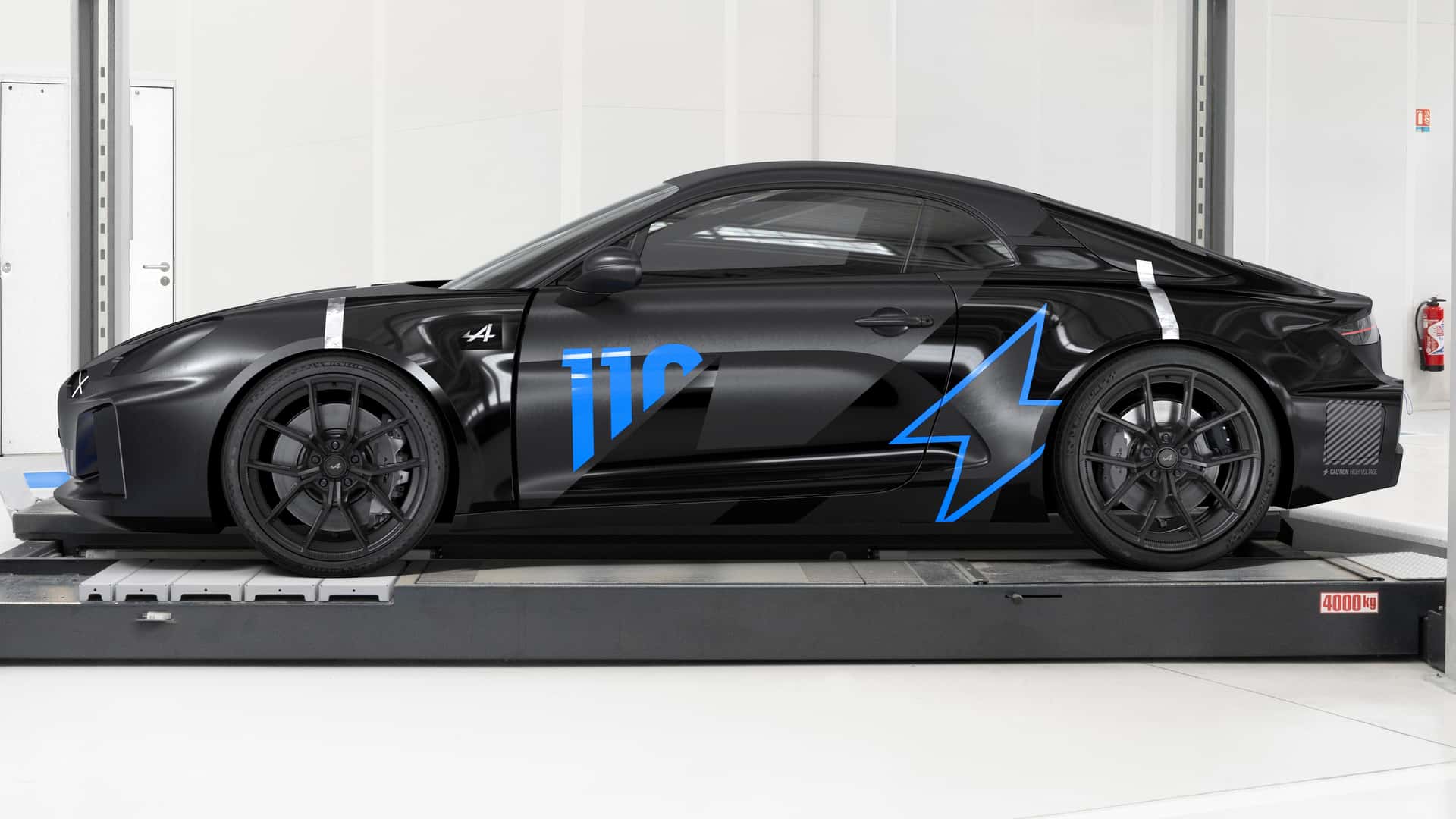
- The A110 Future is a development mule for an electric sports car.
- It has a rear-wheel-drive layout with a pair of electric motors and a split battery.
- Alpine is bringing it to the 2026 Goodwood Festival of Speed next week.
35,450. That’s how many A110s have been built since the original model launched in 1969. Most belong to the second generation, which debuted in 2017 and rolled off the assembly line for the final time a few days ago when the 28,701st car was completed in Dieppe. As the saying goes, out with the old and in with the new. Renault’s performance arm is already previewing the third-generation model, though it won’t be a direct successor.
Currently known as the A110 Future, the development car is essentially a test mule. Gone is the turbocharged 1.8-liter gasoline engine mounted behind the seats. Alpine is replacing the four-cylinder engine, which traces its roots to the Megane RS hot hatch, with a dual-motor setup while keeping the rear-wheel-drive layout. Mind you, this is far more than just an electric conversion of the old car. It’s an all-new development based on the Alpine Performance Platform (APP).
It already looks familiar because development prototypes are usually a mishmash of old and new parts. However, the top view clearly shows much wider wheel arches, so expect beefier front and rear axles. Underneath the skin are two rear-mounted battery packs arranged in a split layout to achieve a 40:60 weight distribution. While Alpine doesn’t address the elephant in the room, weight, there are reasons to be optimistic.
Photo by: Alpine
The battery uses high-energy-density cells, so the pack shouldn’t be excessively heavy. However, it’s highly unlikely the new A110 will come anywhere close to the remarkably low curb weight of its predecessor: 1,102 kilograms (2,430 pounds). Even though it will inevitably be heavier, that isn’t stopping Alpine from hyping up the next A110.
We’re told it will be the “world’s first true EV sports car” and that it will have what it takes to “outperform the best of today’s combustion sports cars.” The pair of electric motors we mentioned earlier is claimed to deliver “exceptional torque and performance.”
Since it’s still early days for the next-generation A110, Alpine is staying tight-lipped about most of the technical specifications. However, it does say the performance EV has a fully aluminum suspension to keep weight in check. For the same reason, the platform is aluminum-intensive, and the battery uses a cell-to-pack design in which the cells are integrated directly into a single large pack.
It’s also getting a silicon carbide (SiC) inverter for greater efficiency and higher power density in a lighter package. Alpine has also confirmed an 800-volt electrical architecture, which should enable ultra-fast charging. While the A110 will remain strictly a two-seater like its predecessors, there are already plans for a larger 2+2 model that will revive the A310 nameplate, last used in 1984.
Following its public debut at the Goodwood Festival of Speed next week, the reinvented A110 will launch in 2027.

5
Source: Alpine
Motor1’s Take: Alpine makes some bold claims about the A110, especially the part about outperforming combustion-engine sports cars. That may well be true, but enthusiasts would likely prefer a slower, lighter sports car with a gasoline engine and all the drama that comes with it. While the old turbocharged 1.8-liter engine wasn’t exactly a benchmark, the previous A110 was remarkably lightweight. We’re probably not going to be able to say the same about the upcoming EV.
Alpine isn’t the only company working on an electric sports car. Porsche is still determined to bring the 718 Boxster and Cayman EVs to market. At the same time, Caterham continues to develop its promising Project V concept, targeting an astonishingly low curb weight of just 1,190 kilograms (2,623 pounds).
Read the full article here