





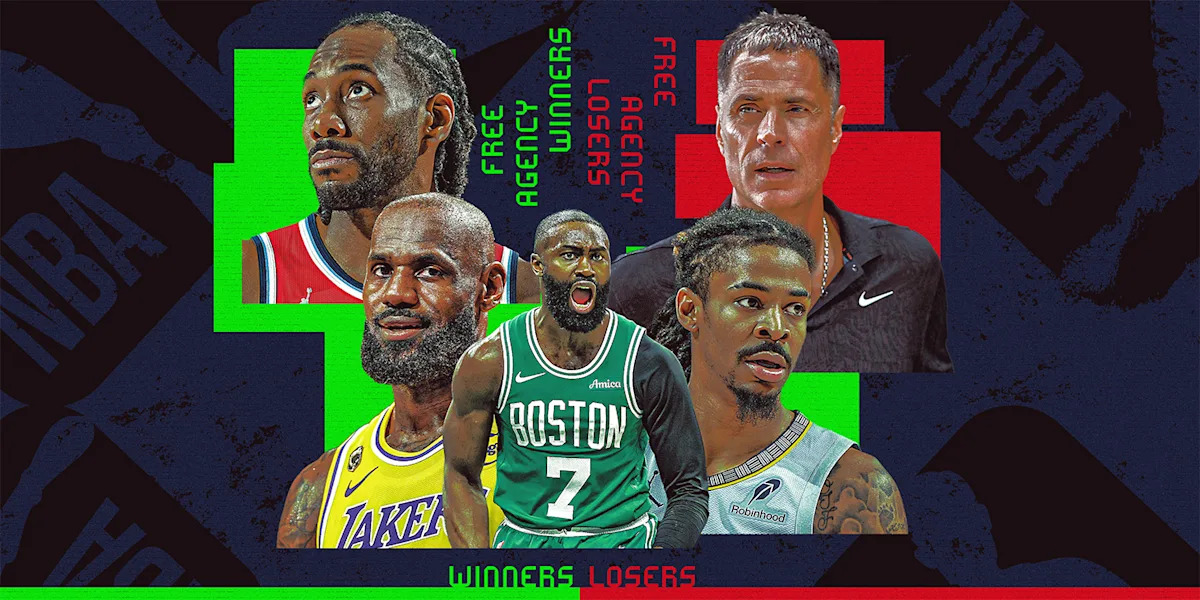
We are approaching 48 hours into 2026 NBA free agency, and a lot has happened.
Kawhi Leonard is a Toronto Raptor again. LeBron James is no longer a Los Angeles Laker. Giannis Antetokounmpo is on the Miami Heat. Jaylen Brown is no longer a Boston Celtic.
Advertisement
Should we go on? LaMelo Ball is a Minnesota Timberwolf. Ja Morant is a Portland Trail Blazer. The Lakers spent $70 million in salary cap space, much of it on Walker Kessler.
Our heads are spinning. We can imagine how you feel. So, we’ve sorted it all out for you in our annual look at the early winners and losers of free agency, starting in Los Angeles …
(Mallory Bielecki/Yahoo Sports Illustration)
WINNER: Kawhi Leonard, LeBron James and narratives
Shoutout, storybook endings.
The Los Angeles Clippers traded seven-time All-Star, two-time Defensive Player of the Year and future Hall of Fame forward Kawhi Leonard to the Toronto Raptors for two-time All-Star Brandon Ingram, Gradey Dick and a collection of draft picks. It marks a reunion between the 2019 Finals MVP and the franchise he led to the championship that season.
Advertisement
The Raptors needed go-to scoring and leaned into the guy who averaged 30.5 points (on 49/38/88 shooting splits), 9.1 rebounds and 3.9 assists in 39.1 minutes a game throughout four rounds of the 2019 playoffs. Granted, we’re seven years and several iterations of the Raptors removed from that era, but Leonard remains one heck of a basketball player, and Toronto again has constructed a team around him to compete (especially on defense).
It is Leonard’s health we worry about, especially after everything his right leg has been through, especially at the age of 35 and especially for the cost of $50 million annually.
But Leonard, when on the court, is one of the league’s most terrifying two-way players, capable of completely taking over games on both ends of the floor, and he gives them a shot that Ingram did not. That’s worth the cost. It’s worth the risk. And it’s worth the story.
As for narratives, does it get better than LeBron James choosing “complete happiness” over the Los Angeles Lakers? The 41-year-old surely could have secured more money to return to the team he has played for over the past eight seasons, but instead he chose joy — and a chance to compete for another title — over rejoining Luka Dončić and company.
Advertisement
Now, from the sound of things, James will choose between the Golden State Warriors, Cleveland Cavaliers and Miami Heat, though more teams have registered interest in him. Each of those three landing spots comes with its own narrative. Does he join forces with Stephen Curry, the rival with whom he will be forever linked? Does he return home, where it all began, where he won a Cleveland franchise’s only championship? Or does he reunite with the Heatles, only this time alongside Giannis Antetokounmpo and Bam Adebayo?
LOSER: Brad Stevens, Boston Celtics
The Celtics reportedly offered Jaylen Brown and two first-round picks to the Milwaukee Bucks for Giannis Antetokounmpo last month. They would not sweeten the pot, however, and the Bucks instead opted for an offer from the Miami Heat based around Tyler Herro.
The relationship between Brown and the Celtics had become so fractured, apparently, that Boston’s executive, Brad Stevens, was then willing to accept Paul George, two first-round draft picks and two second-round picks in exchange for the 2024 NBA Finals MVP.
This is a disastrous statement on the value of Brown, whose game is not received well by advanced analytics, but who’s been the NBA’s winningest player since he was drafted. It makes you wonder if the Celtics ever should have shopped Brown at all, even for Giannis.
Advertisement
With Brown and Jayson Tatum, the Celtics were perennial contenders, twice making the NBA Finals. Now, they are hinging their title hopes on the health of George (a 36-year-old, oft-injured future Hall of Famer) and Tatum (fresh off rupturing his right Achilles tendon).
Yes, the Celtics added Mitchell Robinson and Mike Conley, addressing two positions of need. Yes, they should still be good. And, yes, they gained some flexibility from the Brown deal, which could help them pursue another superstar down the line. But to what end? To find someone commensurate with Brown, who finished sixth in MVP voting this past year.
WINNER: Entirely unpredictable All-Star point guards
We’re speaking of LaMelo Ball and Ja Morant, who for myriad reasons — both on the court and off — are, well, entirely unpredictable. Ball will make some of the most stunning shots you will ever see, because he will take some of the most ill-advised shots you will ever see. I’m not even sure Morant knows what he’s going to do once he leaves his feet. And brandishing weapons on Instagram live is to Morant what reckless driving is to Ball.
Advertisement
The small-market Memphis Grizzlies wanted out of the business of a 26-year-old two-time All-Star, just as the small-market Charlotte Hornets wanted out of the business of a 24-year-old one-time All-Star. That should have told every team in the NBA something.
Except, the Minnesota Timberwolves and Portland Trail Blazers threw caution to the wind, respectively identifying Ball and Morant as players who could help their playoff teams take the next step toward contention in a crowded Western Conference field.
These are good situations for both players. Ball joins a Wolves team that boasts Anthony Edwards, Rudy Gobert and Jaden McDaniels and reached the conference finals in 2024 and 2025. Morant joins a Blazers group that features Deni Avdija and a top-flight defense and was a frisky first-round out against the eventual West champion San Antonio Spurs.
Advertisement
This may be either All-Star point guard’s last opportunity to meaningfully contribute to a contender. Neither can afford another team to lose belief in him. So, whether the Wolves and the Blazers are actually winners in these deals remains to be seen, but Morant and Ball made out like bandits, so long as they can embrace the opportunities in front of them.
LOSER: Rob Pelinka, Los Angeles Lakers
The Lakers wanted to re-sign James, per his agent, Rich Paul. But the 22-time All-Star informed them on Monday he would not return. That meant $52.6 million in savings for the Lakers, who could use that money to better build around Dončić and Austin Reaves, which wasn’t the worst-case scenario for losing one of the greatest players in history.
But then Lakers executive Rob Pelinka committed $70.1 million in average annual value to Walker Kessler, Quentin Grimes, Sandro Mamukelashvili and Collin Sexton in free agency.
Advertisement
Do not get me wrong: These are not bad players. They each fit into a rotation around Dončić and Reaves. But none of them carries the sort of gravitas you would expect from the Lakers. And maybe that is the point. Maybe they just want to go about their business.
But is this good business? The addition of Kessler is a considerable risk. A sign-and-trade with the Utah Jazz cost the Lakers first-round picks in 2031 and 2033, as well as swaps in 2028 and 2030, plus the four-year, $130 million financial commitment they made to him.
The theoretical version of Kessler is an ideal fit for Dončić, because he is a 7-foot-2, 245-pound center who can do it all — score inside and out, protect the rim, pass, everything. But we just haven’t seen the actual Kessler all that much. He has missed almost 40% of his games since being drafted 22nd overall in 2022, including all but five games last year.
Advertisement
And Kessler has never appeared in a playoff game. Nor has Sexton in eight seasons. Grimes and Mamukelashvili each contributed to teams that went seven games of the first round this past season, but they were bit players. And, again, maybe that is the point. Maybe through a collection of free agents the Lakers can amplify Dončić and Reaves.
But that is a difficult needle to thread. Pelinka has threaded it once before, signing Danny Green, Rajon Rondo, Dwight Howard and JaVale McGee, among others, to patch together a championship roster around James and Anthony Davis in 2020. Those were proven players. These are, well, unproven players, and they better be worth $70 million.
WINNER: Bigs
While Kessler landed the richest contract of anyone changing teams this week, he wasn’t the only big man to secure a bag. The paydays may be thanks to one Victor Wembanyama.
Advertisement
As teams try to contend with the 7-4 phenom, who led the San Antonio Spurs to the NBA Finals at age 22, they are padding their frontcourts with as much size and skill as possible.
The Oklahoma City Thunder gave Isaiah Hartenstein — Wembanyama’s opponent in the Western Conference finals — a three-year, $75 million extension. The Boston Celtics signed Mitchell Robinson — Wemby’s Finals foe — away from the reigning champion New York Knicks for $47.4 million over three seasons. And the Portland Trail Blazers, who lost to Wemby in the first round, re-signed Robert Williams III to a three-year, $44 million deal.
Heck, even Jusuf Nurkic scored $22 million over two years from the Utah Jazz.
It pays to be 7 feet again. Bigs are back, baby.
Advertisement
LOSER: Restricted free agency
Abolish restricted free agency. It only benefits the owners, not the players.
In restricted free agency, a player’s incumbent team can match any offer a player receives on the open market. Generally, a team will lowball its restricted free agent, encouraging him to find a better deal elsewhere, only other teams are afraid to make offers, because the incumbent team can just match, tying up cap space for nothing.
The system is designed to run everyone through the ringer.
In Kessler’s case, the Jazz reportedly would not offer anything higher than $27.5 million annually, while the Lakers were willing to go to $32.5 million, so Utah held Kessler ransom for the rights to four first-round picks from Los Angeles. A player is caught in the middle.
Advertisement
Meanwhile, restricted free agents Jalen Duren, Bennedict Mathurin, Tari Eason and Peyton Watson, among others, remain unsigned. It wouldn’t be surprising in the slightest if all of their negotiations have become contentious. Duren’s have become publicly so.
And for what? For no other reason than the suppression of a player’s value.
WINNER: Old dudes
Pour one out for the old guard.
Not only is a 41-year-old James arguably the most coveted free agent on the market, but 40-year-old Al Horford netted a two-year, $14 million deal from the Golden State Warriors, while 38-year-old Conley and 37-year-old DeAndre Jordan (the reigning Teammate of the Year) secured veteran minimums from the Celtics and New Orleans Pelicans, respectively.
Advertisement
Meanwhile, the Raptors and Celtics made plays for 36-year-olds Leonard and George, pinning their hopes for contention to the worn-down legs of two future Hall of Famers.
Oh, and the Washington Wizards are interested in bringing 37-year-old Russell Westbrook back into the fold, according to Substack insider Marc Stein. A locker room needs its vet.
Read the full article here