





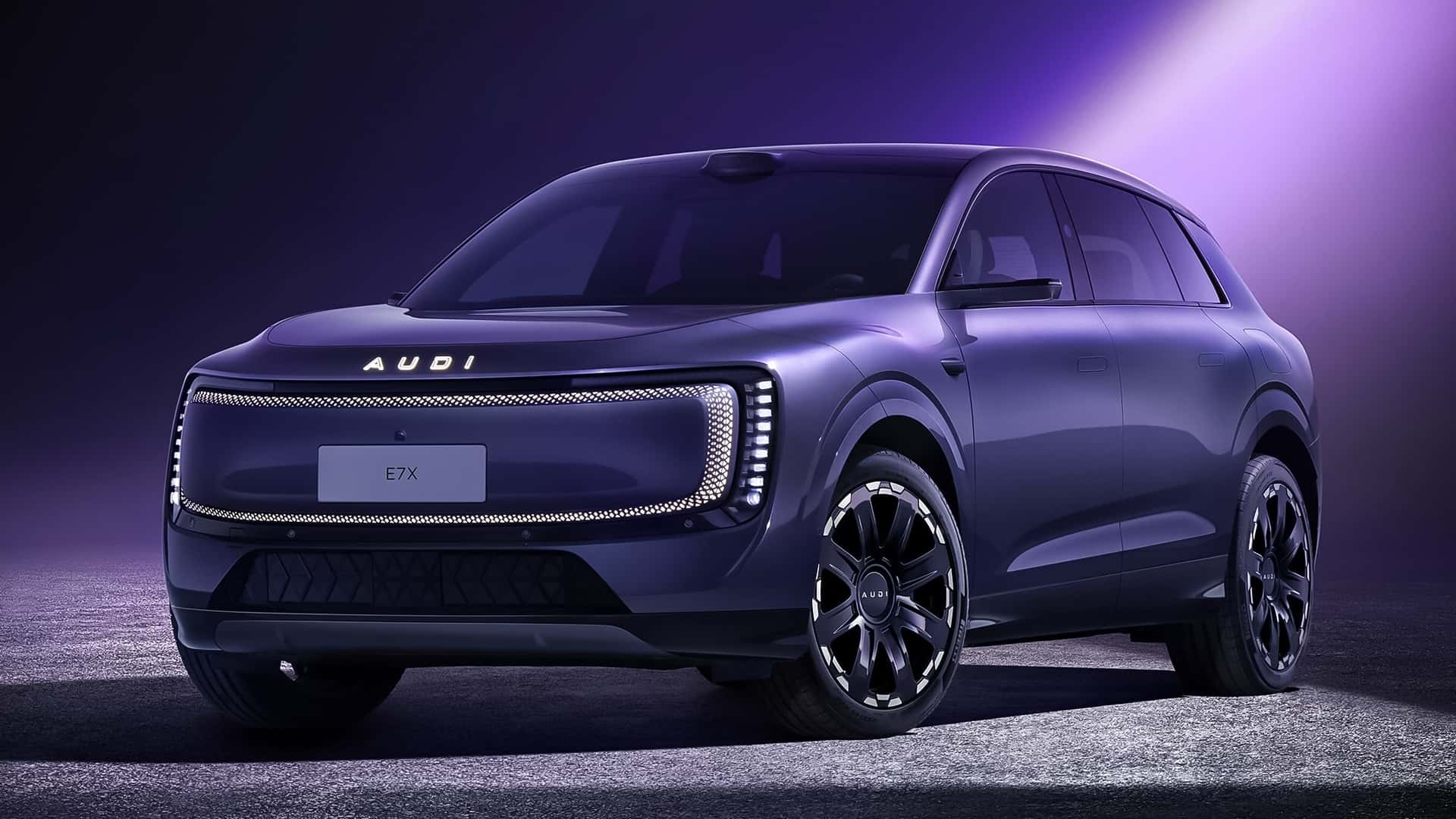
- Audi believes regional differences have killed the global car.
- Audi’s spinoff brand AUDI (without the Four Rings) is exclusive to China.
- Four-ringed models will continue in China.
Audi was the first luxury automaker to enter China in 1988, six years before BMW and 17 years ahead of Mercedes. It didn’t take long for the trio to discover that Chinese customers prefer more spacious cars with roomier back seats. They all adapted by stretching the wheelbases of their global models for the locally manufactured versions. Since then, Western brands have launched a myriad of China-only models, including long-wheelbase SUVs.
With help from SAIC, Audi has taken things to the next level by setting up a separate car brand specifically for the Chinese market. The recently founded AUDI, spelled out in capital letters and without the iconic Four Rings, sells two models in China that you can’t get anywhere else. The wagon-esque E5 Sportback led the way before the E7X SUV arrived, and a new sedan is also on the way.
Why is Audi going through this much trouble? Simple: it believes the era of the global car has come to an end. The days when a one-size-fits-all formula worked are over, and automakers need to adapt their vehicles to suit regional preferences. As the saying goes, different strokes for different folks. In an interview with Australian magazine GoAuto, chief technical officer Rouven Mohr said there are fundamental incompatibilities between what buyers want around the world:
Photo by: Audi
‘I think the idea of the global car – so one car that fits the world – this is gone, to be honest, because it’s not fitting anymore in the US (and) in China. You need this kind of local-for-local pillar.’
His view is echoed by the head of Audi’s fellow Volkswagen brand in China. Last year, Ralf Brandstätter said that while Europeans want “tactile controls, long-term durability, and driving dynamics,” Chinese buyers prefer “AI-first, connected vehicles, with seamless voice control and smart cockpits.”
That’s not to say Audi will stop selling its global cars in China. Some of its four-ringed models will remain, catering to customers who still want one of the long-running nameplates and their German character. However, the CTO believes future growth is likely to come from the AUDI brand. These look completely different inside and out from those wearing the iconic badge, which dates back to 1932, when Auto Union was created.
It’s not just the AUDI models for China that are adopting fresh styling. The core Audi brand is also embracing a new design language. We’ve already seen it on the Concept C and Nuvolari sports cars, and the electric A4 is expected to become the first mass-production model to use it when it arrives in 2028. The “Strive for Clarity” philosophy also brings interior changes, with Audi planning to improve quality and reintroduce more physical switchgear.

77
Source: Audi
Motor1’s Take: The old ways of doing things no longer work because today’s market offers far greater variety. The rise of domestic brands in China has made competition fierce in the world’s largest car market. For years, Audi, BMW, and Mercedes had little reason to worry about direct rivals because there weren’t any.
Chinese automakers, however, have come a long way over the past couple of decades. Once mocked for copying the designs of global cars, they have become a force to be reckoned with. As a result, legacy brands are struggling in China, where local companies are introducing much cheaper vehicles that, in many cases, are far better equipped.
I’d add that brand prestige is no longer as important as it once was, as much younger companies can deliver compelling products at significantly lower prices.
Read the full article here