





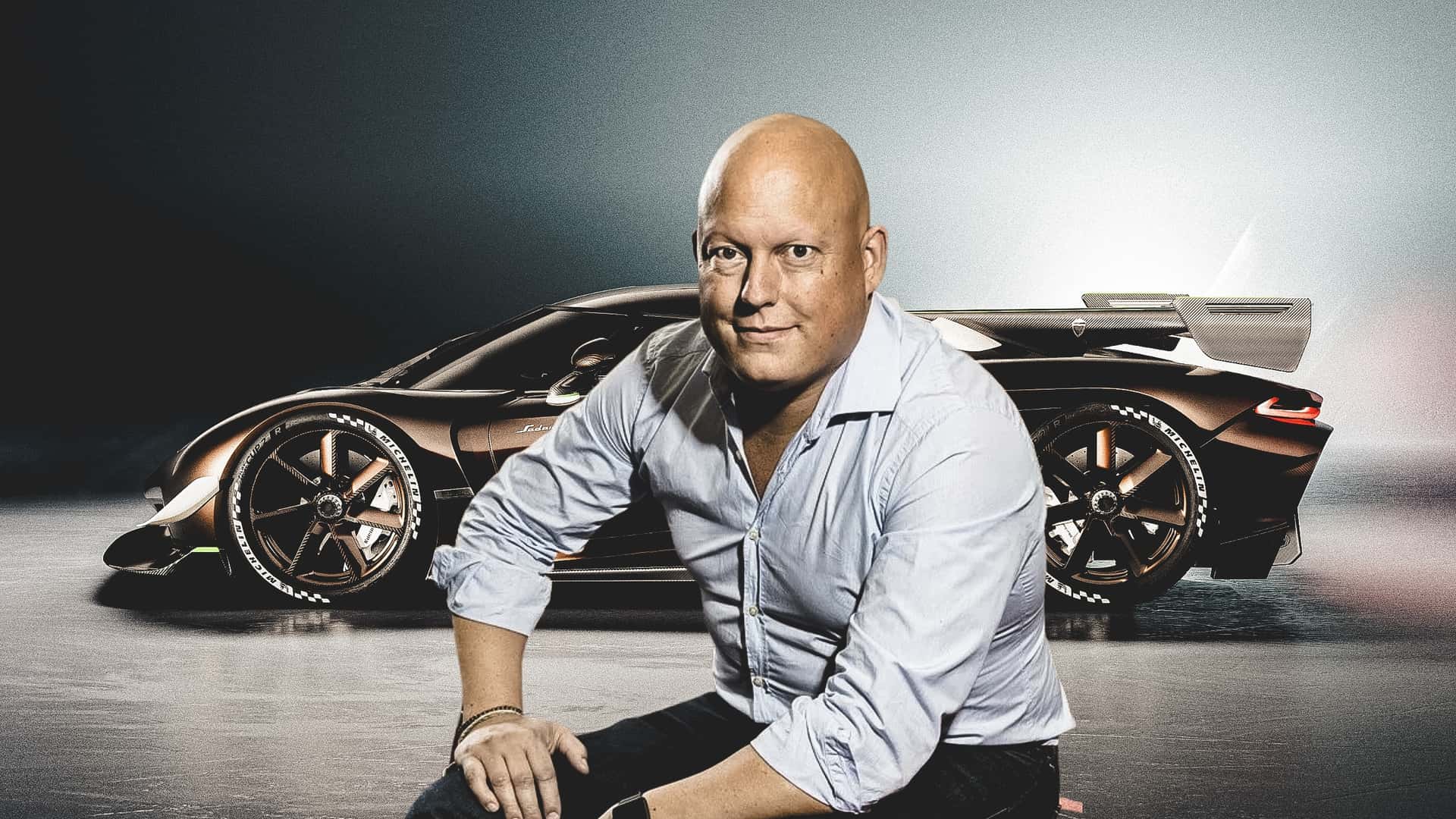
During a visit to Koenigsegg’s factory in Sweden for the unveiling of its latest Lego project dedicated to the Sadair’s Spear, I asked Christian von Koenigsegg a question that’s more relevant today than ever before: “Where does the company stand on building electric cars?”
With Ferrari recently unveiling the Luce, and some of its other competitors at least discussing electrification, it would make sense that Christian and his team have at least considered the idea. For now, at least, Koenigsegg models leave the Ängelholm plant with either internal combustion power or hybrid systems. And that doesn’t appear to be changing anytime soon.
There’s no technological shortfall behind that decision, nor a lack of know-how: the company’s founder and CEO is convinced Koenigsegg would have all the capability to build an electric hypercar, if it wanted to. It simply doesn’t see that as the right path right now for the kind of car it wants to make.
This story originally appeared on Motor1 Italy
Koenigsegg Sadair’s Spear
Photo by: Koenigsegg
A Decade’s Difference
What’s most striking is his admission that his thinking has changed over time. He told me:
‘If you’d asked me 10 years ago, I probably would have thought that by 2026 we’d already have an electric Koenigsegg.’
Back then, he viewed EVs the way much of the industry did: the natural endpoint for high-performance cars. Then something shifted—and not because of spreadsheets or outright performance figures. For von Koenigsegg, the internal combustion engine does far more than push the car forward.
Vibration, sound, mechanical response, character: those are elements he believes build a driving experience that can’t be replaced in the hypercar world. He uses an image that captures the idea well: a combustion-powered car can feel almost like a living organism, while an EV—no matter how quick or advanced—operates on a different emotional level.
‘It never becomes an animal.’

Photo by: Koenigsegg
Performance Over Everything
Koenigseggs, the founder emphasizes, aren’t built to solve everyday transportation. They have air conditioning, comfortable seats, modern infotainment—sure—but those are features you can also find in far less expensive cars. He notes:
‘The real value of a hypercar is elsewhere: in the design, in the engineering, in the sensations it delivers, in the almost emotional bond between driver and machine.’
That’s why, in his view, the combustion engine isn’t a stopgap technology destined to disappear as soon as a viable alternative arrives. It’s integral to what Koenigsegg wants to offer.
Then there’s the environmental question, which von Koenigsegg approaches from a different angle than what typically dominates the public debate. He tells me:
‘With hypercars, you can’t compare EVs and combustion engines using the same criteria as mass-market cars. A vehicle with a very large battery has to be driven a lot to ‘pay back,’ environmentally speaking, the impact of producing that battery. But hypercars are driven very little—often they sit for years in collectors’ garages—and that break-even point might never come.’
Photo by: Koenigsegg
The estimates he cites point to about 50,000 miles as the threshold beyond which a car with a small battery—or no battery—would be more advantageous than a pure EV. With renewable fuels or biofuels, that threshold rises to about 87,000 miles.
‘Not everyone agrees with that interpretation, but it helps explain the logic behind the company’s technical choices.’
Koenigsegg hasn’t ignored electrification, though. The company had also started work on a fully electric platform. In the end, however, it concluded that a hybrid setup was the best balance for what its customers want. A relatively small battery allows electric driving in the city, access to restricted-traffic areas, and quiet operation when needed.
It also enables regenerative braking, reducing the materials required compared with an enormous battery pack. That’s the philosophy on display in the Gemera, where combustion and electric power work together for maximum performance without sacrificing versatility.
Von Koenigsegg doesn’t completely rule out a fully electric hypercar. A lot will depend on how regulations evolve and, above all, on battery technology: if packs become lighter, more compact, and less dependent on critical raw materials, some of his current objections could carry less weight.
At that point the conversation would shift to other issues, like overall vehicle mass and driving feel. For now, though, the company’s position is clear: in hypercars, Koenigsegg believes that engine still delivers something no alternative has managed to replicate.
Photo by: Koenigsegg
Today, Koenigseggs run on E85, a blend that’s mostly ethanol with some gasoline. That gasoline portion, according to von Koenigsegg, could one day be replaced with synthetic fuels. He also outlined a more ambitious scenario: fuels produced using CO2 captured directly from the atmosphere and renewable energy, where part of the collected carbon dioxide would be permanently stored underground, and the rest would be used to produce fuel.
It’s a process that, he says, could even lead to a net-negative climate balance. As for what all of that might cost, von Koenigsegg joked about it as a kind of “tax on nature”—a quip that sums up his approach well: keep developing the internal combustion engine, while finding increasingly sustainable ways to run it.
Read the full article here