






Many campaigns use football to amplify a message. Earth FC starts from a different place — it starts with football itself.
At first glance, the project looks like another attempt to connect sport with climate action. Spend a few minutes with it and something becomes clear. Earth FC is not trying to bring climate change into football. It is arguing that climate change is already there.
Advertisement
That distinction sits at the heart of the project.
That philosophy shapes every part of Earth FC. When I spoke with campaign director Jenna Lamb, she repeatedly returned to the idea of a ‘football-forward’ approach. The project begins with football’s existing culture, communities, and emotional connections. It starts with the game itself and examines how climate change is already reshaping the spaces, people, and routines that sustain it.
It’s a subtle shift, but an important one.
Too often, environmental campaigns ask football fans to care about climate change as a distant global issue. Earth FC flips that question. It starts closer to home and asks what happens when climate change begins to disrupt the places, routines, and communities that football depends on.
Advertisement
The answer is much easier than people realise. That thinking shaped one of the project’s most deliberate decisions. Earth FC presents itself as a football club rather than a traditional environmental campaign. For Lamb, that choice is about legitimacy.
Earth FC ‘defending where football lives’
Campaigns often exist outside football. They observe the game, comment on it, and attempt to enter the conversation. Clubs belong to football. They exist within the culture and understand the language of supporters because they share it.
Football is built on identity. It is built on belonging. It is built on local pride, community memory, rivalries, traditions and shared experiences. Earth FC wanted to operate within that ecosystem rather than alongside it.
Advertisement
The decision also avoids a common challenge facing climate communication. Environmental messaging can sometimes feel distant, abstract or disconnected from everyday life. Football provides something much more tangible.
Most supporters do not experience climate change through scientific reports or policy discussions. They experience it through flooded pitches, postponed matches, unbearable temperatures, damaged facilities and disrupted routines. Those experiences make the issue real.
That shift is already visible on the ground. When asked about the most immediate ways climate change is affecting football today, Lamb pointed to changes that are becoming increasingly difficult to ignore.
How climate change is impacting football
People play soccer at a Brooklyn park at dusk at the end of the hottest day of the year so far on June 24, 2025 in New York City. Temperatures in New York reached into the high 90’s with a heat index of over 100 degrees as the first heat wave of the year moves across parts of the Midwest and East Coast. (Photo by Spencer Platt/Getty Images)
Advertisement
Extreme heat is altering kick-off times and training schedules. Clubs and governing bodies are introducing new player welfare measures. Flooding regularly renders grassroots pitches unusable. Wildfires and poor air quality have forced cancellations in several parts of the world.
These disruptions are no longer rare exceptions. They are becoming part of football’s reality. Yet Lamb believes the biggest impact often receives the least attention. The real threat is not simply to matches. It is to routine.
Football thrives on consistency. The same park every weekend. Same teammates. Supporters arriving at the same ground. The same rituals repeated over months and years. Those patterns create community. When extreme weather interrupts them, the consequences extend beyond the ninety minutes.
As Lamb explained: “When extreme weather threatens to cancel games, it doesn’t just affect the 90 minutes: it puts a strain on our communities. For some, football is a vital part of their social life. For many others — whether playing or watching in parks, pitches and stadiums week in, week out — it is a lifeline. A way to finally switch off. The thing that keeps them going in uncertain times.
Advertisement
“Flooding, extreme heat and wildfires risk the routines, relationships and moments of connection that people rely on far more than we realise. We need to come together to defend where football lives.”
Bridging the gap between climate science and lived experience
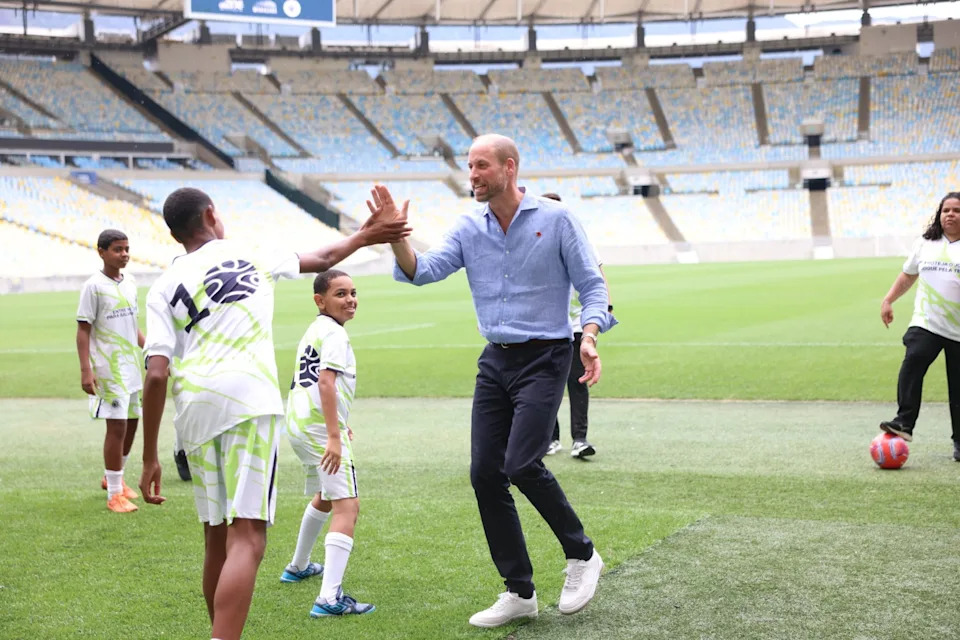
Prince William, Prince of Wales arrives in Brazil for the fifth annual Earthshot Prize Awards Night in Rio de Janeiro Community Football Maracanã Stadium where the Prince tried his football skills with local kids and Brazilian former footballer Cafu on November 3, 2025. (Photo Ian Vogler – Pool/Getty Images)
That final phrase — defend where football lives — captures what Earth FC is trying to achieve.
Advertisement
It shifts the conversation away from abstract environmental concerns and toward something deeply personal. Football does not exist only in stadiums. It exists in local parks, community pitches, recreation grounds, schools and neighbourhood spaces. It exists wherever people gather around the game.
Those places often sit on the front lines of climate change. Earth FC has attracted support from footballers, coaches, activists, and public figures. Lamb is careful when discussing why those voices matter. The answer is not visibility alone.
Football figures bring credibility because they share experiences with the people they are speaking to. Their stories carry weight because they emerge from the game itself.
Supporters may not connect immediately with environmental statistics. They do connect with a player describing a childhood pitch that no longer exists in the same condition. They understand an athlete talking about training in temperatures that were once unusual but now feel routine.
Advertisement
Those stories bridge the gap between climate science and lived experience. Many players have already begun telling them.
Some recall growing up on pitches that regularly flooded after heavy rain. Others describe increasingly extreme temperatures during training and competition. Many have travelled significant distances in pursuit of opportunities, navigating environments shaped by geography, infrastructure, and changing conditions.
These stories do not always arrive labelled as climate stories. That does not make them any less relevant.
Earth FC and the women’s football connection

RECIFE, BRAZIL – JUNE 26: An United States fan looks on in the rain prior to the 2014 FIFA World Cup Brazil group G match between the United States and Germany at Arena Pernambuco on June 26, 2014 in Recife, Brazil. (Photo by Martin Rose/Getty Images)
Advertisement
One of the most interesting aspects of Earth FC’s approach is its connection to women’s football.
Lamb noted that many spaces within the women’s game have shown a particular willingness to engage with environmental and social issues. That openness does not exist because the men’s game is resistant or uninterested. Rather, it reflects differences in culture and history.
Women’s football has often developed through grassroots networks, community structures, and environments where conversations naturally extend beyond the pitch. Players have frequently been required to advocate not only for themselves but also for the broader growth of the game.
That experience can create a greater willingness to discuss wider issues affecting communities. Climate change fits naturally within those conversations.
Advertisement
Many women players already tell stories about access to facilities, changing infrastructure, and the realities of grassroots football. Those experiences make the connection between environment, opportunity, and participation easier to recognise.
The men’s game is also increasingly engaging with sustainability initiatives. Clubs, leagues, and players have invested significant resources into environmental programmes. However, larger institutional structures can sometimes slow how quickly those conversations become part of everyday football discourse.
Earth FC does not present this as a divide between men’s and women’s football. Instead, it highlights different storytelling traditions and different entry points into the same conversation.
‘Football becomes a living record of environmental change’
Throughout my discussion with Lamb, one idea continued to surface. Football often records environmental change without realising it.
Advertisement
Moreover, players remember seasons shaped by weather conditions. Likewise, supporters remember local pitches that looked very different 20 years ago. In the same way, communities remember spaces that once hosted matches every weekend but now struggle with flooding or more extreme conditions.
Football preserves those memories. It becomes a living record of environmental change. That perspective ultimately separates Earth FC from many traditional climate campaigns.
The project does not start with data and attempt to make football care. It starts with football and recognises that the evidence already exists within the game’s own stories.
The flooded pitch. The cancelled fixture. The altered training schedule. The childhood field that no longer looks the same. The community gathering that never happened because extreme weather got in the way.
Advertisement
These moments matter because football matters.
People rarely fight to protect statistics. They fight to protect places. To protect memories and communities. Football gives all three a home.
The challenge now is recognising what is at stake.
Climate change is not simply threatening infrastructure. It is threatening the spaces where football lives, where friendships form, where communities gather, and where generations connect through a shared love of the game.
Earth FC’s call to action is not complicated. Pay attention. Listen to the stories already emerging from football. Recognise the changes happening around us.
Advertisement
Defending football is not only about preserving a sport. It is about protecting the places and people that give the sport its meaning in the first place. Protect the pitches, parks, facilities, and communities that make the game possible.
Related articles from Her Football Hub:
-
Opinion: If the Qatar World Cup was worth boycotting, so is USA 2026
-
FIFA launches Female Health and Performance Project, bridging the gap in research within the women’s game
Read the full article here