





It’s been a strange start to the season. We have veteran hitters struggling, with rookies and unexpected contributors like Zack Gelof and JJ Bleday making some noise. This week, we’re looking at four veteran hitters with a decent track record who aren’t quite meeting expectations through the first two months of the season. We’ll examine their skills and luck factors to identify whether their skills indicate better production moving forward.
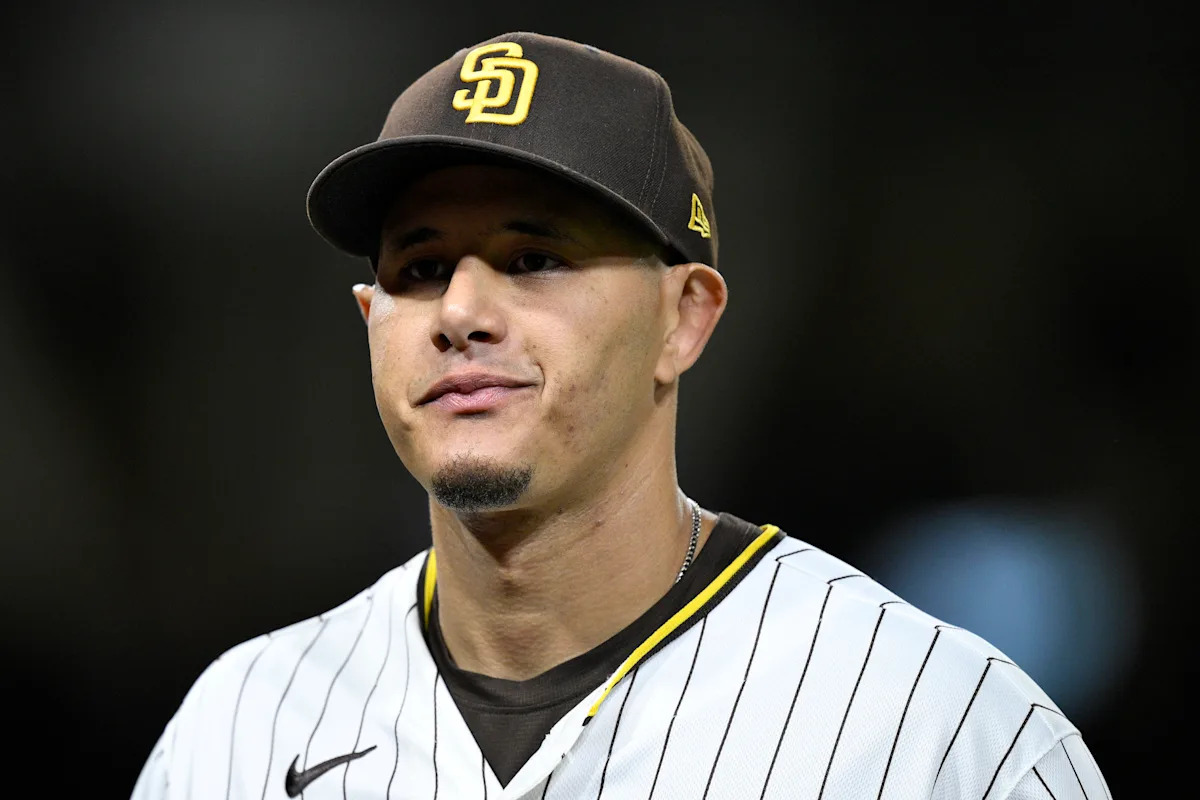
Manny Machado, Padres (97% Rostered)
Should we be buying low on Manny Machado? As we shift toward the end of May, we probably wouldn’t have expected Machado to hit nine home runs with a .169 batting average. Machado has been unfortunate, with a .173 BABIP in 2026 compared to a .296 BABIP in his career. From a plate discipline standpoint, most of Machado’s metrics look similar to his career averages. That’s evident in Machado’s 76.7% contact rate, 28.8% chase rate and an 11% swinging-strike rate.
Advertisement
Machado continues to pull the ball and elevate it in the air around 41% of the time in 2026, within 1-2 percentage points from recent seasons and his career averages. Knowing that, Machado’s BABIP should regress because there haven’t been drastic changes in his batted ball profile. For instance, if Machado was hitting way more flyballs than usual, we could understand the significant drop in BABIP.
Machado still boasts strong power metrics. That’s evident by Machado’s 74.1 mph bat speed, yet his barrel rate per plate appearance has been cut in half in 2026 (4.6%) compared to 2025 (9.3%). Machado still hits the ball hard, with a 101.1 mph Exit Velocity 50 or EV50 (No. 87), which accounts for the average of the hardest 50% of a player’s batted balls. For context, Machado’s EV50 fell from 103.4 mph (No. 28), aligning with the lower barrel rate.
If Machado’s power metrics don’t return closer to 2025 and recent seasons, that will lead us toward adjusting our expectations for a significant fantasy contributor at the position. Look to buy low on Machado.
Advertisement
Vladimir Guerrero Jr., Blue Jays (99% Rostered)
If you had a trivia question about which hitter has more stolen bases than home runs in late May, Vladimir Guerrero Jr. probably wouldn’t be one of them. Guerrero has three home runs and five stolen bases as we hit the end of May. Though Guerrero hasn’t popped off the page, the projections suggest he could have a repeat of the 2025 season. Guerrero historically had near-elite plate discipline, given his higher walk rate (12.8%) than his strikeout rate (10.6%). Interestingly, Guerrero has been swinging (48.3% swing rate) and chasing (31.2%) more often in 2026. However, Guerrero has a similar career swing rate (47.5%), while chasing four points more than his career norm (27.1%).
Vladimir Guerrero Jr.’s 15-game rolling FB, chase rate and HR/F. (Photo by Corbin Young/FanGraphs)
Hitting too many ground balls remains an issue for Guerrero, with a 46-47% groundball rate. That directly impacts his home run luck (5.4% HR/F) in 2026 compared to a 17.1% career average. We should see Guerrero’s home run rate regress favorably with his near-elite power. He continues to swing the bat hard (76.2 mph), but we’ve seen his barrel rate per plate appearance drop to 5.6% in 2026 compared to 9% in 2025, which would be similar to his career norm.
Advertisement
Guerrero consistently hits the ball hard, but the launch angles have been an issue. Furthermore, Guerrero’s launch-angle consistency remains a challenge because he hits the power into the ground often, yet he typically boasts a high-end barrel rate. If hitters hit the ball into the ground often, we want them to destroy flyballs and line drives. For context, Guerrero averaged a 95.7 mph average exit velocity on flyballs and line drives (No. 44) in 2025 after 97.1 mph (2024). Unfortunately, Guerrero’s average exit velocity on flyballs and line drives has drastically fallen to 91.3 mph (No. 204) in 2026.
Guerrero’s 2026 season looks like the outlier from an exit velocity standpoint, potentially making him a buy-low candidate since he hasn’t exploded in the power department.
Gunnar Henderson, Orioles (99% Rostered)
The power and speed have been there for Gunnar Henderson, with 13 home runs and six steals. However, Henderson’s .222 batting average and career-low OBP (.274 OBP) have been the main concerns. Henderson was typically a batting average (.265), on-base (.339) and points-league asset in his career. So, what’s going on under the hood?
Advertisement
Henderson has been more aggressive by swinging more (49.9% swing rate) and chasing more often (35.6%). For context, Henderson’s swing rate was four points lower (46.2%) with a significantly lower chase rate (26.2%) throughout his career. His swinging-strike rate has increased to 11.7% in 2026, not much higher than his career norm (10.7%).
Since Henderson has been more aggressive by chasing more often, it makes sense to see his walk rate dip to a career low (6%). Hopefully, Henderson starts to revert toward his career averages by being more patient to raise his OBP. The Automated Ball-Strike (ABS) System strike zones consist of shadow and chase sections. The shadow area of the strike zone covers the outside edge, in and outside of the zone. Meanwhile, the chase area is beyond the shadow section. Here’s Henderson’s breakdown:

Gunnar Henderson’s Statcast strike zone breakdown. (Photo by Corbin Young/Yahoo Sports)
Henderson has been swinging more in the shadow area (58.4%) and chase zones (31.5%) in 2026. That aligns with his overall chase rate, but breaking down the zones by shadow and chase provides a more detailed look at where he swings. For context, Henderson’s career swing rate in the shadow area (50.8%) and chase sections (20.1%) have been significantly lower in his career. That’s something to monitor if Henderson continues to chase and post a lower OBP.
Advertisement
Henderson has shown a slight change in approach by pulling the ball more (47.9% pull rate) and elevating the ball at a higher rate (39.4%). When hitters hit more flyballs, it can impact their BABIP. That’s what we’re seeing for Henderson, though his flyball rate isn’t extreme toward 50% yet. Both Henderson’s pull and flyball rates have been 6-7 percentage points higher than his career norms. That’s typically an optimal approach for power, especially since he often hit groundballs, with a career average of 47.2%.
Henderson continues to have high-end bat speed (74.5 mph) and a consistent 6% barrel rate per plate appearance. Both metrics have been within one point of his career averages. Theoretically, pulling the ball into the air with strong exit velocities should lead to optimal results, but the batted ball results have been lower in 2026. The visual below shows the results and exit velocities on Henderson’s pulled flyballs.
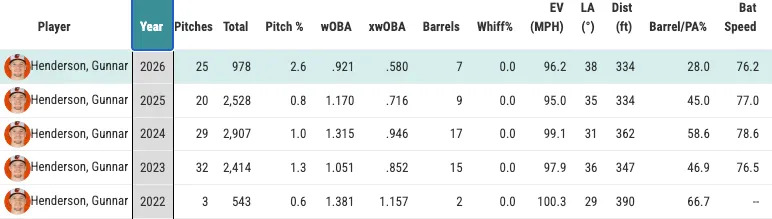
Results of Gunnar Henderson’s pulled flyballs. (Photo by Corbin Young/Yahoo Sports)
Henderson had a wOBA over 1.000 throughout his career on pulled flyballs, but it has been lower in 2026 (.921 wOBA). Notably, Henderson’s .580 expected wOBA has been lower than recent seasons, though it has increased gradually throughout the season. His average exit velocity on pulled flyballs in 2026 (96.2 mph) is similar to 2025. However, Henderson’s barrel rate per plate appearance has nearly been cut in half in 2026 (28%) on pulled flyballs. The 2026 data could be the outlier, meaning Henderson’s barrel rate and results on pulled flyballs could regress favorably.
Advertisement
The projections suggest Henderson could push for nearly 30 home runs and 20+ stolen bases. Henderson’s main sticking point will be the batting average and OBP for different league formats. There probably isn’t a window to buy on Henderson because of his power and speed production, but I would still lean on the track record and strong tools, expecting the batting average and OBP to rise closer to the career norms.
Geraldo Perdomo, Diamondbacks (92% Rostered)
After a peak season in 2025 — with 20 home runs, 27 stolen bases, nearly 200 combined runs plus RBI and a .290 batting average — Geraldo Perdomo has been off to a slow start. He has two home runs and eight steals, yet only a .223 batting average. Like other hitters, Perdomo’s BABIP is down in 2026 (.248), the lowest since 2022 for him. He still has been hitting tons of line drives (24.7%), which would be a career high. There’s a good chance that Perdomo’s BABIP regresses closer to his career norm, since hitters who hit plenty of line drives tend to run higher BABIPs.
Perdomo still possesses near-elite plate discipline, given his 89.8% contact rate and a 21.1% chase rate. That aligns with Perdomo’s higher walk rate (14.5%) than strikeout rate (13.2%), supporting his strong OBP. He should continue being a value in points and OBP leagues, with the potential for a better batting average in those formats.
Advertisement
He wasn’t known for his power, as he compiled his way to 20 home runs across 720 plate appearances in 2025. Perdomo had a 4.6% barrel rate per plate appearance in 2025, which has dropped to 2.8% in 2026. He has been hitting more ground balls in 2026, which impacts his ability to elevate the ball. Perdomo has a 45.3% groundball rate in 2026, up from 37.5% in 2025. That coincided with Perdomo hitting a career-high 9.9% home run per flyball rate (HR/F) in 2025, which has dropped to 4.4% in 2026.
Play 2026 Soccer Pick ‘Em with FOX One and make your picks for the world’s biggest soccer tournament
Thankfully, Perdomo has continued to run often, with a 18% stolen base opportunity rate in 2026. That’s slightly higher than his stolen base opportunity percentage in 2025 (15%). He should steal around 25 bases again, but the home runs might regress to around 10, as the projections indicate.
If Perdomo’s batting average doesn’t rise, it will be a disappointing season from a fantasy standpoint. A hitter with 10 home runs, 25 stolen bases and a lower batting average isn’t what fantasy managers expected if they drafted him. Since it doesn’t appear like there have been any skill declines, we’ll bet on Perdomo’s batting average increasing closer to the .270 or .280 mark.
Advertisement
Perdomo likely has more value in season-long rotisserie and points leagues instead of head-to-head formats because he needs volume to compile fantasy value. It all ultimately looks like a down season for Perdomo in 2026.
Read the full article here