






Prior to the PGA Professional Championship a few years ago, I visited the Titleist Performance Institute in California to have my equipment checked. I was hitting a lot of 230- to 240-yard second shots into the par 5s with little to show for it. I had no problem carrying my 3-iron that distance, but the apex height (about 90 feet) was too low to hold most greens. I needed more loft and stopping power—and I found it! They handed me a 7-wood, and the first ball I hit carried 232 yards at an apex of 115 feet. The next few shots produced similar distances and flew even higher. I was sold.
That extra height and stickiness on the greens is what makes the 7-wood such a popular club among tour players today. Consider this: At the Players Championship in March, 46 players (37 percent) used a 7-wood, including World No. 1 Scottie Scheffler, runner-up Matt Fitzpatrick and 54-hole leader Ludvig Aberg. That should be a strong signal for you to get one, too.
Advertisement
The 7-wood is super versatile and easy to hit from a number of lies, and I’m going to show you how to use one for three typical second shots—tightly mown grass, fairway bunkers and the rough. Give these tips a try and discover why this should be your new favorite club.
1. TIGHT LIES
/content/dam/images/golfdigest/fullset/2026/2/GD0626_FEAT_7WOOD_02a.jpg
Treat it like a 7-iron shot
The 7-wood has a bigger head than its hybrid equivalent, and the center of gravity is farther back, which makes it easier to get the ball airborne. But like any other long-approach-shot club, you still have to resist the urge to try to help the ball up with a wristy strike or swinging off your back foot. Both those faults lead to fat and thin shots.
Advertisement
Instead, approach the 7-wood the same way you would a 7-iron—both in terms of setup and swing. Center your weight between your feet with your shoulders fairly level and the ball just forward of your sternum (above, left). From there, make a controlled, three-quarter-length backswing and focus on transferring your weight to your front leg on the downswing. Then rotate toward the target like you’re throwing a punch (above, right). This shift toward the target will bring the low point of the swing also forward, just ahead of the ball, which allows you to compress it like a mid-iron shot.
More From Golf Digest
Golf Digest Logo Put Chris Gotterup’s game to work for you

Golf Digest Logo The Undercover Pro: Staying out of the PGA Tour gossip machine

Golf Digest Logo How AI will transform your game
Advertisement
2. FAIRWAY BUNKERS
/content/dam/images/golfdigest/fullset/2026/2/GD0626_FEAT_7WOOD_04a.jpg
Become more forward-thinking
If the ball is sitting up in fairway sand and you can clear the lip of the bunker, this is a great club to not only get out of jail but also get some distance back.
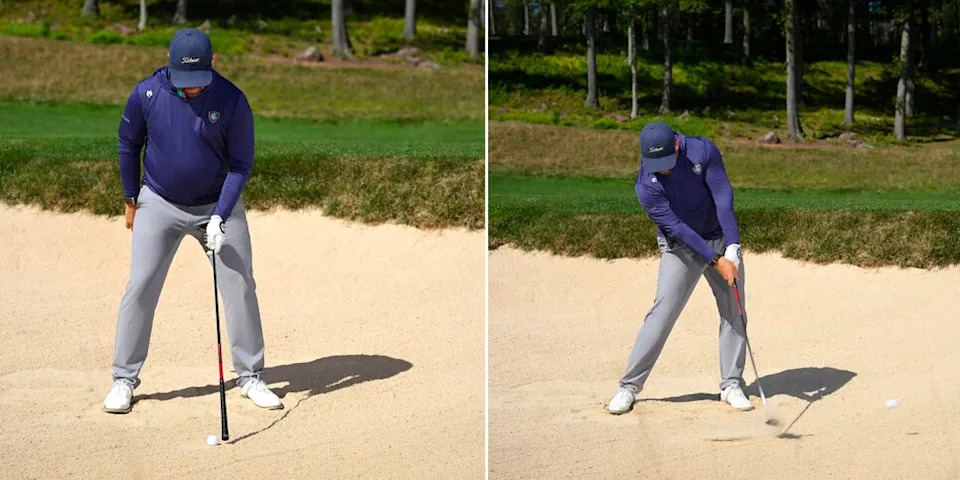
Start by digging your feet in to help quiet your lower body and make you more stable, and grip down on the handle a similar amount to compensate. You also should position yourself so that the ball is a little closer to center in your stance than normal and set your feet and shoulders open (aimed left of your target for righties). The ball-position adjustment and open stance promote a steeper angle of approach, helping you catch the ball first and sand second. Now here’s the big key to getting the clean contact you need:
Advertisement
Adjust your focal point to a spot in front of the ball on the target side (above, left). Coupled with the ball position and open stance, that aim point gets you to catch the ball first (above, right) and then the sand. You’ll give yourself a decent chance of knocking it on.
3. ROUGH LIES

/content/dam/images/golfdigest/fullset/2026/2/GD0626_WELL_7-Wood -2a.jpg
Drop it down on the ball
The 7-wood’s mass and deeper center of gravity make it a rocket-launcher from the rough, provided the lie is good. First, test the grass by making a few practice swings to the side of the ball. If you encounter little resistance and the club passes through smoothly, you are cleared for launch.
Advertisement
To set up correctly, inch your feet closer to the ball and narrow your stance to promote a steeper backswing and downswing. That prevents interference from the grass as much as possible. Hinge the club up sharply on the backswing (above, left), then feel a big weight shift onto your front leg prior to dropping the clubhead down onto the ball (above, right). Make sure you turn your hips through and finish in balance. You should be able to chase it up to the green—and you owe it all to that wonderful new 7-wood. I should get a commission for all the new ones sold after this article.
NICK BOVA, voted Golf Digest’s Best Teacher in New Jersey, is director of instruction at Hamilton Farm Golf Club in Gladstone.
MORE: Rickie Fowler is really good at something the rest of us are bad at
Read the full article here