





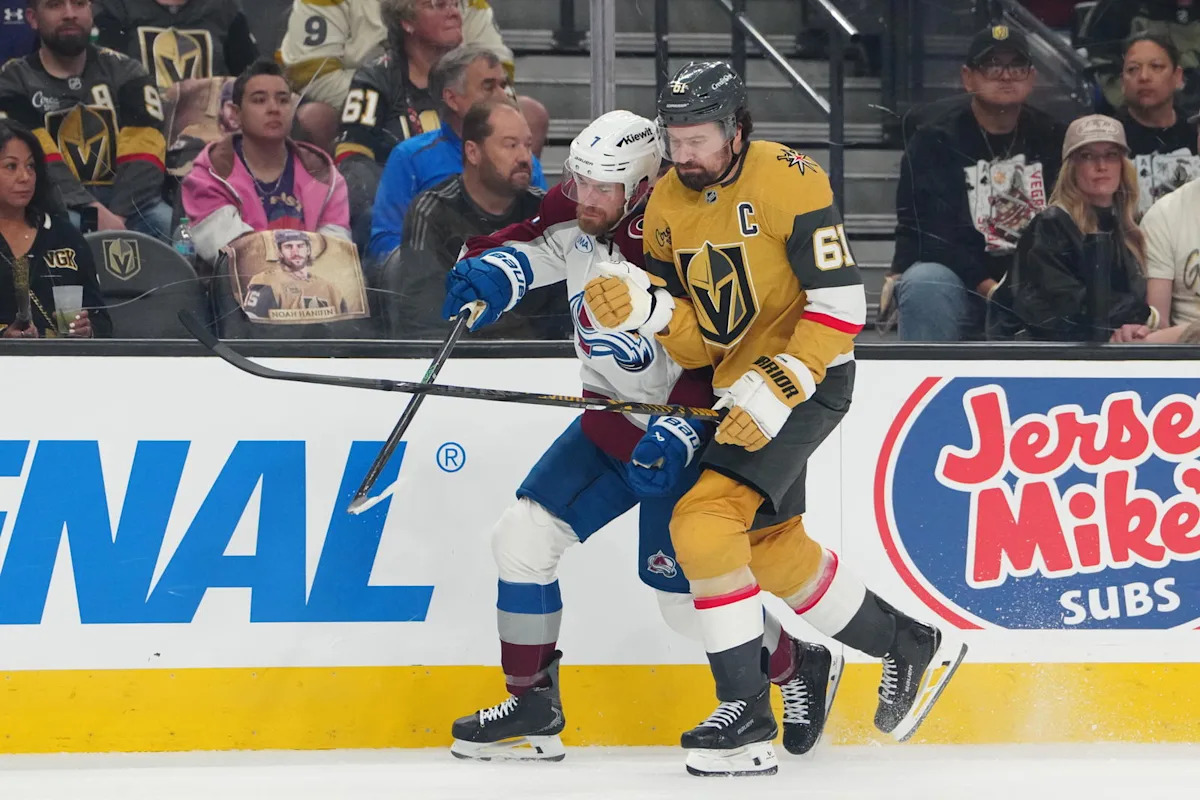
One week ago, the Colorado Avalanche looked like a team that was inevitable. Today, they’re cleaning out their lockers after one of the most stunning collapses in franchise history.
For months, the Avalanche looked destined to lift the Stanley Cup. They won the Presidents’ Trophy. They overwhelmed opponents with speed and skill. They entered the Western Conference Final as heavy favorites.
Advertisement
Four games later, they were swept. Not beaten. Swept.
The easy explanation is to point at Vegas and say the Golden Knights got hot at the right time. The better explanation is that Colorado spent an entire season flirting with problems that eventually became impossible to ignore.
And no, this has nothing to do with some mythical Presidents’ Trophy curse.
The Presidents’ Trophy isn’t cursed. It’s a trophy. You make your own destiny. And the Avalanche made theirs.
Throughout the season, there were warning signs hiding beneath the wins. If you’ve watched our interviews all year long, you’ve heard the same phrases repeated over and over: poor puck management, defensive-zone turnovers, sloppy play, unforced mistakes.
Advertisement
The difference was that those mistakes usually came with a safety net. Scott Wedgewood would make a ridiculous save. Mackenzie Blackwood would erase a defensive breakdown. Nathan MacKinnon would score a goal and suddenly nobody cared about the turnover that happened three shifts earlier.
Winning has a way of covering up flaws. Until it doesn’t.
Against Vegas, it was like pneumonia and sepsis hit at the exact same time. The offense stopped scoring. The goaltending advantage disappeared. The power play went silent. The injuries mounted. Every issue that had been masked by elite talent and timely saves suddenly stood naked under a spotlight.
Everything that could go wrong went wrong.
Advertisement
Nathan MacKinnon didn’t score a goal in the series. Think about that for a second. The most dominant even-strength player in hockey went four games without scoring. That’s never happened before, and the Avalanche had no answer.
Watching Colorado during the final three games of this series reminded me of Oscar De La Hoya’s fight against Manny Pacquiao in 2008.
On paper, it looked like a massive showdown between two stars.
What people forget is what De La Hoya had to go through just to get there. He hadn’t fought at that weight class in years and spent his training camp draining his body to make weight. By fight night, he looked depleted, dehydrated, and physically empty. When the fight started, Pacquiao immediately took over, and De La Hoya had no ability to change the momentum.
Advertisement
At one point, the late Emmanuel Steward — one of the greatest trainers in boxing history and a former coach of De La Hoya himself — watched the fight unfold and delivered a brutally honest assessment:
“He doesn’t know what to do. He doesn’t know what to do at all.”
Watching Colorado against Vegas, it was hard not to think about that quote.
The Golden Knights kept punching. The Avalanche kept absorbing. And no adjustment ever came.
Vegas clogged the middle of the ice and dared Colorado to beat them from the perimeter. Colorado kept trying anyway.
Vegas erased a third-period lead in Game 2. Colorado looked stunned. Vegas stormed back in Game 3. Colorado looked stunned again.
Advertisement
For a team that entered the third period with a lead and won 41 consecutive regular-season games, plus four playoff games, the inability to respond was shocking.
“I think we let Games 2 and 3 slip away from us,” Logan O’Connor said. “Super uncharacteristic from our group to give up the leads like that, especially in consecutive games.”
The scary part wasn’t just that Colorado lost those games. It was how they reacted afterward. The confidence disappeared. The swagger disappeared. By Game 4, they looked like a team waiting for something bad to happen.
Then it did.
A lot of attention will naturally fall on Nathan MacKinnon, because that’s what happens when superstars go quiet on the biggest stage.
Advertisement
But he wasn’t alone.
Martin Necas, Brock Nelson and Valeri Nichushkin combined for 88 regular-season goals. In this series, they combined for four. Only two came against goaltenders.
Necas was supposed to be the connector, the secondary engine who punished teams for overloading on MacKinnon. Instead, Vegas forced him to the perimeter and took away his ability to attack the middle of the ice.
Nelson generated chances but couldn’t finish them. At times, he looked like a player pressing for offense that never arrived. In 20 playoff games with Colorado, he has just two goals, both empty-netters.
Advertisement
Nichushkin’s story was more physical than statistical. His offense had already faded late in the regular season, and it never returned in the playoffs. A lower-body injury eventually ended his series after Game 4.
Now the Avalanche face difficult questions about his future, with four years remaining on his contract and a modified no-trade clause attached.
But regardless of the individual cases, the result is the same: Colorado’s depth scoring vanished.
And when MacKinnon stopped scoring, there was nothing left to catch the slack.
There’s a temptation to frame this as a collapse defined by one issue.
Advertisement
It wasn’t.
It was everything at once.
The power play struggled for most of the season and carried that problem straight into the postseason. Puck management issues that showed up in November were still there in May. Defensive-zone breakdowns never fully disappeared.
The Avalanche often survived those flaws because they had enough elite talent to erase the consequences.
Vegas removed that safety net.
The Golden Knights defended with structure and patience. They clogged the middle of the ice, forced Colorado to the outside, and waited for mistakes.
And Colorado kept giving them.
You can point to injuries. You can point to goaltending swings. You can point to luck.
Advertisement
All of it matters.
But great teams are eventually defined by what they repeatedly are, not what they occasionally become.
For months, Colorado’s flaws were survivable.
Against Vegas, they were decisive.
Even the goaltending story fits that pattern. Scott Wedgewood earned his role with a strong season, but Carter Hart consistently outplayed Colorado’s netminders throughout the series. When Mackenzie Blackwood finally delivered Colorado’s best performance in Game 4, it came too late, with too little support in front of him.
By then, the series had already slipped away.
Meanwhile, Vegas only got stronger. Health returned. Execution tightened. Confidence grew.
Advertisement
That’s how a sweep happens in a series that was supposed to be competitive.
Not because of fate.
Not because of a curse.
But because one team adapted — and the other didn’t.
And once the punches started landing, Colorado never found a way to answer them.
Image
Read the full article here