





CLEVELAND — Mikal Bridges nodded.
He’d just watched longtime teammate and friend Josh Hart break out of a shooting slump in a major way, knocking down five 3-pointers to fuel the New York Knicks’ sprint to a 2-0 lead in the 2026 Eastern Conference finals. And in his postgame press conference, Bridges fielded a question about what he’d seen in Hart’s ability to persist through the frustration of failing against a scheme designed to exploit his weakness until he found a way to succeed.
Advertisement
“Yeah, just staying mentally tough, you know?” Bridges said. “That’s the biggest thing. And just keep trusting his game, trusting his work. We’re super confident in him, and we’re gonna keep finding him, and we know he’s gonna make some shots.
“But just for him, personally? Just mentally tough, you know. Staying with it.”
You wonder if, as Bridges answered, he found his mind drifting back to last month, when he himself seemed to be struggling with a crisis of confidence — one that threatened to dash the Knicks’ championship hopes against the rocks of cold, hard reality before they’d even really had a chance to set sail.
Advertisement
And you wonder whether, as he thought about how Hart came out the other side on Thursday night — “He kept making shots toward the end, and we got to where we got to” — he took a moment to consider just how far he’s come since.
Bridges occupies a fascinating position on this Knicks team. He’s sort of like the pilot light in your furnace. When he’s operating as intended, nobody really says very much, because, y’know, how often do you make a point to comment about how it’s just the right temperature in the living room while you’re watching TV?
When the light’s out, though? Suddenly it’s cold and uncomfortable, and people start getting grouchy, and everybody begins loudly wondering why the hell they gave up unprotected first-round picks in 2025, 2027, 2029 and 2031, plus another 2025 first-rounder, a 2028 pick swap and a 2025 second-round pick for something that doesn’t even let them take a decent shower.
(OK: The metaphor got away from me a little bit.)
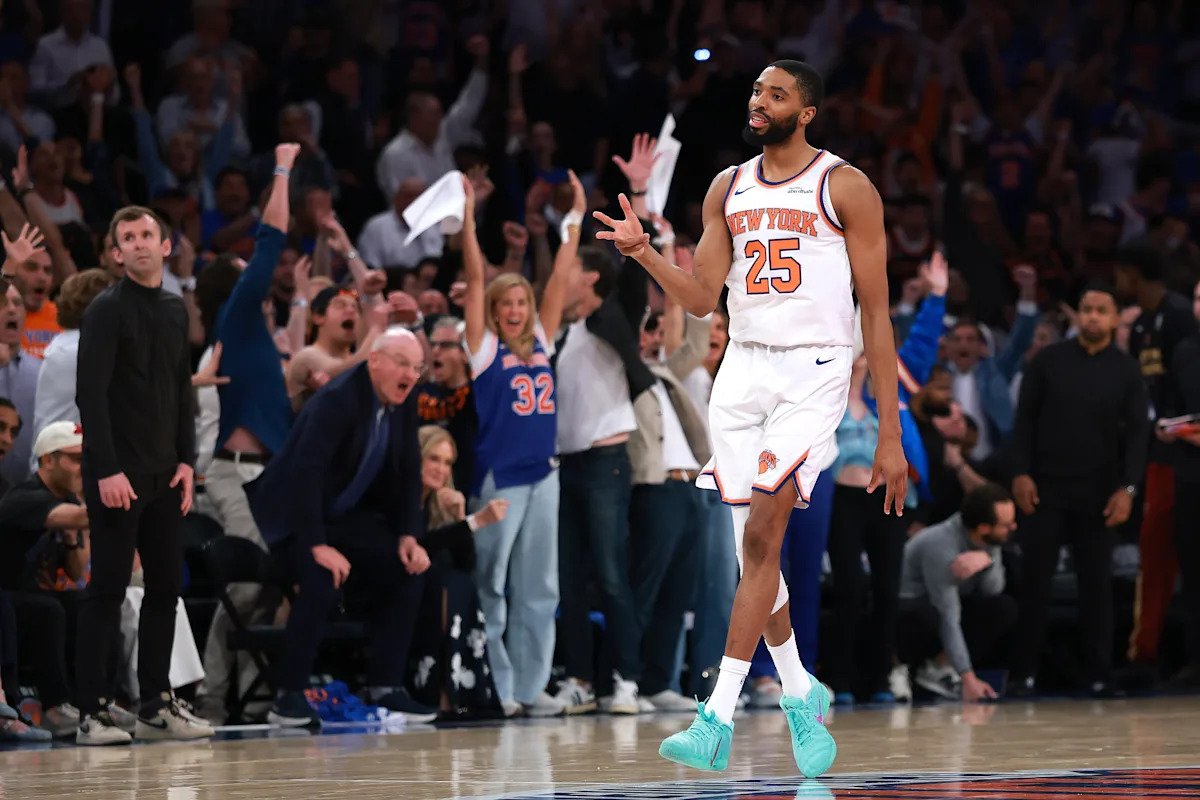
Mikal Bridges is playing his best basketball of the season during the Knicks’ nine-game playoff winning streak. (Sarah Stier/Getty Images)
(Sarah Stier via Getty Images)
This, largely, has been Bridges’ lot in life since Leon Rose forked over a half-decade’s worth of draft capital to move him from Brooklyn to Manhattan. When he’s doing what fans think he’s supposed to do at a high level — gloving up opponents’ top perimeter playmakers, sprinting like a gazelle in transition, knocking down every corner 3, and doing it all without grinding the gears of an offensive system in which he is often, at best, the fourth option — nobody really bats an eye. (Mostly, they’re too busy looking at Jalen Brunson or Karl-Anthony Towns’ latest gaudy stat line.)
Advertisement
But when he doesn’t — when he’s not quite as impactful at the point of attack as you’d like, when he’s misfiring from deep, when he’s barely even looking to run a pick-and-roll, and when the Knicks start slogging through what have become fairly rare spates of sluggish play — the weight of dealing all those picks to get Bridges and the subsequent $150 million extension to retain him, and the opportunity cost of not having the draft capital and financial flexibility to hunt for Insert Superstar Antidote to All Our Problems Here, starts to feel crushing.
You’d understand if, at times, it also feels crushing for Bridges, who had a pretty strong season on balance, even if it was rarely described that way. Yes, his counting stats were down — 14.4 points per game, his lowest since his final full season as a fourth option in Phoenix — and his free-throw attempt rate continued its plummet to career-low levels, as he seemed intent on avoiding contact around the basket.
That dip also came in the context of him playing fewer minutes than he had in five years. And averaging 8.5 fewer frontcourt touches per game than he did last season — and fewer than he had since 2021-22. And trying to figure out how to get in where he fit in offensively under a new head coach in Mike Brown, who had to figure out, first and foremost, how to get his All-Star fulcrums bought into what he was selling, on the same page, and firing on all cylinders.
“You come here and have Jalen and [Towns] and, offensively, might have to take a step back,” Hart told James L. Edwards III of The Athletic earlier this season. “Sometimes that’s difficult. Sometimes that’s tough. You go from getting 15-20 play calls to getting three or four play calls. Mentally, it can take time to adjust to that.”
Advertisement
Bridges seemed to acknowledge as much after a January win over the Raptors that saw him break out of a weeks-long funk — one mirroring the Knicks’ broader post-NBA Cup swoon — by exploding for 30 points on 12-for-15 shooting.
“I think I just wasn’t playing how I was supposed to be playing,” Bridges said in a postgame interview. “I think I wasn’t coachable enough. I don’t know what it was. Maybe I felt too much entitlement. I just had to talk to myself about it and be coachable and be the best teammate I can be.”
But progress isn’t always linear. The next several months would see Bridges alternate peaks and valleys — a string of 20-point outings here, a quiet night with barely a half-dozen shot attempts there.
On the whole, though, Bridges still performed. Among players who made at least 60 appearances and averaged at least 25 minutes a night this season, Dunks and Threes’ estimated plus-minus metric graded Bridges out as a top-40 player in the league, providing roughly the same level of on-court impact as Rudy Gobert, Trey Murphy III, Desmond Bane, Cason Wallace and Julius Randle.
Advertisement
Notably, Bridges’ contributions were evenly split: plus-0.9 points per 100 possessions added on offense, plus 0.9-per-100 on defense. In that group of players who logged 60-plus games and 25-plus minutes per night, only 20 other players in the NBA provided that kind of value on both ends of the floor — a list littered with All-NBA, All-Star and All-Defensive Team candidates.
That quiet effectiveness, though, got drowned out by a louder fact: Entering the 2026 postseason, Bridges had scored 20 points in a game just twice since the All-Star break — an offensive recession that hit rock bottom in Round 1 against Atlanta.
Bridges maintained his defensive effort, ping-ponging all around the court to stick with and limit Most Improved Player winner Nickeil Alexander-Walker. On the offensive end, though, a player who’d averaged 19.9 points per game in the two seasons prior to joining the Knicks had become little more than an apparition.
Advertisement
Despite being guarded by CJ McCollum, Bridges seemed reluctant to enter the fray, rarely setting screens or calling for the ball to run pick-and-rolls that would draw the Hawks’ weakest link into the center of the Knicks’ actions. When the ball did find him, he looked tentative handling it and uncomfortable shooting it — resulting in a scoreless, four-turnover performance in Game 3 that led Brown to bench him down the stretch of Game 3, seemingly putting his spot in the starting lineup in jeopardy.
“It’s a tough one,” Bridges told reporters after his benching. “I got to take it on the chin and handle how I’m supposed to and be ready for the next one. It’s going to suck. It is what it is. I just got to be better to help my team out there.”
Brown stuck with him in the starting five, but curbed his minutes, leaning harder on Miles McBride, Jordan Clarkson and Jose Alvarado in Games 4 and 5. And then came Game 6 — the all-consuming, world-historic inferno of Game 6 — and Bridges emerged from the fire looking burned clean, reborn, like a brand new man.
Over his last seven games — all Knicks victories, as the team has rampaged through the Hawks, 76ers and, thus far, the Cavaliers — Bridges has averaged 18.7 points, 3.9 rebounds and 3.0 assists in 34.1 minutes per game, flirting with making 75% of his 2-point tries and half of his 3s.
Advertisement
“He’s a huge factor for us, and he’s been playing great,” Brunson said after Bridges scored 17 points in the Knicks’ Game 1 win over the Sixers. “There’s times throughout the season for every player when there’s ups and downs, but he stays mentally strong, he stays mentally focused, comes into work, does his work, his routine, and all that stuff. As long as you keep chipping away, things are gonna fall in your favor.”
Bridges has been lethal from midrange, draining 60% of his shots between the restricted area and 3-point arc in this seven-game stretch, with some important release-valve buckets from just inside the free-throw line when opposing defenses look to blitz or trap the ball out of Brunson’s hands …
… but, perhaps even more importantly, he has rediscovered the rim. During the regular season, just 24% of Bridges’ shot attempts came in the restricted area, according to Cleaning the Glass. He’s gone from barely looking at the basket to aggressively seeking it out; starting with his Game 6 breakthrough against the Hawks, that’s up to 40%, and he’s converting an absurd 88% of those point-blank looks.
Advertisement
Some of that stems from the Knicks’ much-discussed shift midway through the Atlanta series toward initiating offense through Towns at the high post — a tactical adjustment that created more space underneath for cutters like Bridges to exploit. Asked after New York’s Game 2 win over Cleveland what he’d seen change for Bridges of late, Brown answered, “His aggression.” But then he acknowledged the bigger picture of ensuring that Bridges stayed involved.
“But I also have to help him, too, by putting him in position to be able to make plays,” Brown said. “He’s a guy that can make plays for himself. He can make plays for his teammates. But he just started to impose his will on the game a little bit more, while I also tried to make sure I called this number every once in a while and make sure he stays in a flow.”
Staying in that flow does, to some degree, require a shift in mindset for the 29-year-old swingman — one predicated on making the defense pay for treating him like an afterthought, even if that’s what he’d very recently appeared to be.
“I’m just taking what the defense gives me,” Bridges said after Game 2. “You know, just being aggressive. Open? Shoot. If not? Drive. I think it’s just that simple.”
Advertisement
When Bridges drives, he’s been more regularly looking to finish. During the regular season, Bridges scored just 2.5 points on 5.4 drives per game shooting 49.7% on those forays into the paint — and passing out of them 48% of the time. Over the last seven games, his point production has nearly doubled — 4.7 points on 6.1 drives per game — with Bridges shooting 71.4% on his dribble penetration, and looking to kick out just 37% of the time.
He’s combined that increased aggression and improved finishing touch with elite ball security. Bridges has committed just four turnovers in 239 minutes over the last seven games; he has a 5.25-to-1 assist-to-turnover ratio in that span, and three times as many steals-plus-blocks as cough-ups.
That quick-processing, strong-decision-making, don’t-think-just-go mentality has paid particular dividends when the Knicks find themselves needing a bucket late. Since Game 5 against the Hawks, Bridges is 8-for-11 from the field (72.7%) in the fourth quarter, including 3-for-4 from 3-point land, with several massive shots to help put away the Sixers and come back on the Cavs, keeping New York’s magical postseason run rolling.
“He really makes those winning plays, especially down the stretch, when it’s winning time,” Hart said earlier this week. “Whether it’s big shots, big stops. You’ve seen game-winning blocks, game-winning shots, game-winning steals. You’ve seen him impact the game and win the game in a variety of different ways, especially down the stretch, and that’s something that I’ve seen, I’m continuing to see. And it’s surreal sometimes.”
Advertisement
More within the bounds of expectation, though: Bridges’ consistently excellent defensive work.
The Knicks’ midseason schematic shift to icing pick-and-rolls — positioning their defenders to keep the ball out of the middle of the floor, funneling the ball-handler to the sideline — has helped mitigate some of Bridges’ struggles with getting over the top of screens. It’s allowed Bridges to focus more on the aspects of defense he’s great at: aggressively plugging gaps off the ball as a help defender in what Cavs coach Kenny Atkinson called a “shift-heavy” defensive scheme; being disruptive by getting his hands in passing lanes, averaging 3.3 combined steals and deflections per game in the playoffs; and just sitting down and guarding his yard.
Thus far in these playoffs, Bridges has been New York’s primary option on Alexander-Walker; he shot just 38% from the field with more turnovers than assists in Round 1. He took on Tyrese Maxey, whom the Knicks flummoxed with traps triggered by Bridges at the point of attack, and who shot 7-for-16 from the floor with more turnovers than assists when matched up with Bridges, according to NBA Advanced Stats matchup data. And now, he’s handling James Harden, whose quiet start to the conference finals has plenty to do with Bridges’ ability to use his 7-foot-1 wingspan, quick feet and quicker hands to keep him from getting loose.
“Yeah, I think it’s just how I’ve always been,” Bridges said after the Knicks’ Game 1 win over Cleveland. “Just trying to be a defender and make plays. […] Definitely one of my roles is to play defense, to guard the best guys — obviously, it’s never by myself; like, you know, I got teammates behind me that’s gonna help me — but yeah, it’s just always dope to have the challenges of guarding different guys who are really skillful, from, Nickeil [and] CJ [McCollum] to Maxey [and Paul George], now to James and Donovan [Mitchell]. Yeah, it’s just something I’ve always embraced. Trying to keep getting better.”
Advertisement
He has gotten better. Going back to Dunks and Threes’ estimated plus-minus metric, Bridges has reached a higher level in these playoffs — a plus-2.6 EPM, up from plus-1.8 in the regular season — and has, again, nearly evenly split that value on offense and defense. The only other players in these playoffs providing such balanced positive contributions: Victor Wembanyama, Towns, Alex Caruso and Ajay Mitchell.
“Yeah, we never worried about Mikal,” Towns said at the Knicks’ Saturday shootaround ahead of Game 3 in Cleveland. “We know what he can do, so there was never a worry in our locker room about Mikal or anything like that. We know when we need Mikal, he’ll show up, just like he did last year in Boston, [with those] two big steals.
Advertisement
“He does a lot of things that don’t end up on the stat sheet, that he doesn’t get credit for,” Towns added. “Right now, you know, the stat sheet’s giving him the credit for it. But we always know the impact he has on our team.”
That support in the locker room helped Bridges continue to fight through the rough patches, and find his way back to the light. Asked after Game 2 on Thursday what gave him the confidence to turn things around, Bridges simply replied, “My teammates.”
“I think it’s just more knowing they’re my brothers, you know what I’m saying?” Bridges said at the Knicks’ Saturday shootaround. “Like, you don’t have to be sometimes too much just talking so much about the court. I think off the court and hanging around each other and just giving that energy to each other, you know, helps a lot. Especially for me.”
The Knicks enter Game 3 just two wins away from the franchise’s first trip to the NBA Finals since 1999. That’s as close as they got last year; thanks to the Indiana Pacers, they got no farther. To keep pressing on, they’re going to need Bridges to keep that same energy, keep staying with it, keep that pilot light lit.
Advertisement
“It’s who he is,” Brunson said earlier this week. “When he’s needed to step up, for as long as I’ve known him, he’s stepped up.”
Read the full article here