






Vitals
Player: Parker Wotherspoon
Born: Aug. 24, 1997 (28 years old)
Height: 6-foot-1
Weight: 190 pounds
Hometown: Surrey, British Columbia, Canada
Shoots: Left
Draft: Fourth round pick of the New York Islanders (112th overall) in 2015
2024-25 Statistics: 80 games played; 3 goals; 27 assists; 30 points; one assist in six playoff games
Contract Status: Signed through 2026-27 ($1.0m cap hit)
Advertisement
Story of the Season
General manager Kyle Dubas stated the obvious at the end of the 2024-25 season when he declared that one of the areas of improvement that he needed to address was on the left side of his defense.
“You can’t just wish that all of them [Ryan Graves, Ryan Shea and Vladislav Kolyachonok] are going to improve and all move up into 1-2-3, the left side of the defense,” Dubas said. “So, that’s an area I think, externally, that we have to (improve). So, we’ll be on the lookout for that as we go through here.”
That lookout ended up bringing in Parker Wotherspoon to the organization from free agency on a two-year contract. Understandably enough that news didn’t exactly inspire a ton of fanfare or excitement as a high-profile add. Wotherspoon appeared in 96 NHL games from 2023-25 with Boston, getting his career on track after spending most of 2017-23 with Bridgeport of the AHL with the Islanders’ organization. The analytical profile suggested that Wotherspoon did well with his minutes, but there also didn’t look like a lot of meat on the bone for a player with one career goal and 16 points in 108 NHL games as a ready-made solution to help fix what ailed the Pens.
Advertisement
Partially out of necessity, the Penguins placed Wotherspoon with Erik Karlsson early in training camp and that stuck all year long as duo grew together to form an impressive and successful pair over the course of the season. Karlsson had by far his best campaign as a Penguin, with some credit due to having a partner in Pittsburgh who could capably, consistently and solidly provide a defensive anchor to compliment the high-skill Swede’s offensive game. Wotherspoon was a perfect fit and great match to play off of Karlsson.
Wotherspoon surely was one of the best values in the league, joining the Pens on a contract worth not much over the NHL’s minimum wage at a $1.0 million annual salary. Pittsburgh got an incredibly solid top-pair performer out of the mix who added physicality, a great stick and managed to keep up with the best players on their team all season long.
Achievements for the Pens compared to Wotherspoon’s fellow defensemen on the team included:
-
Leader in blocked shots (112), penalty minutes (55), PK time per game (2:22 average), total ES ice time (1421:10)
-
Being second in +/- (+17), hits (162), takeaways (26), total ice time (1613:44)
-
Ended up third in total ice time per game (20:10), even strength points (28)
Dubas and the Penguins wanted an external add to improve the left side of their defense in 2025-26. Wotherspoon being that add ended up as a stroke of genius. Based on Dubas’s recent comments about the 2025-26 season, he had almost the same outlook about the defense as he did 12 months prior about wanting to find further improvements and help reduce chances against. What the Pens will be desperately searching for are more players like Wotherspoon – if only it were so easy to pluck another ready-made option low on the radar into a key spot and have it work out so well!
Advertisement
Monthly Splits
via Yahoo
Wotherspoon’s season mirrored that of the Penguins at large: surprisingly good in October to get into a fast start, hit some choppy waters by December but then stabilized in January and eventually started to excel by February and March. Wotherspoon had a good time to have his best statistical month in March when the team was dealing with the absences of Sidney Crosby and Evgeni Malkin and needed offense from whatever source could supply it.
Regular season 5v5 advanced stats
Data via Natural Stat Trick. Ranking is out of 11 defensemen on the team who qualified by playing a minimum of 150 minutes.
Advertisement
Corsi For%: 52.4 (3rd)
Goals For%: 54.7 (5th)
xGF%: 50.9 (7th)
Scoring Chance%: 51.9 (4th)
High Danger Scoring Chance%: 52.2 (6th)
5v5 on-ice shooting%: 10.9 (6th)
On-ice save%: .899 (8th)
Goals/60: 0.09
Assists/60: 1.00
Points/60: 1.09 (7th)
Solid stuff here, Wotherspoon integrated seamlessly playing with Karlsson and often scoring line forwards and came out pretty clean. A lot of those other players are pushing to create offense and he did the heavy lifting there, Wotherspoon did his part as the defensive stopper and help limit the bleeding in the other direction.
Charts n’at
Via Advanced Hockey Stats and NHL Edge
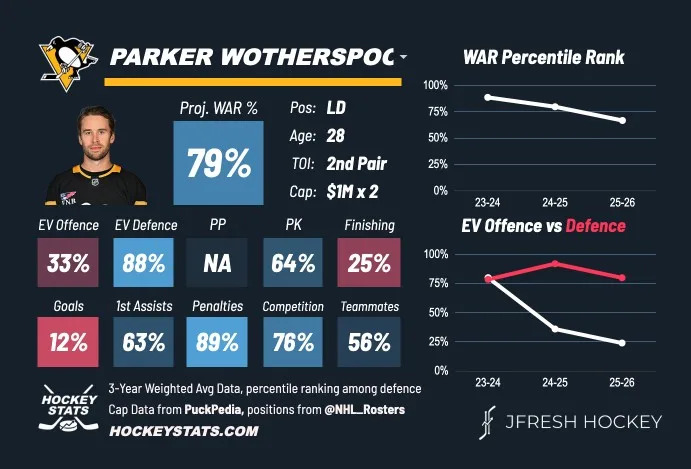
It’s one thing to put up a nice looking WAR in a third pair, sheltered role like Wotherspoon had with the Bruins in the prior years to 2025-26. It’s another to ramp up the competition and still succeed like Wotherspoon did this year with the Penguins. Wotherspoon’s recent sample ought to put him in discussion of the best defensive defensemen in the game right now, or at least one of the most under-rated. While it would be too big of a leap to consider him THE singular best in that area, his name does belongs in the conversation about the best players that don’t get talked about much given the strong results he’s putting out there defensively. The Pens had decent enough data from the past to put Wotherspoon in a key role and see if he could perform well and he rewarded that faith in a major way.
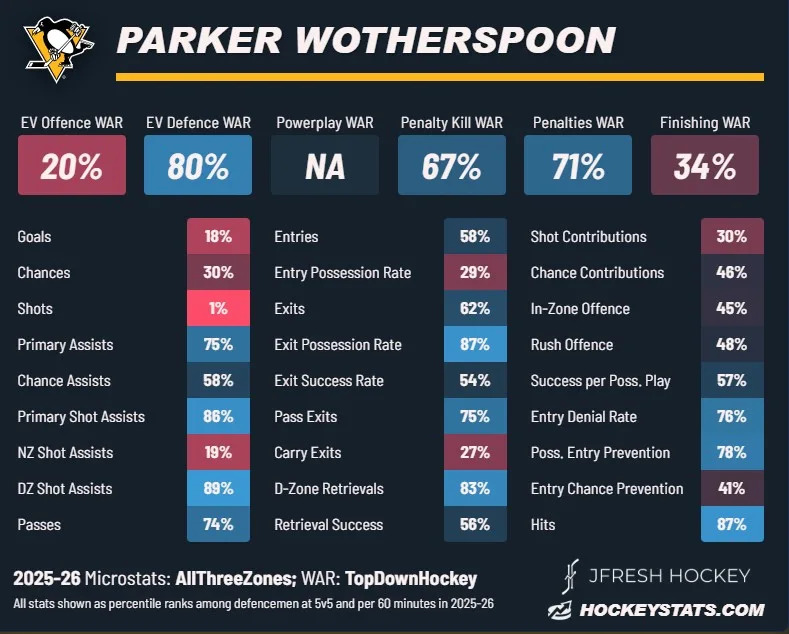
Despite putting up 27 assists and 30 points, there still were moments left to be desired in the offensive zone. Often times Wotherspoon’s stick was where the play went to die for in-zone offense. He doesn’t have a very good shot for the NHL level and his offensive game in general can be fairly mundane and basic, playing with such gifted offensive players can make that stand out even further.
Advertisement
However, Wotherspoon more than made up for those limitations by being excellent with the puck in the defensive zone and between the bluelines. He is a good player at exiting the zone with a pass and helping the transition game. He racks up a lot of assists by starting sequences, 15 of his 27 assists were secondary. Plays have to start somewhere, and Wotherspoon is exceptional at being that starting point. That may sound simple but is often a differentiator between an effective defensive player and one that languishes is that consistency element.
The other standout from this chart demonstrates Wotherspoon’s ability to prevent entries to the opposition with possession and his physicality. If they don’t dump the puck, he is capable to deny entry with his stick or standing up a player physically with his body. If opponents do surrender possession by chipping the puck in deep instead of carrying it, then Wotherspoon can shift to go back to retrieve it and start play the other way. (This element was also boosted by Karlsson’s strengths, who as we’ll see in his season recap excels at using his skating to retrieve pucks as well). Based on that active stick and outright eagerness to engage physically, there’s no doubt Wotherspoon makes the game incredibly difficult for the opposition and was surely the most consistent and competent defensive defender on the team this season.
Also should stop for a sticktap to Wotherspoon’s work on the PK as well. No Penguin defender got called on more in this realm and Pittsburgh ended up in sixth in the NHL in PK percentage. Wotherspoon was a cornerstone player for that group and deserves a ton of credit for his part of that end result.
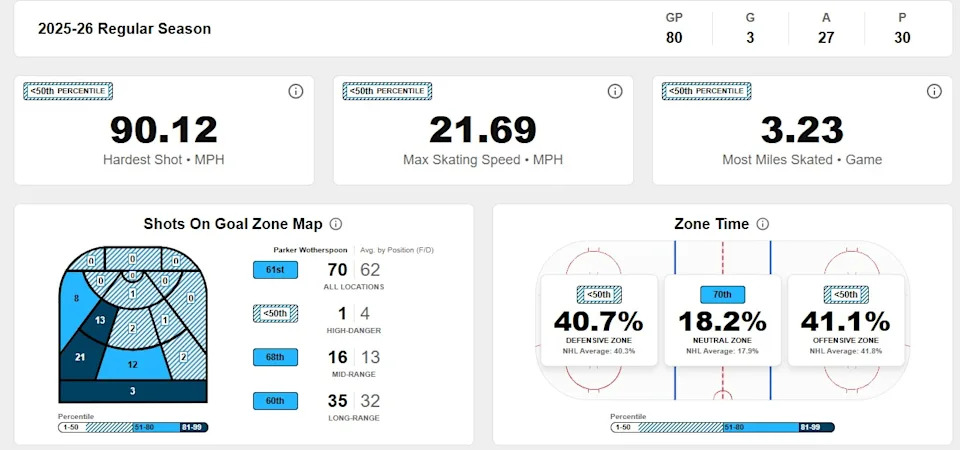
The NHL Edge data feeds into the story the microstat data tells of Wotherspoon being fairly basic and nondescript in the offensive zone. He doesn’t have an overpowering shot by NHL standards and he doesn’t stray far from his left point position to create more. Fairly vanilla in that regard, which isn’t meant to be a complete pejorative, it just is what it is where he’s not going to activate or look to get too far out of the structure where a player like him is meant to be. Wotherspoon’s game isn’t centered on pushing the envelope to create chances in the o-zone, it’s about defending and then working in transitional play to get the puck headed the right direction so that his more skilled teammates can do their thing.
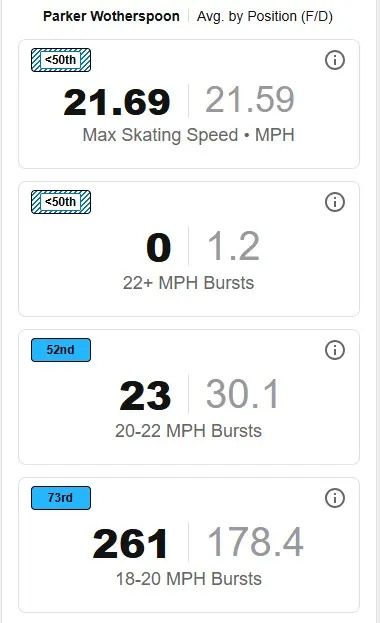
Despite not being an excessively fast or gifted skater, Wotherspoon certainly has enough burst and athleticism in his legs to get around the ice effectively. His speed isn’t high-end by any means, though he isn’t slow either and becomes a punishing player around the boards, corners and net with physicality once the play zeroes in on those areas.
Advertisement
Highlights
Questions to ponder
Should the Penguins engage in contract extension talks this summer? Wotherspoon would be worth seriously considering it. Both player and team might want to take more time to firm up his true value and level moving beyond 2026-27, but I think it’s fine to be of the belief that enough has been displayed to know this is a player a team (with practically no defensive depth) should be interested in extending the length of time they keep Wotherspoon around. Otherwise, there’s not much to question for a low-maintenance option that fit right into the team.
Ideal 2026-27
Really, an ideal 2026-27 for Parker Wotherspoon would be a carbon copy of how 2025-26 actually unfolded. Give me 80 games of a physical, reliable, sturdy first pair defender that can handle the puck well in the DZ/NZ, covers up effectively for teammates when needed and plays important PK minutes. And all for a million bucks!
Advertisement
Bottom line
Wotherspoon would be a steal at twice the price, as the old saying goes. He had a tremendous season and was way better than anyone could have expected. Which helped the Penguins do much the same.
Pensburgh Grade: A Wotherspoon was a huge presence at even strength, strong on the PK, and he produced 30 points. He was a rising tide that elevated his unit and by virtue, the team at large. It’s not a pretty picture to think about what the blueline would have looked like without his contributions, which says a lot about his value and performance.
Read the full article here