





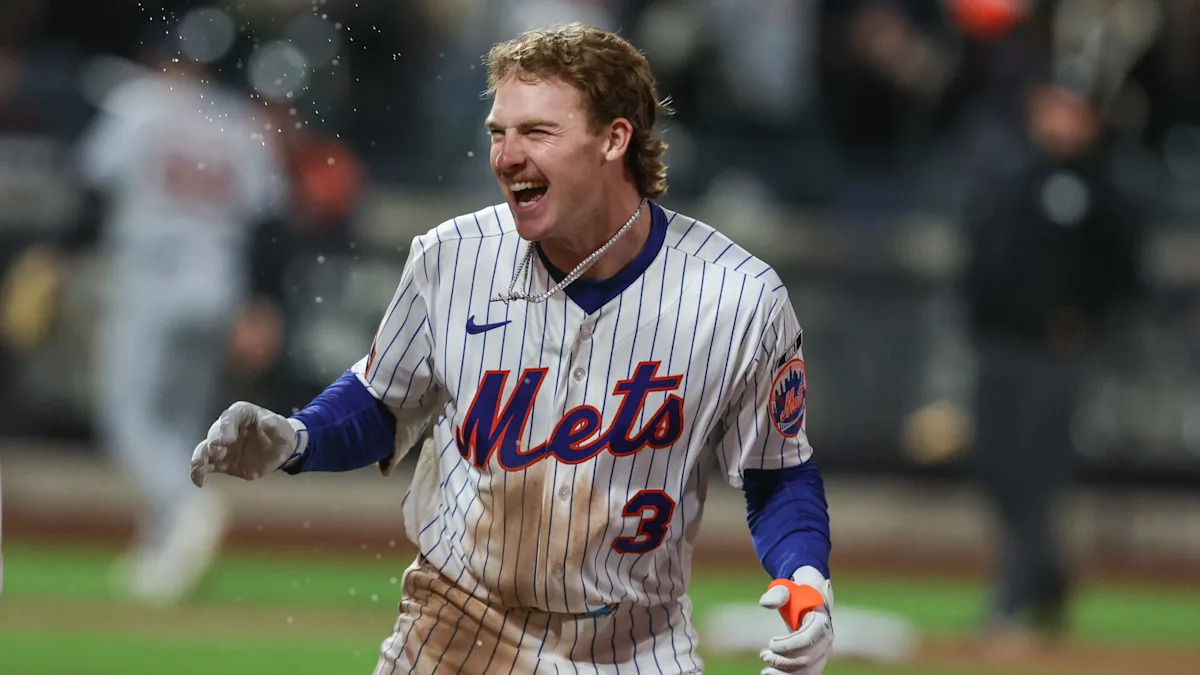
Nothing about this season is going as planned for the New York Mets. They enter play on Tuesday at five games under .500 despite having the second-highest payroll in baseball. Even while being in the midst of a hot streak, it’s not the high-priced stars who are driving the turnaround, but an infusion of young talent that wasn’t meant to be relied on so much in 2026.
When Carson Benge made the Mets roster out of spring training, it wasn’t a major surprise. He was the 19th overall pick in the 2024 MLB Draft and the second-ranked prospect in the Mets’ system. Coming into spring training, he was the 13th-ranked prospect in all of baseball, according to MLB Pipeline, and the 19th-ranked one, according to Baseball America. He was a highly-regarded young player.
Advertisement
He was just supposed to be an ancillary piece of the puzzle in 2026.
Benge had played just 24 games above Double-A in his professional career, and had only played 32 games at Double-A, so he didn’t have a long track record of at-bats in the upper minors. What’s more, he struggled in his time at Triple-A, slashing .178/.272/.311 in 103 plate appearances. Even after winning the starting right field job out of spring training, he hit either eighth or ninth for the Mets in the first 12 games of the season. This was Francisco Lindor and Juan Soto’s team, and Benge was just one of a handful of players who could help the team win with defense, baserunning, or contact rates that would support the superstars.
Until injuries changed everything.
First, Juan Soto missed 15 games with a right calf strain. On the day he came back, Francisco Lindor strained his calf and has now been sidelined for 23 games. Newly-acquired center fielder Luis Robert has also missed 20 games with a lumbar spine disc herniation, and new first baseman Jorge Polanco has missed 31 games with wrist and Achilles injuries.
Advertisement
Somebody else was going to need to step up.
Early on, it didn’t seem like that would be Benge. The rookie slashed .179/.247/.282 in his first 25 MLB games with two home runs and six steals, but also a 22.4% strikeout rate and a well-below-average 53 wRC+. It would be natural for a young hitter to feel overwhelmed by that kind of early struggle.
“It’s tough when you first get here and start off slow,” said Mets second baseman Marcus Semien, who hit .234/.300/.372 with six home runs and a 27.5% strikeout rate in 64 games as a 23-year-old in 2014 with the White Sox. “They gave [Carson] the starting outfield job right away as a guy who spent a lot of time in Double-A last year, a little bit in Triple-A. That’s a tall task for him, but we’re all going to go through ups and downs. The talent will eventually get you out of it. While you have all that talent, while you’re here, you’re going to learn more and more, so you’re only going to get better.”
That’s certainly been the case for Benge, who, despite his early struggles, never deviated from his approach: ‘I don’t feel like anything changed. Just coming out here, playing the same game, staying steady in my work, and I feel like things just started to turn the corner.” They turned the corner in a big way.
Advertisement
Over his last 25 games, Benge is hitting .333 with two home runs, 18 runs scored, 14 RBI, and three steals. The Mets moved him into the lead-off spot seven games ago, and he has responded by hitting .412 with six RBI, eight runs scored, and a .915 OPS in those seven games entering Tuesday. Not that where he hits in the order matters to Benge at all.
“Not at all,” he said one day after delivering a game-winning hit against the Tigers on May 12th. “It’s always hit the ball hard, have a quality AB, get on base. That’s all I’m thinking about every time I go up there.”
That business-like approach seems to be a common thread among the Mets’ young talent. Despite both Benge and fellow rookie outfielder A.J. Ewing being dynamic athletes who are capable of making explosive plays on the field, they both seem methodical and measured in their approach to the game: “I’m just coming out here and competing every day,” said Benge. “Having fun, not taking it too seriously, treating it like a kid’s game, but also having that professional approach to it.”
“Professional approach” may also be the best way to describe Ewing.
Advertisement
The 21-year-old has shot through the Mets system this year. He started the season at Double-A but was promoted to Triple-A after just 18 games. Then, after 12 solid games in Triple-A, the Mets promoted Ewing to the big league roster to help fill the void left in the wake of Luis Robert’s injury. Some on the outside may have viewed that promotion as rash or desperate, but the Mets knew what they were getting in Ewing, who stole 70 bases in the minors in 2025. The 21-year-old has hit the ground running, going 7-for-23 in his first seven games with one triple, one home run, six runs scored, two steals, and a 7/7 K/BB ratio.
It’s that advanced approach at the plate that has fueled much of Ewing’s early success.
“I think I’m a patient hitter at the plate,” he said just two days after his MLB call-up. “I see a lot of pitches. I also put the ball in play a lot, and I’m just not going to stray away from that, spray line drives everywhere, and just keep doing that.”
He did that in his MLB debut against the Tigers on May 12th, going 1-for-2 with two walks, two RBI, a stolen base, and two runs scored.
Advertisement
“You look at the game A.J. had, getting on base four times, using his speed,” explained Semien. “That added a spark to us immediately with 10 runs.”
Yet, despite evidence to the contrary, neither Ewing nor Benge sees themselves as a spark plug. Or they won’t admit it.
“I feel like everybody in this clubhouse can help. That’s why we’re all here,” said Benge. “We’re all here for a reason, so anyone can be the spark plug that can get us going at any time.” In a similarly muted fashion, Ewing mentioned that, “Every game, there are nine guys who go out there and try to win a ball game. No matter who’s out there, we’re going to do our best to do it.”
That level-headed approach has helped the rookies handle the added scrutiny of their expanded roles on this Mets team. Being in your first big league season and having an everyday job on a team with World Series aspirations is pressure enough. Having to do that in a media market like New York, during a season in which much of the focus has been on your team’s early-season struggles, is a level of pressure not many athletes face. Yet neither Benge nor Ewing is running from it.
Advertisement
“You can’t shy away from anything,” stated Benge. “You just got to attack it head-on.”
“It still feels [surreal], and I think it’s gonna feel that way for a while,” said Ewing of his current role on this Mets team. “I mean, this is a dream I’ve had since I started playing the game, and it’s awesome to be here… The atmosphere is a lot of fun, and it’s a great time, but when you’re out there, it’s tunnel vision. I’m just trying to win a ball game.”
Winning ballgames is exactly what the Mets have started doing. The team is 6-1 since Ewing was recalled and Benge was moved to the lead-off spot. That could be a coincidence, but it could also be because of the focus and strong will of two young players who have risen through the minor league system together and know how much this moment means.
“You know, [Ewing] is the first one I’ve played with to be able to come up here with me, besides Nolan [McLean],” said Benge. “It’s definitely cool to see.”
Advertisement
For his part, Ewing is also happy to see his former teammate in a high-profile role with the big league club: “It’s awesome to see Benge in that situation, just because I went through the system with him…Everyone here has been a great help to me, but I think he’s one of the guys that I gravitate to, just because we’re super comfortable with each other.”
They’re not only comfortable with each other, but they’re comfortable with themselves. Benge trusted that he would start to see some results on the field by sticking true to his approach, while Ewing has been convinced that his stellar track record of production will continue, no matter what level he’s at.
“There are good pitchers at every single level,” he said about the transition to the big leagues. “Obviously, everyone here is gonna have really good stuff, and they’re here for a reason, but at the same time, I’m good in my own regard too, and I’m just gonna stick to what I do….Not changing in the box and just doing exactly what I did in Low-A, High-A, Double-A, and Triple-A, and just sticking to that.”
It’s a steadfastness and a self-belief that the Mets needed amidst their early-season struggles. Maybe that, more than their vibrant, youthful energy, is how the two youngest stars are helping to turn fortunes around in Citi Field.
Read the full article here