





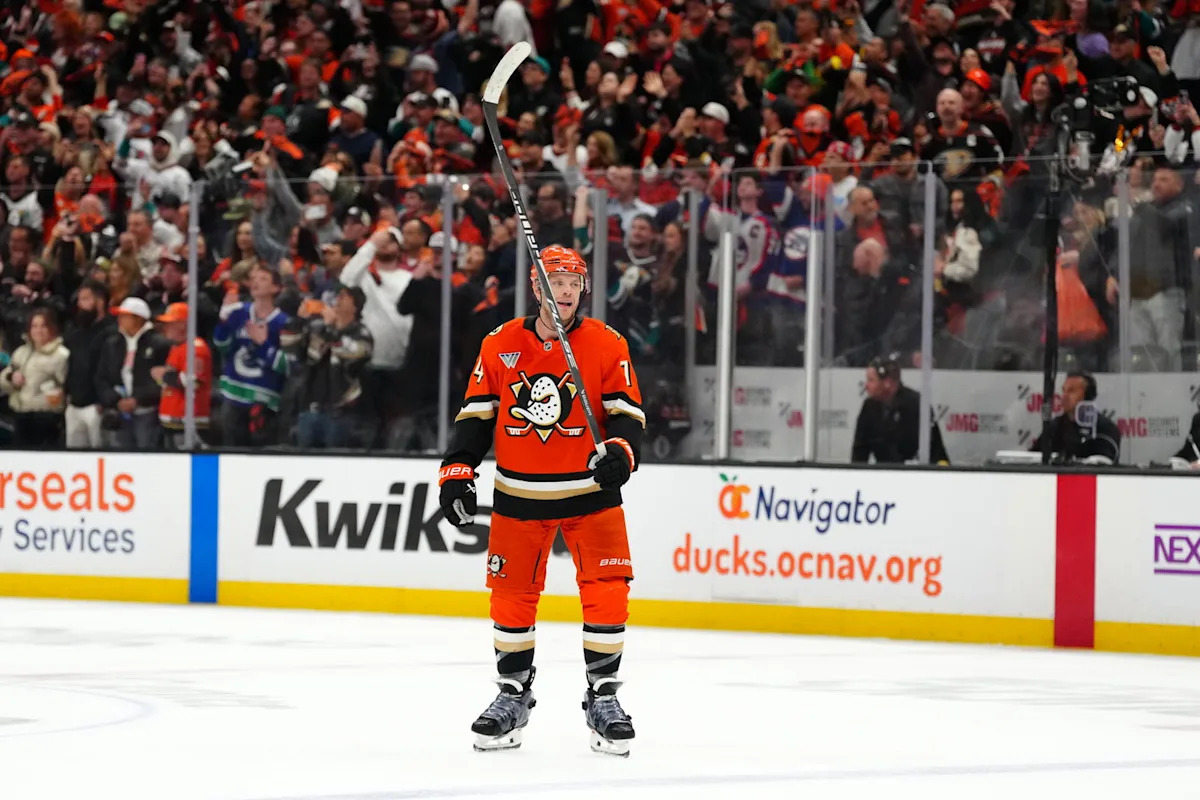
In the late hours on the eve of the 2026 NHL trade deadline, the Anaheim Ducks acquired defenseman John Carlson from the Washington Capitals in exchange for a conditional 2026 first-round pick and a 2027 third-round pick.
The condition on the pick stated that if the Ducks missed the 2026 playoffs, they could elect to send Washington their 2027 first-round pick instead. The Ducks made the playoffs, so conditions were not met, and their 2026 pick now belongs to the Caps.
Advertisement
Carlson (36) was in the final year of his contract that carried an AAV of $8 million.
Lack of Adjustments Proved Costly for Ducks against Golden Knights
Takeaways from the Ducks’ 5-1 Loss to the Golden Knights, Vegas wins Series 4-2
“I thought this was a time where I looked at giving this group another extra push, another little aid in helping us make this push to where we want to go,” Ducks general manager Pat Verbeek said after the trade. “And so ultimately, if we get into the playoffs and we can have a nice run, I looked at it like this: it’s worth it. It’s worth it to give this group experience, give them a chance to make the playoffs, and to do well in the playoffs, with the hope that we’ll be able to re-sign him when this season’s over.”
Advertisement
Carlson was injured at the time of the trade, but wound up playing 16 games for the Ducks down the stretch of the regular season, where he was a fixture on both Ducks special teams units, averaged 24:11 TOI per game, and scored 14 points (3-11=14).
He played all 12 of the Ducks’ games in the playoffs, in the very same role as he did in the regular season, greatly factoring into the franchise’s first series win since their trip to the 2017 Western Conference Final. In those 12 games, playing primarily with partner Pavel Mintyukov, he averaged 24:03 TOI/G and scored six points (0-6=6).
Anaheim’s season came to an end on Thursday in Game 6 of their second-round series against the Vegas Golden Knights. Carlson played a total of 28 games with the Ducks (including regular season and playoffs), and he will become an unrestricted free agent on July 1 if he and the Ducks do not come to an agreement on an extension before then.
Perry Nelson-Imagn Images
“I certainly loved it here, and there’s a lot of moving parts, but I’ve loved my time,” Carlson said during his exit interview. “It’s a special place here for sure, with some extraordinary talent and a bright future. So, that is certainly attractive to anyone, not just myself.”
Advertisement
The Ducks will now send the 18th overall pick in the 2026 Draft and their third-round pick in 2027 to the Capitals. Now that the dust has settled and the landscape is clear, the question of worth comes back to the forefront.
The idea of adding a player of Carlson’s caliber and experience to the Ducks’ roster made perfect sense at the time of the trade. The critiques of the trade lie in the price of acquiring a player on an expiring contract and the fit of said player on the roster he was joining.
Carlson had been Washington’s #1 defenseman for over a decade prior to the trade, was a force on both sides of the puck, and ate minutes on the power play, penalty kill, and at 5v5.
As his career has progressed and he’s found his way into his mid-to-late thirties, Carlson’s mobility has predictably declined, as has his defensive impact, while he’s maintained a high percentage of his offensive prowess.
Advertisement
With dynamic, albeit unproven offensive talents littered throughout their blueline (Olen Zellweger, Pavel Mintyukov) and defensive pipeline (Tristan Luneau), adding another offensive-oriented defender raised eyebrows and questions of whether it was the right add for this Ducks lineup.
“The things that I’ve liked a lot about him is he’s a very intelligent player, very good puck mover,” Verbeek said of what he adds to his defense corps. “I like how he joins the rush in a real cerebral way. His 5-on-5 numbers this year have been outstanding. So I think moving forward, whether it’s a playoff run or a playoff push, 5-on-5 play becomes very important, and it’ll be important for our group to make sure that we can keep pushing to make the playoffs.
“When I look at what he’s done, I think that was probably the most important part of all. Now, we can distribute the ice time in a different manner. We can get better matchups.
There’s a lot that went into acquiring him and allowing us to have different looks, different options for our coaching staff.”
Advertisement
Carlson produced well in the regular season, and his underlying numbers were positive in the playoffs. When he was on the ice at 5v5, the Ducks accounted for 53.36% of the shots on goal, 54.59% of the shot attempts, and 51.55% of the expected goals, despite being outscored 11-7.
He was a key factor on the Ducks’ spectacular power play in their opening series against the Oilers, where they converted on eight of 16 opportunities. He was an important piece on the breakout, executing key first passes out of the zone to spark rush opportunities for his teammates.
However, his impact and the positive aspects he brought to the Ducks were somewhat negated in the Ducks’ next series against the Golden Knights.
Vegas was able to thwart the Anaheim power play, which only converted four goals on 22 opportunities through six games. The Knights played a stingy brand of defense in their end, blocking endless perimeter shots and limiting Carlson’s ability to produce from a relatively stationary position at the point. Lastly, they were able to eliminate his breakout impact, cycle for extended periods of time in the Anaheim zone, and exploit the Ducks’ overall lack of inner slot defensive prowess, an area where Carlson doesn’t exactly thrive.
Advertisement
Hindsight will always be 20/20, and Carlson did inarguably improve the Ducks’ blueline down the stretch of the regular season and into their playoff run. However, one can’t help but wonder if other reportedly available defensemen at the trade deadline, such as Colton Parayko, MacKenzie Weegar, or Brandon Carlo, would have been better stylistic and long-term fits on the Ducks’ back end than Carlson.
Until July 1, the Ducks will have exclusive negotiating rights with their three veteran UFA right-shot defensemen: Carlson, Jacob Trouba, and Radko Gudas. This offseason will provide Verbeek a unique opportunity to address an area of need, both on the roster and on the ice, and decisions made could prove pivotal in determining how they can build off the success of the 2025-26 season and playoff run.
Takeaways from the Ducks’ 3-2 Overtime Loss to the Golden Knights, Vegas Leads Series 3-2
Olen Zellweger Has Given Ducks A Boost
Ducks GM Pat Verbeek Finalist for General Manager of the Year
Read the full article here