





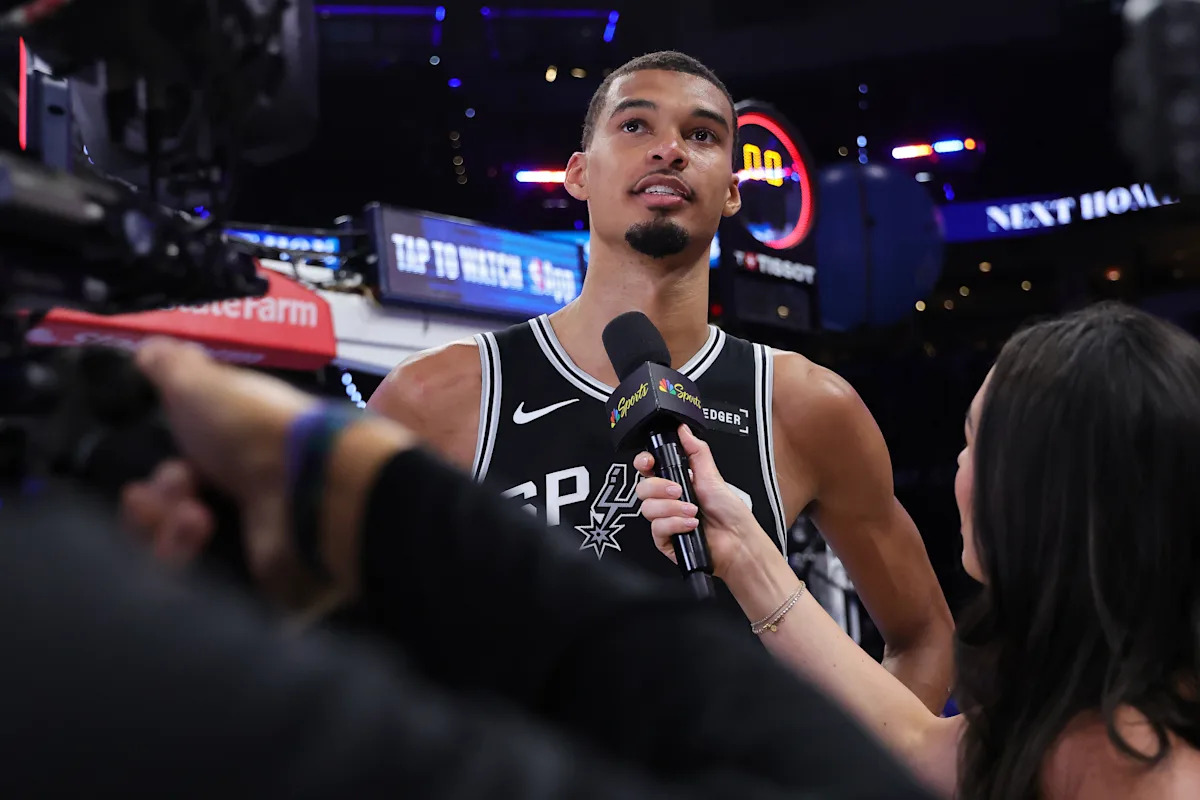
I won’t blame you if your jaw hit the floor watching Victor Wembanyama score his 41 points in the thrilling Game 1 win over the Oklahoma City Thunder. The 30-foot, Steph-esque 3-pointer in overtime. The mind-melting dunks all over OKC’s defense. Pure cinema.
Feel free to shake your head at the fact that he pulled down 24 rebounds, which was more than the entire OKC starting lineup. Add in that he swatted away three OKC offerings and held the Thunder to 35.7% shooting on twos while he was on the floor. That’s all great.
Advertisement
But the craziest number of all is 22 — the number of years that Wembanyama has been alive.
“Best player in the f***ing world,” his teammate Stephon Castle said after the game.
To be clear, that was a reminder, not an announcement. I understand why folks have been reluctant to crown Wembanyama as The Best Player In The F’ing World because we’ve been conditioned to wait until it feels safer. Wait until they hit their prime. Wait until their team has won the championship. Wait until … well, they’re older than 22 f***ing years old.
But as a basketball species, Wemby is different, hence the alien moniker. He’s taller than everybody, yes, but the true differentiator is that he’s processing the game quicker than anyone. I noticed his processing power two years ago when I wrote that he was on the GOAT path. I doubled down this season when I predicted in October that he’d win MVP this season (he qualified under the 65-game rule, but I don’t think he played enough minutes to convince voters).
Advertisement
So as someone who has been touting Wemby perhaps earlier than most (too early at times!), let me say this: Monday’s Game 1 supernova didn’t establish him as the best player in the galaxy. Because he already snatched that mystical accolade weeks ago from Shai Gilgeous-Alexander, Nikola Jokić or whichever name you throw into that pile.
We can look at the measurables, which have been admittedly warped downward by Wembanyama’s unexpected absences. The Game 2 concussion against Portland and Game 4 ejection against Minnesota threw a wet blanket on his per-game averages because he only played a handful of minutes in those games.
But rest assured, when Wembanyama was on the floor, he was putting up numbers. Wembanyama was averaging 25.4 points, 13.9 rebounds and 5.2 blocks per 36 minutes heading into Monday’s Game 1, hinting that a monster 41-23-3-3 outing was within reach. But judging by his more pedestrian 20.3 points, 10.7 rebounds and 4.1 blocks (OK, that last one isn’t pedestrian), you might not have guessed that Wemby made another leap.
Make no mistake about it, Wemby leveled up. Those gaudy box-score numbers don’t do justice to Wemby’s recent impact, especially on the defensive end. Even before Game 1, he has been neutering opposing offenses in ways that we haven’t seen. The Blazers entered the first-round series averaging 113.1 points per 100 possessions, per NBA advanced stats. With Wembanyama on the floor in the series, that scoring rate plummeted from 113.1 to 95.7 — a near 20-point drop.
Advertisement
OK, but that was a play-in team, right? What about a team that went to back-to-back Western Conference finals? With Wemby on the court, the Minnesota Timberwolves, who had just scored 112.8 points per 100 against Denver, saw their scoring rate crash to 96.8 in the second round — another near 20-point drop.
Well, they were short-handed in the backcourt! Wait until Wemby faces the undefeated defending champs! The Thunder torched the Suns and Lakers to the tune of 126.3 points per 100 possessions this postseason. And now they have Jalen Williams!
In Game 1, Wembanyama held the Thunder to 96.8 points per 100 possessions — a near THIRTY-point drop.
Welp.
Advertisement
Again, this guy was posting a higher scoring rate than Nikola Jokić this postseason, and I can promise you that Jokić wasn’t single-handedly making every opponent crash out offensively on every possession down the floor. Even before Game 1, no player was controlling the game like Wembanyama.
Need more cold, hard evidence that Wembanyama had already taken the torch from SGA and Jokić? We can look at the advanced impact numbers at Dunks and Threes, headlined by Estimated Plus-Minus, which attempts to measure a player’s per-100 possession impact on the scoreboard according to a variety of factors including box-score data, opponent strength, teammate quality and on-off splits.
When the season started, EPM agreed with the conventional wisdom that Jokić and Gilgeous-Alexander were head and shoulders above the competition, posting a +7.5 and +7.4 EPM, respectively. No one else was higher than +6.5, and Wemby sat at +3.8 EPM.
And then the regular season happened. Wembanyama migrated closer to the basket just as we saw in the preseason and became an unstoppable force.
Advertisement
The gap closed. For those clocking BPITFW (Best Player In The F-Ing World) status, Wemby flew past the competition in the impact metrics by the end of the regular season, registering a +8.5 EPM compared to SGA’s +8.4 figure and Jokić’s +7.7 mark in early April. Take a look at how Wembanyama’s green line — depicting the trendline of his in-season EPM marks — soars upward toward SGA’s blue line and Jokić’s yellow line. He eclipsed them a month ago.
via Dunks and Threes
On Tuesday morning, as one would imagine, Wembanyama’s lead remains.
If you’re suffering from Wemby whiplash, I get it. This happened quickly. Wemby went from All-Star (+4.0) to BPITFW status (+8.0) this past season, a tiny span which is basically unheard of. It’s hard to see in the above graphic, but a cluster of Wemby’s green dots illustrating his recent games hovered above the yellow and blue ones — even before Monday’s Game 1.
Advertisement
If you want analytical evidence that a passing of the torch has already happened, there you go.
I’ve been tracking this in real time. Ahead of the playoffs, I said that if I needed to win one game, I’d pick Wemby over the rest — yes, SGA and Jokić included. Most people didn’t see it that way because the Spurs’ core hadn’t won a playoff game yet, but from my view Wemby was already the most dominant force in the game. And now we’re here.
I will keep banging this drum because I don’t think people have quite grasped what we’re witnessing: this is the worst version of Wembanyama that we will see for the next decade. This is only the beginning. Wembanyama is going to get stronger, smarter and more refined. Like any player, we have to slap on the annoying caveat, barring injury, but this will be the worst version he’ll be for the foreseeable future.
Let me put this a different way. Imagine if Wembanyama was playing against his peers at the University of Texas, the Austin campus sitting just 80 miles down the road from the Spurs’ Front Bank Center. It’s a preposterous thought. But he’s young enough to fit in there as a college senior.
Advertisement
Think about that. At 22, Wemby just put up 41 points, 24 rebounds, 3 blocks and 3 assists in Game 1 of the Western Conference finals. Against the defending champs. In their building. Without the benefit of his starting All-Star point guard.
And he did all that while being a year younger than lottery prospect Yaxel Lendeborg, who has NBA execs drooling after winning the national championship at University of Michigan. Kareem Abdul-Jabbar — then Lew Alcindor — was Wemby’s same age when he was drafted No. 1 overall by the Milwaukee Bucks in 1969 (well, technically he turned 22 about a week after draft night). By most accounts, he was the best collegiate ever, winning three championships in his time at UCLA.
Now envision this Wemby in college as the modern Kareem. You thought tanking was bad this year? Just imagine for a second if this version of Wembanyama was in this draft. We’d have our first 0-82 team, I’m convinced. And I’m saying only one because it’s mathematically impossible to have multiple winless teams. I think owners would be suiting up their GMs just to have a chance at this guy in the draft lottery.
Advertisement
Because what we just witnessed from Wemby on Monday was prime Shaq, the one that bulldozed his way through opposing centers like a freight train slamming through tumbleweeds. In fact, according to Stathead, Wembanyama became the first player to put up at least 40 points and 20 rebounds in the conference finals game or later since Shaquille O’Neal in the 2001 NBA Finals.
But Shaq was 29 years old then, at the peak of his powers. Wembanyama has seven years to go before he reaches that physical apex. With his Game 1 performance, Wemby etched his name in NBA history as the youngest player to record at least 40 points and 20 rebounds in a playoff game.
As crazy as it sounds, this might not be his best performance of the season. The Frenchman didn’t have the luxury of De’Aaron Fox in Game 1 and the center’s numbers get even better when next to his All-Star point guard. Once Fox comes back, there’s a chance Wemby’s next big moment will be even gaudier than 41-24-3-3. Don’t wait for conventional wisdom to catch up. Wembanyama isn’t waiting for anybody.
Read the full article here