





It’s believing season in Major League Baseball.
This weekend, all but one team will pass the 40-game mark, a very unofficial but nonetheless meaningful checkpoint that signals the season is already – gulp – one quarter complete. And it’s officially OK to start buying what you’re seeing.
Advertisement
Oh, that’s not a hard and fast rule. Fans can believe the New York Mets won’t lose 99 games, and Fernando Tatis Jr. won’t finish with zero home runs, and they’ll probably be correct.
But for many trends, the cement has set even if it’s not totally dry. With that, we take a look at six paces that are defining the season – and would certainly look startling come the end of September:
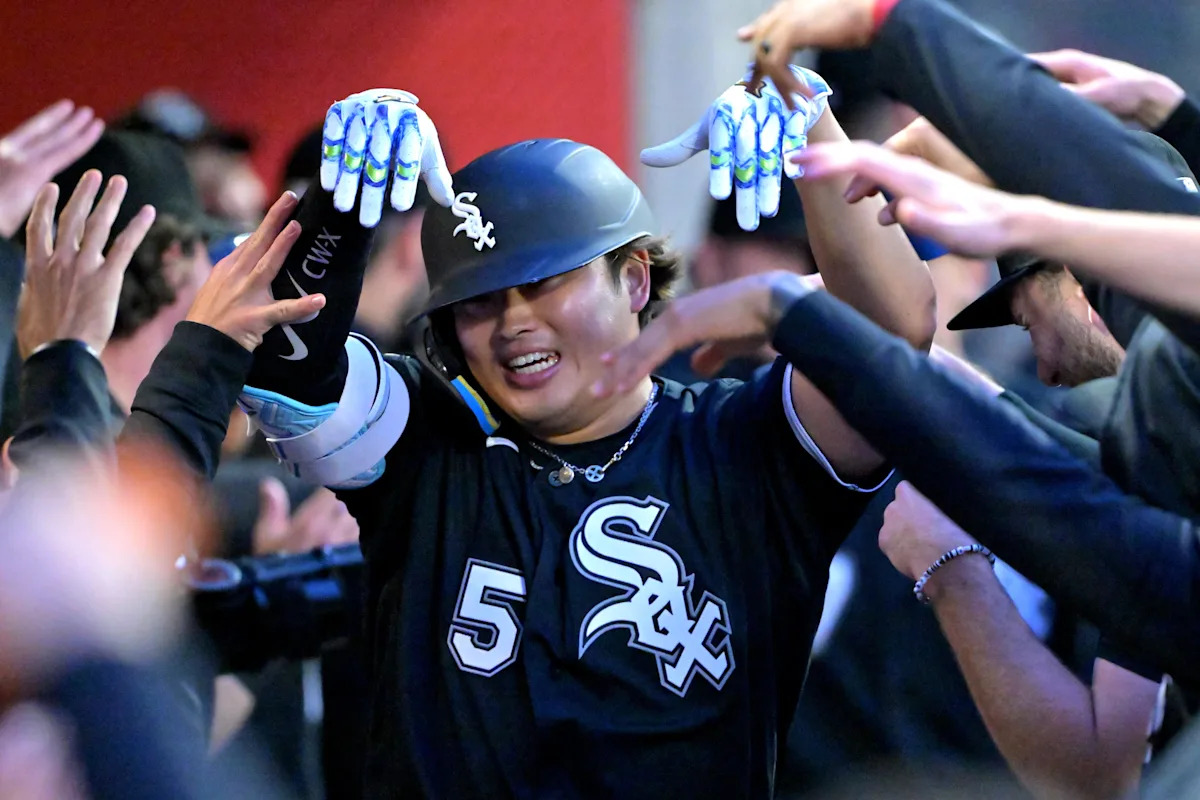
Munetaka Murakami is striking out a lot, but his production – 14 home runs through 37 games – justifies the whiffs.
OK, this one might be tough to maintain. That doesn’t diminish what the 6-foot-2, 213-pound Murakami has done in his first season in the world’s premier league.
Sure, the worrywarts were right: Murakami is striking out 34.4% of the time, his 55 punchouts leading the AL. His whopping 43.9% whiff rate is near the very bottom of the majors. Yet he’s clearly running into enough balls, and his expected slug (.568) practically mirrors reality (.565).
Advertisement
Additionally, his .369 on-base percentage was only slightly dented by the move to MLB, as he posted a .379 OBP his last full season in Japan. An elite 22% chase rate certainly helps that, allowing him three shots to unleash his “A” swing against pitches in the zone.
His two-year, $34 million deal is possibly the White Sox’s finest free agent investment ever. In concert with slugging middle infielder Colson Montgomery and emerging ace Davis Martin, Murakami has helped the 17-20 Sox push memories of 121 losses seem much longer than two years ago.
110: Wins for the Cubs, Braves and Yankees
OK, so these teams probably won’t maintain their .684 winning percentage, right?
Advertisement
Well, you probably didn’t figure that the Cubs would win (at least) 15 games in a row at Wrigley Field, either. Heck, a streak that long hasn’t happened since 1935, but Chicago is now a stunning 18-5 at the Friendly Confines after a raucous four-game sweep of the Reds, who went from second to last place in a hurry.
Now, however, the Cubs will have to carry on without lefty Matthew Boyd, who tore meniscus in his knee. Then again, they lost ace Cade Horton for the season and lefty Justin Steele suffered a setback on the rehab trail and still, the club is 26-12, tied with Atlanta and the Yankees for the best record in baseball.
Once again, Shota Imanaga is off to a fantastic start, with 11- and 10-strikeout games already. Yet April and May are by far the two best months of his career (2.28 ERA, 3.83 the rest of the time). Put it this way: If Imanaga can sustain, the Cubs may just run off with their first full-season division title since 2017.
.500: Winning percentage for AL Central, West champions
Yep, we have at least a remote shot at baseball history: First time a team “won” a division without a winning record.
Advertisement
Folks might remember 1994 for the lost World Series or the historic statistical seasons washed away, but perhaps the real tragedy was sweating whether the Texas Rangers (52-62 and in first place when the plug was pulled on the season) could win the AL West with a .456 winning percentage.
In subsequent seasons, the 2005 San Diego Padres (82-80) and 2007 St. Louis Cardinals (83-79) captured ignominious “championships” in the six-team format, with the Cards Jeff Weaver-ing their way to a World Series title.
Now, we have perhaps the most parity-laden year in recent memory, with 18 of 30 teams within three games of the .500 mark. The flat distribution of wins is most pronounced in the AL’s Central and West, with Cleveland and the Athletics “leading” their divisions at 20-19 and 18-19, respectively.
What gives?
Advertisement
Well, we’re firmly out of the tanking era, teams like the Chicago White Sox and Colorado Rockies have cleaned up their acts and exited their historically awful periods and even clubs trying not to win (hello, St. Louis) are finding surprise success.
Additionally, the schedule – which seems to get weirder every year – has kept many division combatants away from each other. Four AL Central teams have just six or seven games against division foes, while the Tigers, say, have already played 21 interleague games.
Separation may occur once the division games pile up. Then again, there’s no obvious punching bag anywhere in the majors, with only the Rockies and San Francisco Giants barely on track for 100 losses.
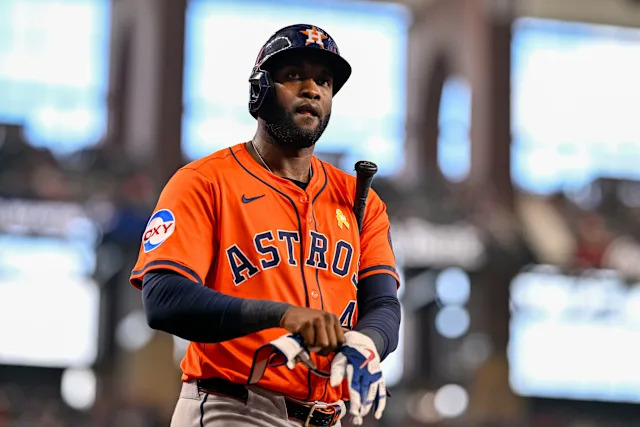
Yordan Alvarez, in the conversation as the greatest hitter of his era, is having arguably the finest season of his career. Yet Alvarez, and Aaron Judge, and Matt Olson and the resurgent Mike Trout are all looking up at a part-time catcher drafted in the 12th round by the New York Yankees.
Advertisement
Ben Rice is not just off to a powerful start, as his major league-best OPS suggests, he’s nearly in the Triple Crown conversation at the moment, leading the AL with a .343 average, second with 27 RBIs and 12 homers trailing only Judge and Murakami.
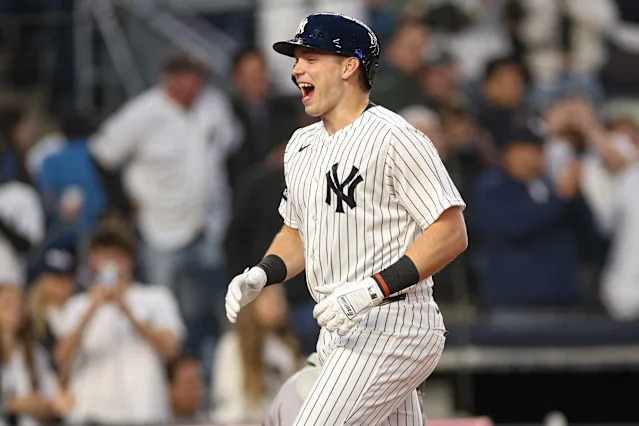
Ben Rice leads MLB with a 1.214 OPS, though he’s sidelined for the moment by a bone bruise on his hand.
This thing is real: Rice ranks in at least the 97th percentile in a half-dozen measurables, and his batting average on balls in play is a normal .269. Sustainable?
Well, Rice is currently day-to-day with a bone bruise on his hand, slowing his roll just a bit as the second quarter nears tipoff. But plenty is already in the bank both for he and the Yankees, now 26-12 after largely bringing back last year’s roster.
Advertisement
Projecting another big step forward for the 27-year-old Rice was clearly a prudent part of their grand plan.
3.61: Walks per game
Weird one, we know. Yet no stat probably better exemplifies the effect the automated ball strike system has had on the game.
That walk rate (per team) is the highest since a 3.75 mark in 2000 (right in the teeth of the steroid era) and third-highest since 1956. And why’s that?
Well, the ABS challenge system has empowered batters to be more selective around borderline calls, and provided a real-time check on umpires who might be more inclined to give pitchers the edge.
In short: The strike zone is smaller.
Advertisement
Has that made it easier to hit? Alas, not really. The leaguewide .242 batting average is the worst since the mound was lowered after the 1968 season, and down 2.5% since 2023, when hitter-friendly rules (a shift ban, bigger bases) were enacted and the league batted a collective .248.
So is life getting easier for pitchers? Um…
8: Complete games
Yeah, that’s the pace. For the entire league. This is not a misprint.
So far, only Miami’s Sandy Alcantara and Seattle’s George Kirby have managed to go the distance, Kirby’s the eight-inning variety in a losing effort. While that seems like nothing new – nobody faces the order three times through, velocity and relievers are king, blah, blah, blah – this drop is still precipitous.
Advertisement
Just last season, pitchers threw 29 complete games, one more than the previous all-time low set in 2024. Starters aren’t working dramatically less than 2025 – averaging 5.1 innings per start, compared to 5.2 a year ago.
Still, it’s instructive to think how dramatic the drop has been over the past decade: Starters averaged 5.8 innings in 2015 and threw 104 complete games that season. Nowadays, the opener is still prevalent as both a strategy and survival mechanism – 21 of 30 teams have used a reliever to start the game so far – and traditional pitching roles continue to get blurred.
Will a 72% drop in complete games hold throughout the season? Perhaps. Pitchers are all stretched out and can get deeper into games than in March and April, but warmer weather also helps the hitters.
Just don’t be surprised when $35 million becomes the baseline salary for the handful of sentient starters on the free agent market.
This article originally appeared on USA TODAY: MLB stats to know: Murakami home runs, Cubs and Braves top standings
Read the full article here