





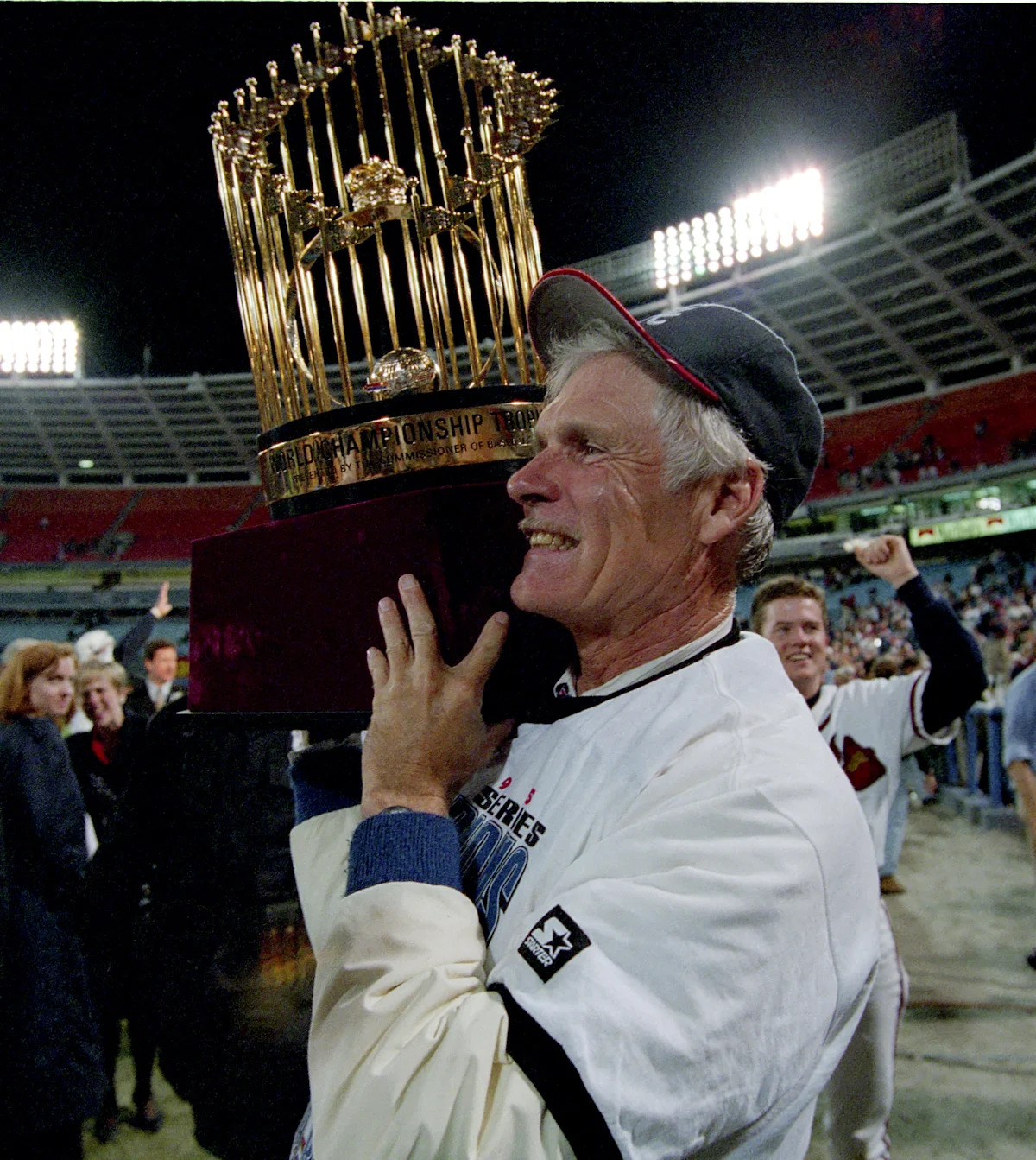
Media mogul, philanthropist and former Atlanta Braves owner Ted Turner passed away earlier today at the age of 87.
The bombastic businessman and cultural icon reshaped the media landscape in the latter half of the 20th century after taking over his father’s company, Turner Outdoor Advertising, in 1963.
A rebellious and ambitious entrepreneur, Turner began acquiring radio and television stations, including Atlanta’s WJRJ (channel 17), in the late 1960s and early 1970s. He renamed WJRJ to WTCG (for Turner Communications Group), and by the late 1970s began leveraging the emerging technologies of satellite and cable television to expand his media reach nationwide.
Driven by a need for content and profitability for his stations, Turner purchased the Atlanta Braves in 1976 – and the Atlanta Hawks the following year. Both franchises became central to the success of what became known as the Superstation WTBS, helping drive ratings and advertising revenue as Turner broadcast his teams’ games across the country.
Turner bought the Braves during a transitional period for the franchise. The team had moved to Atlanta only a decade earlier, and Braves legend and inner-circle Hall of Famer Henry Aaron had been traded to Milwaukee two years before Turner’s purchase. With future franchise cornerstone Dale Murphy still a young catcher trying to establish himself in the majors, the first four years of Turner’s ownership saw the Braves lose 90-or-more games including a 101-loss season in 1977.
While the team’s on-the-field performance was at a nadir, the team’s 162-game schedule provided a copious amount of content and that combined with Turner’s larger-than-life personality quickly became part of TBS’s identity. Turner famously branded the Braves as “America’s Team” as his station’s baseball broadcasts introduced the club to fans nationwide, making a superstar of Murphy as his back-to-back National League Most Valuable Player seasons came as cable and satellite service exploded across the country.
Turner’s hands-on approach with his MLB team occasionally crossed into controversy. In May 1977, during a 16-game losing streak, Turner briefly named himself interim manager, replacing Dave Bristol for one game before National League president Chub Feeney forced him to relinquish role. Turner appealed the decision, but commissioner Bowie Kuhn upheld the decision. The Braves lost their 17th consecutive game in Turner’s only turn as the team’s skipper.
In another instance, Turner had free agent signee pitcher Andy Messersmith, who wore the number 17 on his jersey, wear “Channel” as his nameplate until the league made Messersmith remove “Channel” from his jersey because of the blatant – albeit humorously ingenious – bit of advertising.
In 1978, Turner hired Bobby Cox as manager, beginning one of the most important relationships in franchise history. Cox managed the Braves until being fired after the 1981 season. In a press conference announcing the managerial change, when asked who he would ideally replace Cox with, Turner famously answered, “Bobby Cox”.
Turner hired former Braves All-Star Joe Torre as the team’s next manager. Torre led the Braves to the playoffs in 1982 before being fired after the 1984 season after two middling but disappointing seasons based on the expectations created during their 1982 success.
Cox, who had become manager of the Toronto Blue Jays in 1982 and led the team to the ALCS in 1985, returned to Atlanta when Turner brought Cox back into the organization as general manager following the conclusion of the 1985 season.
After rebuilding the organization’s farm system, Cox returned to the dugout during the 1990 season as the team’s manager. With John Schuerholtz brought in the from the Kansas City Royals as new general manager, the Braves “Worst-to-First” 1991 season launched an unprecedented era of success that permanently transformed expectations for baseball in Atlanta.
Turner, who was at his peak of celebrity, and then-partner Jane Fonda became regular fixtures in the stands during the Braves’ postseason run in 1991 and throughout the1990s, culminating in the franchise’s 1995 World Series championship.
While Turner labeled is own tenure running the operations of the club a “disaster” his support of his organization’s leadership and financial backing took the Braves from a cellar-dwelling laughingstock in the late 1980’s to a National League juggernaut in five seasons.
Outside of his sports ownership, Turner built one of the most influential media empires in history. His portfolio included Atlanta-based CNN, TBS, TNT, and Turner Classic Movies. CNN, which launched in 1980, revolutionized television journalism as the first 24-hour-a-day news network.
At the zenith of his success in media, Turner’s eponymous Turner Broadcasting merged with Time Warner in 1996. Half-a-decade later, Timer Warner merged with America Online (AOL) in 2001, creating AOL Time Warner. Although Turner initially retained high-level leadership roles with Time Warner, his influence diminished significantly following the AOL merger despite remaining the company’s largest shareholder.
Turner’s accomplishments extended far beyond media and sports. Through Turner Enterprises, he became the second-largest private landowner in the United States. He founded the United Nations Foundation and the Nuclear Threat Initiative, among other philanthropic organizations. He also created the Goodwill Games as an alternative to the Olympics.
Among the honors Turner received are two lifetime achievement Emmy Awards, a Peabody Award in 1997, the Walter Cronkite Award for Excellence in Journalism in 1990, and Time magazine’s “Man of the Year” in 1991. He also has a star on the Hollywood Walk of Fame.
The wry-smiling and mustachioed Turner also left a lasting mark on professional wrestling. In 1988, he purchased Jim Crockett Promotions and rebranded it as World Championship Wrestling (WCW), using it as programming for his networks. His enthusiasm for wrestling helped fuel the “Monday Night Wars” of the 1990s, as WCW battled WWF/WWE for television ratings dominance bringing the entertainment product to a higher national profile.
Turner, who began competitive sailing while at Brown University, won the 1977 America’s Cup as the ship’s skipper and was inducted into the National Sailing Hall of Fame.
Turner’s impact on Atlanta sports extended beyond baseball. His ownership of the Hawks helped establish the franchise in the South, beginning with the hiring of coaches Hubie Brown and later Mike Fratello. The team would then acquire the draft rights to Dominique Wilkins in 1982, giving the team their biggest star since relocating to Atlanta. Although the Hawks did not win an NBA title under Turner, they remained consistently competitive for much of his ownership before the franchise was sold in 2004 to Atlanta Spirit, LLC.
Born in Cincinnati, OH, Turner moved to Savannah, GA, as a child and attended school in Chattanooga, TN. He studied at Brown and served in the Coast Guard Reserves. After his father’s suicide in 1963, Turner assumed control of his father’s advertising business, laying the foundation for the media empire.
For Braves fans, Turner’s impact remains immeasurable. His vision of using the Braves as nationally distributed programming created generations of fans across the country and gave the franchise the financial wherewithal to maintain one of the sport’s highest payrolls throughout most of his ownership.
Although his formal ties of ownership to the Braves ended Time Warner sold the franchise to Liberty Media in 2007, his association with the team was a contestant reminder through his namesake Turner Field, the team’s home until relocating to what is now-known as Truist Park in 2017.
Whatever missteps and controversy Turner made during his early years as owner has largely faded with time. Fifty years after purchasing the franchise, his legacy in Atlanta sports and media is undeniable.
Without Ted Turner, the Braves may never have fully established their roots in the Southeast and wouldn’t have become the brand they are today.
Turner was inducted into the Braves Hall of Fame in 2000.
Read the full article here