





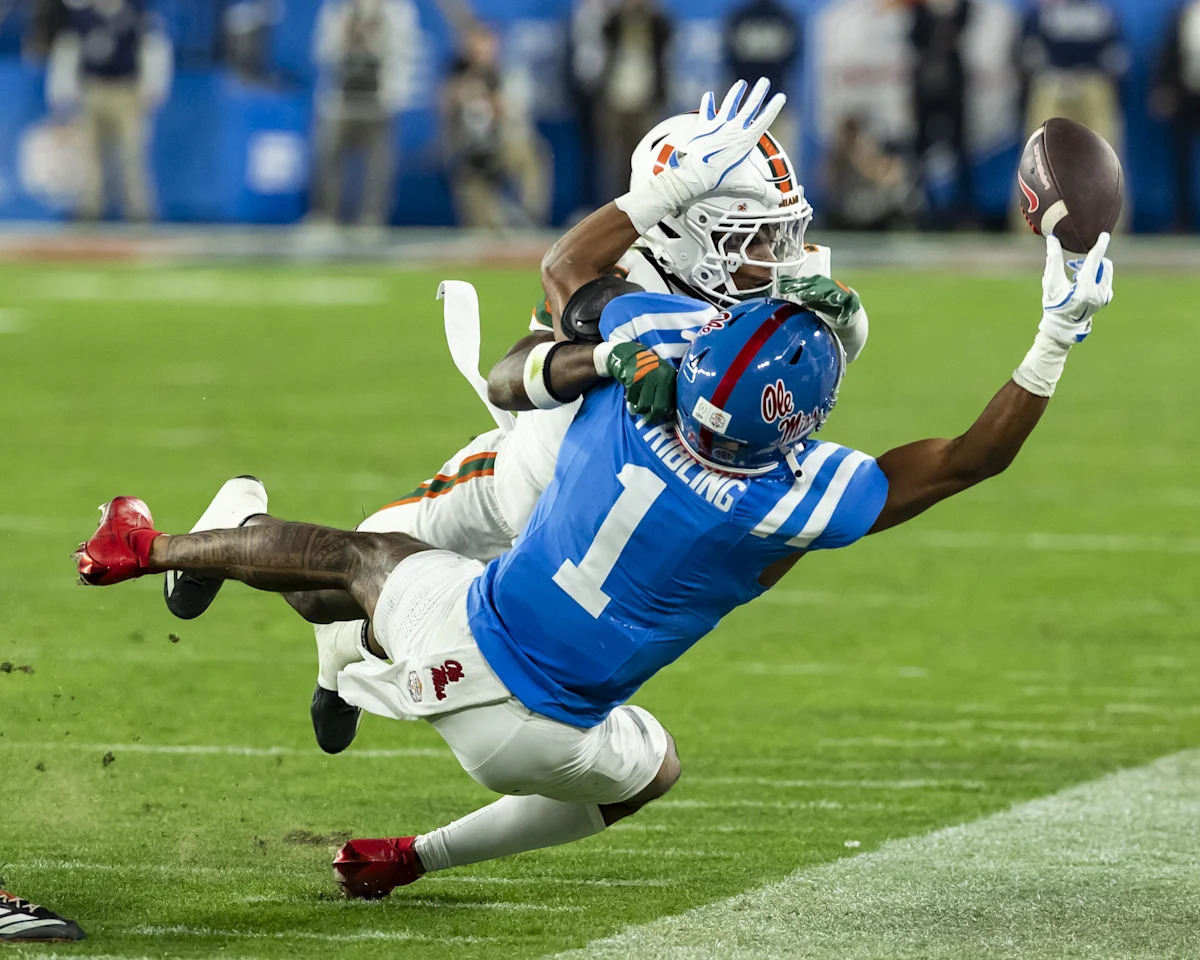
The San Francisco 49ers have been catching quite a bit of flak for their 2026 draft class, especially their choices to deviate from the consensus board with a couple of perceived reaches throughout the draft.
The most notable selections being scrutinized so far have been taking wide receiver De’Zhaun Stribling, considered a late-second round or early-third round player, at No. 33, and running back Kaelon Black, considered a late Day 3 pick, at No. 90 in the third round.
Advertisement
The Stribling pick, though, has been receiving quite a bit of justification from NFL media over the last week, with several insiders believing the NFL was higher on him than the consensus board. NFL insider Albert Breer shared his piece on the Stribling pick on Monday, acknowledging that he had the receiver going at No. 35 to the Tennessee Titans before the draft.
Of course, that was due to him mocking linebacker Arvell Reese over wide receiver Carnell Tate to the Titans at No. 4. But that was around the area he expected Stribling to go in Round 2.
“The 49ers weren’t flying blind with their selection of De’Zhaun Stribling with the first pick in the second round of the draft,” Breer wrote. “Let’s start here: If you would have asked me before the draft began when I thought the Ole Miss receiver would be drafted, I’d have guessed he’d go 35th to the Titans.
“At that point, of course, I didn’t know Tennessee would take Carnell Tate fourth; I had them selecting LB Arvell Reese at No. 4 (their decision was between those two). And in an alternate reality in which Reese goes at No. 4, I believe Stribling would’ve been a real consideration at 35. That didn’t happen, but it’s an example of how Stribling was more highly thought of than the public knew. I got more proof of that prior to Day 2 of the draft, when a few coaches brought him up to me.”
Advertisement
Breer revealed that the 49ers probably had Stribling in that late-second/early-third round category weeks before the draft, before doing their final evaluations and getting a stronger consensus on the wideout.
“And the truth is, for San Francisco, getting there on him was a process,” Breer continued. “Going into the final two weeks before the draft, the Niners viewed him as a really good talent, and probably a late second- or early third-round pick. That’s around when GM John Lynch and coach Kyle Shanahan started drilling down on prospects together.
“They saw a big receiver who ran 4.36 at the combine. They saw a player who came on late, starring in the playoffs, and talked to ex-Ole Miss coach Lane Kiffin, who conceded he was late to the party on Stribling, which limited him a bit early in the year, and that his offensive coordinator, Charlie Weis Jr., saw a special talent right away. They then went back deeper into his tape from Oklahoma State and saw more in-breaking routes, and Washington State, where they saw him star in the screen game. A more complete picture was coalescing.”
But, knowing that Stribling, whom head coach Kyle Shanahan said would’ve been the pick at No. 27 or No. 30 without the trade backs, likely wasn’t going in the first round, the 49ers were comfortable moving back twice before settling at No. 33 on one of their ‘gold helmet’ players.
Advertisement
“They also knew he probably wasn’t going in the first round,” Breer said of the 49ers and Stribling. “Meanwhile, there was a cluster of players they felt comfortable taking with the 27th pick, and they made the decision that if that pool of guys was drained by the time they got on the clock, trading down would be the right move. So the days before the draft, Lynch worked out terms on a trade down to 30 with Dolphins GM Jon-Eric Sullivan on the contingency that the players they were considering were gone.
“When they got on the clock, the aforementioned pool was empty, so they dealt the pick to the Dolphins, who moved up to select San Diego State CB Chris Johnson. Then, ahead of getting on the clock at 30, they looked at Stribling, and figured one more move down would make sense. So San Francisco traded with the Jets, who moved up to select Indiana WR Omar Cooper Jr., and landed at the top of the second round. The Niners fielded calls at that catbird seat of 33, but the prices weren’t quite right and there was enough concern that other teams saw Stribling like they did, so Lynch and Shanahan pushed the button.
“The Niners had gotten themselves to a point where they didn’t want to lose Stribling at 33. Every year, they designate certain prospects who check every box from an athletic, football and character standpoint as “gold helmet” players. This year, they had 16 gold helmets, and Stribling was one of them. In addition, Shanahan’s vision for Stribling in his offense was crystal clear, both in the short and the long term.”
Overall, it looks like the NFL was higher on Stribling than the media, and it seems like there was a good chance he’d be gone somewhere in the second round. Now, could this be more of a positive spin on the Stribling pick after the questions over the last week? Perhaps. But Breer sheds a different perspective here that a couple of analysts are starting to share following the draft.
Advertisement
“To me, this is the sort of case you see closer to the draft every year, where a quiet drumbeat grows on a player and they wind up going before the public expects them to. Johnson, who went in the Niners’ original slot, is an example of that, as is Dallas’ second first-round pick, UCF edge rusher Malachi Lawrence.
“Time will tell whether Stribling is a reach. For now, I know the Niners feel pretty good about getting him.”
Read the full article here