





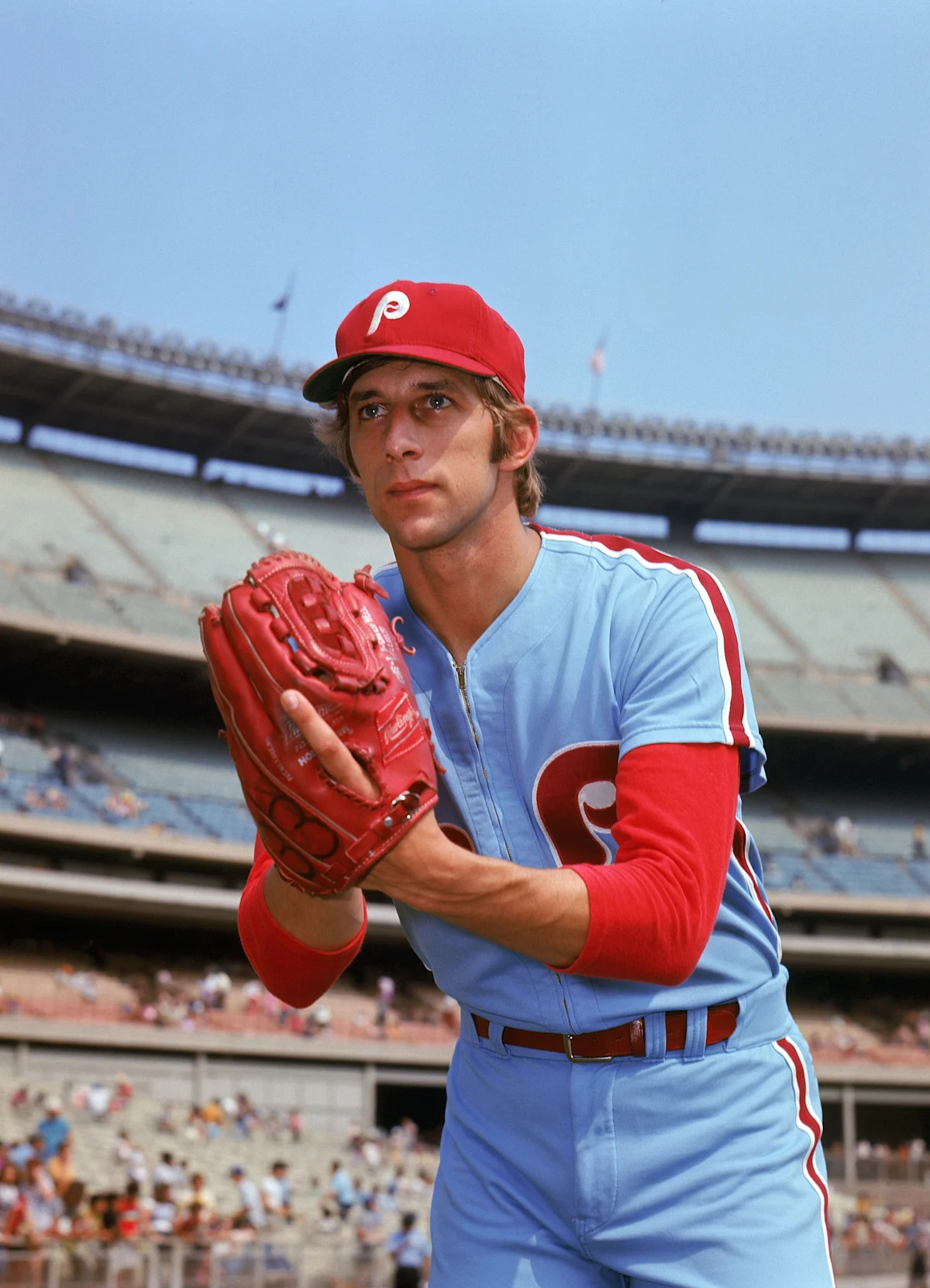
In honor of the Philadelphia Phillies playing host to the 2026 Major League Baseball All-Star Game at Citizens Bank Park, we here at The Good Phight are launching a yearlong series that focuses on the history of the Phillies and the All-Star Game. Check back regularly for posts about the Phillies participation (or lack thereof) in the Midsummer Classic over its history.
It’s that time again. That’s right, it’s time to look back at two obscure Phillies all-stars from yesteryear, this time from the groovy decade of the seventies. If you missed the rest of our series on one and done all-stars, you can catch up with the 1960s, the 1950s, the 1940s part 1 + part 2, and the 1930s.
Advertisement
Joe Hoerner, 1970
The story of Joe Hoerner is one of heart, both literally and figuratively. The son of an Iowan farmer-turned-deputy sheriff, Hoerner grew up in a family full of athletes. Both brothers flirted with a baseball career, with the older Bob playing in the Cubs organization and the younger Jim (who was Joe’s catcher in high school) declining to pursue a career in the White Sox organization. Two of his cousins were football stars, Dick Hoerner being an All-Pro running back for the Los Angeles Rams and Mike Reilly being a linebacker that played in Super Bowl IV against the Kansas City Chiefs.
Joe Hoerner originally played outfield for his high school team, but his coach soon began to slowly have him pitch more. His team won a state championship in 1954 where he earned the win out of the bullpen in the quarterfinal and pitched a one-hitter in the semifinal. This was all after he was nearly killed in a car accident where Hoerner fell asleep at the wheel and smashed into a tree, suffering a separated shoulder and broken ribs.
Hoerner elected to forgo college and play semi-professional baseball while working at a Sears Roebuck. The White Sox offered Hoerner a contract after watching him play against one of their minor league affiliates, he accepted, and he was assigned to Duluth-Superior in the Northern League. Hoerner, despite being just 20 in his first professional season, dazzled with a 16-5 record and a 2.58 ERA in 28 games including 23 starts, throwing a no-hitter on May 12th for good measure.
Advertisement
1958 started off pretty well for Hoerner, as he was assigned to big league camp with the White Sox as a non-roster player just a week after marrying his longtime girlfriend, Darlene. Hoerner was assigned to Class-B Davenport, allowing him to go home to Iowa to see his new wife. One night with his wife watching, Hoerner felt his heart racing after delivering a pitch and soon collapsed on the field. He was taken to a hospital where he remained unconscious for the next two to three hours, even receiving the Last Rites of the Catholic Church. Hoerner eventually woke up and his symptoms disappeared. The local newspaper called the event a “minor heart attack”, but Hoerner was back on the field a few days later.
Unfortunately, Hoerner continued to be plagued by what he described as “blackout spells”, but only while he was on the mound and pitching. Multiple tests found nothing, and Hoerner spent his 1959 split between Class-A Charlston and local medical centers, pitching only 32 total innings on the year. Finally, doctors concluded that the muscles around Hoerner’s heart were weak, possibly as a previously undetected effect from his car accident. Some medical professionals tried to talk him into retirement, but Hoerner refused. Instead, he altered his delivery from an overhand motion to one that was more sidearm on the advice that his previous motion may have been putting stress on an artery.
Hoerner remained in the White Sox farm system through 1961 but never appeared in the majors, thus exposing him to the minor league draft where he was selected by the Houston Colt .45s. He made his MLB debut on September 27th, 1963, against the New York Mets in a game where Houston deliberately fielded an all-rookie lineup, including a 17-year-old starting pitcher. Hoerner entered in the top of the fourth with the score 8-0 New York and threw three scoreless innings while allowing two hits and collecting two strikeouts.
The 27-year-old Hoerner started 1964 with Houston but was demoted after just seven appearances. He would then bounce around the minor leagues for the next two years. By his wife’s count, the Hoerners and their young family had 35 residences, and their daughter attended 11 schools before Joe became a regular in the majors. Hoerner contemplated retirement but was talked out of it by his older brother.
Advertisement
His luck began to change when playing winter ball in Puerto Rico in late 1965. That’s when a scout from the St. Louis Cardinals was puzzled why Hoerner wasn’t in the majors and was able to convince the team to select him in the Rule 5 Draft. Hoerner made the team in 1966 despite manager Red Schoendienst’s reservations and impressed, as he finished the season with a 1.57 ERA across 57 appearances and 76 innings, all in relief. He would remain with St. Louis through 1969, winning a World Series in 1967 and accumulating a 2.10 ERA across a total of 244.1 IP.
In November of 1969, Hoerner was included in a massive seven player trade with the Phillies that included Dick Allen heading to the Cardinals. Hoerner along with Tim McCarver, Byron Browne, and Curt Flood went to Philadelphia while Allen, Cookie Rojas, and Jerry Johnson went to St. Louis. Flood never played for the Phillies though, as he refused to report to the Phillies and instead sued for free agency, ultimately losing his legal battle and retiring but setting the standard for the players and their union to fight for and win free agency.
Hoerner meanwhile did embark on his new career with the Phillies, but an old problem surfaced once again on June 28th, 1970. Hoerner was in the midst of an appearance against his old team in St. Louis when he once again felt a sharp pain in his chest. After picking up a strikeout of Carl Taylor and walking Dick Allen, Hoerner was removed from the game by Phillies manager Frank Lucchesi. He was then examined by the Cardinals team physician with whom he was familiar and diagnosed with a minor heart spasm. Hoerner was then carted off and sent to the hospital. But once again just like his first episode in 1958, all tests at the hospital were negative and he returned to the team a day later.
It didn’t seem to stop Hoerner’s momentum though, as he went on to pitch to a 2.86 ERA through 34.2 innings by the time Mets manager Gil Hodges selected Hoerner for the 1970 NL All-Star team for the game to be held in Cincinnati. However, despite the game being a 12-inning thriller that ended with Pete Rose barreling over Ray Fosse to score the winning run, Hoerner did not appear in the game. His brother claimed though that Hoerner was warming in the bullpen to pitch the 13th inning were it not for Rose’s infamous play that ended the game. In any case, Hoerner would go on to finish 1970 with a 2.65 ERA across 57.2 IP.
Advertisement
The 34-year-old Hoerner improved in 1971, ending his year with a 1.97 ERA in 73 innings, but his efforts were wasted on a 95-loss Phillies team. He continued to pitch well in 1972, but the Phillies were on their way to another losing season. That’s why the Phillies traded Hoerner to the Braves in June of 1972. Hoerner himself had even recommended them doing so, telling the Inquirer “If they don’t trade me, they’re crazy. My value isn’t going to get any higher.” In return, the Phillies got what Bill Conlin of the Inquirer called “two of the most expendable members of a staff that can’t get anybody out” in Jim Nash and Gary Neibauer who were in their final and penultimate year in the majors, respectively.
Hoerner then spent the rest of his career bouncing around the majors, including landing back in Philadelphia for 1975. His career ended in 1977 where, despite being 40 years old, the Reds called him up to the big-league club as they were desperate for any pitching. Hoerner faced the Phillies in his first MLB appearance of the year on June 22nd, and he promptly allowed a grand slam to Larry Bowa. His final game of his career came on August 5th, where he entered in mop up duty in a blowout and punched Pirates shortstop Frank Tavares in the face after the latter rushed the mound following a hit by pitch. Both were ejected from the game, but Hoerner would never again appear in a major league game.
Wayne Twitchell, 1973
The one thing that may be more interesting than just looking back at history is looking back and thinking what could have been. That’s even more true with baseball, and it’s very true in the case of Wayne Twitchell. Twitchell excelled in sports at his local high school in Portland, Oregon, being an All-State winner for baseball and football. The tall lanky Twitchell preferred playing football, where he played quarterback, over baseball. But his father Ralph, a former running back for Oregon State, tried to steer Wayne away from the gridiron where he suffered a career-ending knee injury by warning his son that such injuries ran in the family.
Advertisement
The Houston Astros stepped in to make the choice easier when they selected Twitchell with the third overall pick in the 1966 amateur draft, one selection after Reggie Jackson. Labeled a “pitching phenom” by the Houston Post, Twitchell stood a staggering 6’6 and weighed in at 220 pounds despite being only 18 years old at the time he was drafted. Twitchell impressed enough in his first season in A-ball that he was promoted all the way to Triple-A for three (unsuccessful) starts.
But by 1969, Twitchell was still in the minor leagues, and the Astros were growing impatient. He finished 1969 with a 4.76 ERA across 68 innings and 13 starts in Triple-A, which wasn’t deemed good enough for the Astros. Houston sold Twitchell’s contract to the Seattle Pilots, giving him dreams of pitching close to home, but the Pilots franchise was moved to Milwaukee a few months later after being purchased by a group headed by Bud Selig.
Luckily for Twitchell, he was still able to go back home as the Brewers’ Triple-A affiliate was coincidentally in Portland. He made 26 starts there in 1970 before earning a call to the majors on September 7th. The 22-year-old Twitchell entered in the fifth inning against the Twins and struck out the side, including reigning MVP Harmon Killebrew, to work around an error and a walk. Unfortunately, his effort went to waste as the Brewers ultimately lost 7-6. Twitchell made another appearance three days later but didn’t have nearly the same amount of success, as he lasted only two-thirds of an inning and allowed two runs on three hits.
Despite the promise Twitchell showed, the Brewers decided to trade him to the Phillies in exchange for outfielder Pat Skrable prior to 1971. Twitchell later remarked that the reasoning behind the trade was that he didn’t “fit in” with the Brewers and that their ideas for his pitching style differed from his own, saying “I was a fastball pitcher and they were trying to make me into a spot pitcher.” The Phillies sent him to their Triple-A affiliate in Eugene, Oregon, once again close to his hometown of Portland. Twitchell credited Eugene manager Andy Seminick for allowing him to be himself and inadvertently convincing him not to retire in doing so.
Advertisement
Twitchell made his Phillies debut not long after in 1971. Despite being used almost exclusively as a reliever in Eugene, Twitchell made his first MLB start against the Mets on September 4th at Veterans Stadium. He lasted four innings and surrendered three unearned runs on five hits including a home run while walking two and striking out one in a 6-5 Phillies loss. However, he made five more appearances in relief and did not allow an earned run while racking up 14 strikeouts in 12 innings with just three hits. Twitchell earned his first big league win on September 23rd after throwing 2.1 hitless innings against the Montreal Expos in a 6-4 Phillies win.
The retirement of Jim Bunning allowed Twitchell to keep his spot on the Phillies for 1972. That was the year in which the Phillies won only 59 games, but Steve Carlton won 27 of them. Twitchell meanwhile had a good showing in his first full season as a major leaguer. The 24-year-old Twitchell posted a respectable 4.09 ERA in 139.2 innings with 112 strikeouts to just 56 walks across 49 games and 15 starts. His best start came against his old team the Astros on August 19th when Twitchell pitched a complete game shutout with eight strikeouts to no walks and only five hits.
After the 1972 season, Twitchell sought out Bunning for advice on developing a slider at the behest of pitching coach Ray Ripplemeyer. The new pitch proved to be a boon for Twitchell, as he started 1973 in the bullpen but earned a spot in the rotation by May 7th. Twitchell excelled in both roles, with a 2.29 ERA and 103 strikeouts in 137.2 innings pitched by the All-Star break. That first start on May 7th against the Reds where Twitchell went 7.1 IP and allowed 2 runs stuck in the mind of Cincinnati manager Sparky Anderson, who just so happened to be managing the NL All-Star team and put Twitchell on the team over Steve Carlton who was presumed by some to be in line to be the Phillies lone representative.
Anderson was impressed enough to actually use Twitchell in the game too, albeit the big right hander entered in the sixth inning of what was a 7-1 NL lead. Twitchell allowed a double to John Mayberry before striking out the man taken one pick before him in the draft in Reggie Jackson, getting Dave May to pop out, and Bobby Mercer to groundout to end the inning. The score would remain the same as the NL bested the AL, with Bobby Bonds taking home MVP honors with two hits including a two-run homer off of the Angels’ Bill Singer.
Advertisement
As for Twitchell, he returned to the Phillies and continued to look like he was finally realizing his phenom potential at age 25. But that all changed on September 18th at Wrigley Field. Twitchell was working in the sixth inning of a 2-0 game when Billy Williams hit a ball on the ground in the infield. Twitchell ran over to cover first base, but Willams attempted to slide headfirst into the base, and he connected with Twitchell’s right knee. Twitchell immediately left the game with what was first called a strain to his MCL. The saddest irony of the whole event was that it was totally unnecessary, as the ball Williams hit had been ruled foul.
Twitchell underwent four hours of surgery to repair damage to his ligaments, cartilage, and capsule in his right knee. He was ruled out for the rest of the 1973 season. His doctor told Twitchell that if he followed orders, he would be able to pitch again. But the doctor also warned Twitchell that if he didn’t listen, he wouldn’t be able to walk normally again. The Phillies even sent their team trainer to Portland to help Twitchell in his recovery.
Despite the injury, Phillies general manager Paul Owens claimed he turned down numerous trade offers for Twitchell before 1974, as Owens and the Phillies believed he was on the verge of becoming a star. But Twitchell was extremely ineffective when he finally returned to action in May, finishing the 1974 season with a 5.21 ERA in 112.1 innings. He then lost his spot in the rotation in August of 1975 and by 1976 was pitching almost entirely out of the bullpen. Twitchell started 1977 with a 4.53 ERA in 45.2 IP before being traded to the Expos along with catcher Tim Blackwell in exchange for Barry Foote and Dan Warthen. Twitchell made 22 starts with the Expos after the trade, posting a 4.21 ERA in 139 innings. At the same time the Phillies were shipping out Twitchell, they unsuccessfully tried to trade for Tom Seaver, with the Mets preferring the Reds offer instead of the package of Larry Christenson, Jerry Martin, Jay Johnstone, and two minor leaguers presented by Owens.
Twitchell meanwhile would go on to play two more years in the majors. He was released by the Expos following the 1978 season and signed on with the Mets for 1979, but he was later sold to the Mariners who ultimately released him after the season. Despite playing six more seasons after his devastating knee injury, he never again reached the potential he seemed to be realizing, making his father’s premonition from when Twitchell was a teenager come true.
Advertisement
Sources
Baseball-Reference.com
Brian Cooper, Society for American Baseball Research (SABR) Biography for Joe Hoerner
The Daily Times, August 28th, 1958
Sandy Padwe, The Philadelphia Inquirer, July 1st, 1970
Bill Conlin, The Philadelphia Inquirer, June 16th, 1972
The York Dispatch, August 6th, 1977
Neal Poloncarz, Society for American Baseball Research (SABR) Biography for Wayne Twitchell
The Beaumont Enterprise, June 8th, 1966
Clark Nealon, The Houston Post, August 30th, 1966
Bill Conlin, Philadelphia Daily News, July 17th, 1973
Bruce Keidan, The Philadelphia Inquirer, September 19th, 1973
Bill Conlin, Philadelphia Daily News, September 19th, 1973
Allen Lewis, The Philadelphia Inquirer, June 17th, 1977
Read the full article here