





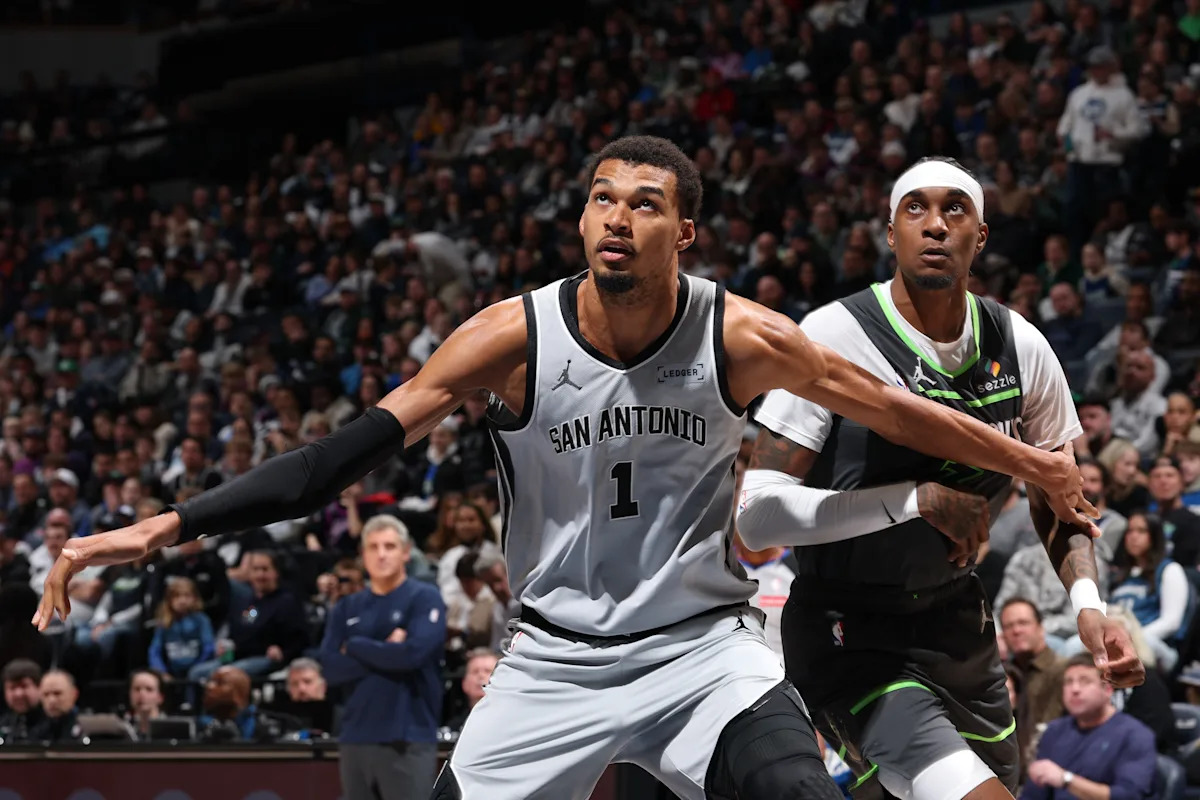
The Western Conference’s second-seeded San Antonio Spurs will take on the sixth-seeded Minnesota Timberwolves in the second round of the 2026 NBA playoffs. It’s the first time these teams have squared off in the postseason since 2001, when Tim Duncan, David Robinson and Co. outclassed Kevin Garnett’s overmatched squad in a 3-1 opening-round win.
(That’s right: San Antonio and Minnesota haven’t played in the postseason since the first round was only five games. And if you remember that, do me a favor and please also remember to schedule that colonoscopy screening. We can’t be too careful at our ages.)
Advertisement
Schedule | Odds | Spurs breakdown | Wolves breakdown
Head-to-head | Matchup to watch | Key question | Prediction
Series schedule
Game 1: Mon., May 4 at San Antonio (time and network TBD)
Game 2: Wed., May 6 at San Antonio (TBD)
Game 3: Fri., May 8 at Minnesota (TBD)
Game 4: Sun., May 10 at Minnesota (TBD)
*Game 5: Tue., May 12 at San Antonio (TBD)
*Game 6: Fri., May 15 at Minnesota (TBD)
*Game 7: Sun., May 17 at San Antonio (TBD)
*if necessary
Series odds
San Antonio Spurs (-2000)
Minnesota Timberwolves (+950)
What we know about the Spurs
That, despite their relative youth, they are not just happy to be here.
San Antonio handled its business viciously, efficiently and with aplomb in Round 1. The NBA’s No. 3 regular-season defense held the Trail Blazers below 100 points three times in five games, limiting Portland to 40% shooting from the field and 30% shooting from 3-point range as a team. Ascendant backcourt stars Stephon Castle and Dylan Harper looked mighty comfortable in their maiden postseason voyage, most notably when they combined for 60 points on the road in a Game 3 win. Veteran lead guard De’Aaron Fox earned his keep, leading the Spurs in scoring in Games 4 and 5 to close the Blazers out.
Advertisement
Portland’s lone win came after Victor Wembanyama left Game 2 early following a frightening fall that landed him in the NBA’s concussion protocol. When he returned for Game 4, though, so too did San Antonio’s sense of near-invulnerability; the Spurs outscored the Blazers by 45 points in the 112 minutes that the unanimous Defensive Player of the Year saw in the series. That works out to nearly 20 points per 100 possessions — a level of dominance firmly in keeping with his full-season impact for a Spurs team that now moves past the first round for the first time since 2017.
What we know about the Timberwolves
That they’re tough as s***.
After a somewhat wobbly regular season that led some to wonder whether a two-time conference finalist had grown complacent or bored with the 82-game preamble preceding the pulse-quickening postseason, the Wolves bounced back from a rocky Game 1 to make it clear that, two springs later, they were still the monster hiding underneath the Nuggets’ beds. Minnesota erased a 19-point deficit on the road to win Game 2 and steal home-court advantage, then blitzed Nikola Jokić and Co. in Games 3 and 4 by a combined 33 points to push favored Denver to the brink of elimination — this, despite losing All-NBA centerpiece Anthony Edwards and starting shooting guard Donte DiVincenzo in the first half of Game 4.
Advertisement
Jaden McDaniels called out every single Nugget’s defense and then backed up his talk, averaging 17.8 points per game on 49.4% shooting in the series. When Edwards and DiVincenzo went down, trade-deadline acquisition Ayo Dosunmu stepped up, delivering a 43-point Game 4 masterclass to become a Twin Cities folk hero. And when Dosunmu, too, became unavailable due to right calf soreness for Game 6, leaving the Wolves without their top three guards in a closeout game, it was McDaniels (32 points and 10 rebounds in 45 minutes) and little-used sophomore wing Terrence Shannon Jr. (24 points and six rebounds) who stepped in to join Julius Randle and Naz Reid in shouldering enough of the offensive workload to finish the job.
The offense held up because the defense never buckled. Rudy Gobert’s defensive reputation shouldn’t have needed any rehabilitation to begin with, but after what he just did against Jokić — holding him to 42% shooting when they were matched up, and with Denver losing the Jokić vs. Gobert minutes behind a league-worst-caliber offensive efficiency mark — his bona fides shouldn’t come under question again. McDaniels all but erased Jamal Murray from the series, helping limit the All-Star point guard to 34% shooting over the final four games.
A Denver offense that led the NBA in offensive efficiency during the regular season scored nearly 14 fewer points-per-100 against this snarling Minnesota defense; three of the Nuggets’ seven worst offensive performances of the season came in the past week.
Advertisement
This is who Minnesota has been during these past few years: a physical, unrelenting crew eager to take any opponent to the mat, even a three-time MVP, and just maul ’em. Doing that against a fully healthy, rested and operational Spurs team profiles as an awfully daunting task, especially given the myriad injury issues the Wolves are now navigating. You know the old saying about wounded animals, though; the Spurs look past Chris Finch’s club, compromised though it might be, at their own peril.
Head-to-head
Minnesota won the season series, 2-1.
The Wolves took the opener back in November, 125-112, behind an efficient 32 points from Edwards, a 22-point, 12-assist double-double from Randle, and blistering 46% 3-point shooting as a team in what went down as San Antonio’s worst defensive performance of the season:
Minnesota just edged out the Spurs in their next meeting, with Edwards drawing Wembanyama on a switch before sliding around a screen for a tough runner that proved to be the game-winner in a 104-103 thriller:
“I was like, ‘Damn! Do I got the shot? Do I drive on him?’” Edwards told reporters after the game. “I was confused. I ain’t never been confused. I ain’t going to lie. I’m like, ‘S***, I’m [going to throw it] to Ju[lius Randle]. I don’t know what to do right now […] I feel like he thought I was going to take a jump shot, for sure. He probably would’ve blocked that s***, so I had to drive him.”
Advertisement
San Antonio struck back six nights later, eking out a 126-123 victory despite a career-high 55 from Edwards thanks to 39 points in 30 minutes from Wembanyama, 25 points and 12 dimes from Fox, and 20 points off the bench from Sixth Man of the Year winner Keldon Johnson:
There are caveats. Wembanyama and Castle missed the first Wolves win. Devin Vassell missed both January meetings. And, of course, a lot has changed in the four and a half months since the teams last squared off — most notably that DiVincenzo (who had the second-highest plus-minus of any Timberwolf against San Antonio during the regular season) won’t factor into the matchup, and that Edwards (who averaged 36.7 points per game on 58.3% shooting against the Spurs this season) might not, either.
Matchup to watch
The Wolves’ promoted ball-handlers vs. the Spurs’ elite defense
On one hand, Minnesota scored 114.3 points-per-100 against San Antonio in 58 minutes with Wembanyama on the floor during the regular season — which, considering the league at large scored just 103.6 points-per-100 in Wemby’s minutes, is pretty damn good! On the other, though, 47 of those 58 minutes came with Edwards at the controls for the Wolves, and all 58 of them came with at least one of Edwards or DiVincenzo on the floor … which, y’know, renders that sample a little trickier to parse, given the current state of affairs for Finch’s team.
Advertisement
After the injuries to Edwards and DiVincenzo, Minnesota’s offense scored at about a league-average clip for the remainder of Round 1, but did so against a much more permissive defense than the one San Antonio brings to bear. Without their starting backcourt — for at least the early part of the series, with Edwards’ status looming as (spoiler alert) The Key Question in this matchup — the Wolves must search for shot creation elsewhere, and Spurs head coach Mitch Johnson will have to decide how to deploy his phalanx of nasty, long-limbed defenders in an attempt to render that search unfruitful.
If Dosunmu’s calf injury clears up, he’ll be tasked with resuming primary ball-handling duties against the likes of All-Defensive Team candidate Castle — a significantly sterner test than anything Denver threw at him. If Ayo’s not ready, and with Edwards sidelined, would Johnson station his sophomore stopper on Randle, aiming to fluster and frustrate the three-time All-Star by having a smaller, quicker disruptor get underneath him and pressure his dribble?
Maybe not, if Finch keeps the electric Shannon in the starting lineup after his breakout 24-point performance in Game 6:
Can Shannon continue flexing his muscle on those north-south drives against the Spurs’ size and length on the perimeter? Can McDaniels continue to soak up more isolation and shot-creation possessions while operating as the primary defender on Fox — and, when Finch wants to shake things up, pulling shifts on Wembanyama with Gobert helping behind him, as he did in San Antonio’s January win? How much can Minnesota rely on veteran caretaker Mike Conley, who was largely out of the rotation until the injuries mounted but contributed 27 big minutes in the Game 6 clincher, against a Spurs backcourt full of bigger, stronger guards who can hunt him on the defensive end?
Advertisement
If Finch doesn’t like the sound of that, fearing the prospect of introducing a smaller target into his defensive ecosystem, does he instead veer the other way, looking for more opportunities to supersize with lineups featuring all three of Gobert, Randle and Reid? Those units played just 56 minutes together during the regular season, but were plus-15 in 17 minutes in Game 6 against Denver, and could give the Wolves the opportunity to force a Spurs squad that typically flanks Wembanyama with small-ball 4s Julian Champagnie and Harrison Barnes to deal with a physicality disadvantage up front — a potential pathway to offensive rebounding opportunities, paint points and fouls to get into the bonus and muck the game up.
It remains to be seen whether any of those options will provide a consistently reliable pathway to points against a Spurs defense that’s been elite all season in limiting rim attempts, contesting the arc, preventing fast-break opportunities and dominating the glass. But some combination of them — continued breakouts from unlikely sources, a tactical curveball from Finch, a monster performance from the giganto-ball look — will have to make the favorites play off the back foot if the Wolves want to have a chance to steal a game early, extend the series, and potentially give their game-breaking superstar a chance to get back and change the math.
About that:
Key question
Can Anthony Edwards make an impact on this series?
At the risk of overstating the obvious, Minnesota’s chances of being able to pull the upset increase dramatically if Edwards — who finished third in the NBA in scoring during the regular season, becoming one of just 10 guards ever to average at least 28 points per game on a true shooting percentage (which factors in 2-point, 3-point and free-throw accuracy) higher than 60% — is able to play in it. As it stands, though, that’s a big “if.”
Advertisement
Right knee inflammation sidelined Edwards for 11 of the Wolves’ final 14 regular-season games. He returned in time for the playoffs, but was pretty clearly not his All-NBA self, shooting 39% from the field and 25% from 3-point range in the first three games against Denver. And then, late in the first half of Game 4, he landed awkwardly after elevating to protect the rim, resulting in a hyperextension and bone bruise in his left knee — an injury that is considered a “week-to-week” proposition.
So: How many weeks might it take before Edwards could be available?
“There is a chance that Edwards returns at some point in this series,” according to Jon Krawczynski of The Athletic. “But he is not expected to be back for the start of it.”
Advertisement
Friday’s Game 3 would mark 13 days since he suffered the injury. If two weeks is enough for Minnesota’s medical team to get Edwards — a famously fast healer in the past — not only back in the fold, but back with the requisite explosiveness to elevate on jumpers and attack the rim with his typical force, it could go a long way toward giving Minnesota a puncher’s chance against heavily favored San Antonio. If he needs more weeks than that, though … well, there just might not be enough weeks left for him to have a say in whether or not the Spurs advance to the Western Conference finals.
Prediction: Spurs in six
If I knew for a fact that Dosunmu was 100% and that Ant would be back midway through the series, I’d think hard about Minnesota here; you don’t win as many playoff series as the Wolves have over these past few years, in as many different ways as they’ve won them, without earning a certain measure of respect. But I’m not sure toughness and smothering defense will be enough to outlast an opponent that pairs those traits with depth, youth and an alien. The Wolves make a proud stand, but the Spurs march on to the Western Conference finals.
Read the full article here