





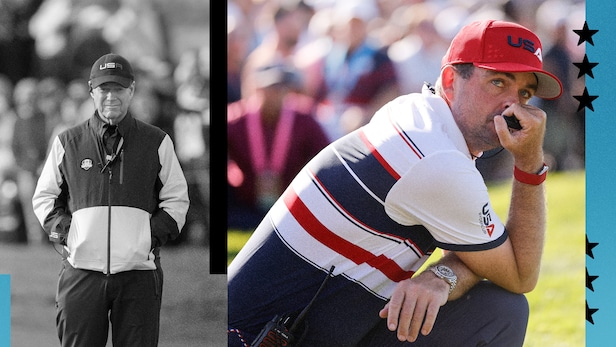
Let’s start by anticipating a line of attack against Jim Furyk—that he’s a boring, predictable choice to be the 2027 U.S. Ryder Cup captain—with a truth everyone needs to digest post-haste: Flashy captain announcements lead to Ryder Cup disasters.
Again: Flashy captain announcements lead to Ryder Cup disasters. If you hate this decision because you wanted to feel stirred, excited, inspired? Good.
Advertisement
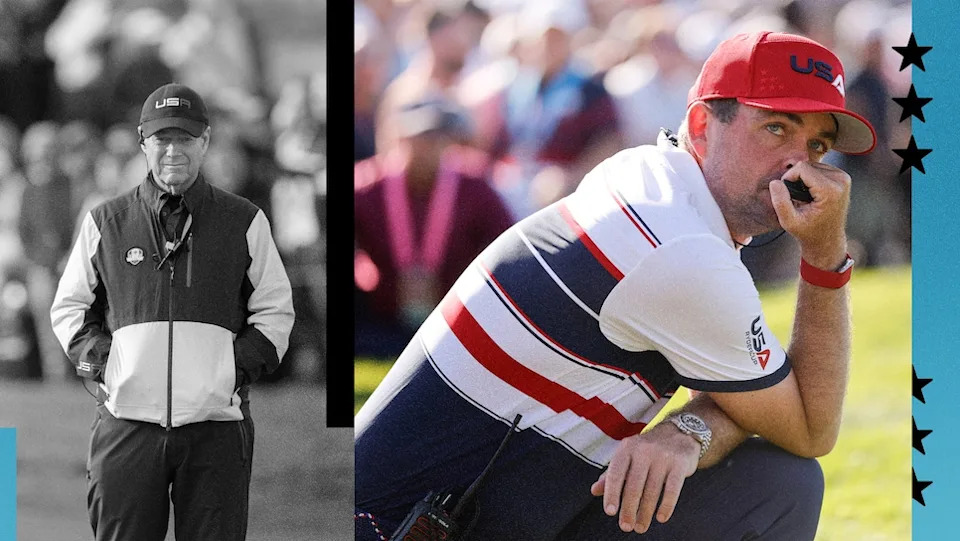
In 2014, Ted Bishop thought he was rattling Europe’s cages when he picked Tom Watson, and in his press conference announcing the decision, he relayed the story of a friend calling it “brilliant.” In 2024, when the PGA of America officials named Keegan Bradley … well, who knows what they were thinking, exactly. My best guess is that the very good “Full Swing” episode on his snub from the 2023 Ryder Cup team made them feel bad and planted a poisonous notion in their heads. Either that, or Team Europe now had the Jedi-like ability to control minds as far away as Frisco, Texas.
In any case, it was the exact same brand of outside-the-box seat-of-the-pants decision-making, and it gave them a captain, in Bradley at least, with divided attention and no comprehensive plan (or at least a very bad one) whose main legacy today falls into one of three categories. Pick your favorite:
1. Pulling off the difficult feat of losing a home Ryder Cup, even with an astounding 8½-3½ singles session.
2. A profane speech guaranteeing victory that Europe immediately plastered on its locker-room walls for motivation and used to taunt him afterward.
Advertisement
3. The months afterward he has spent telling us how bad he feels about it, but without acknowledging any specific mistakes that might actually help future captains.
You could see the nightmare unfolding from the outset—it’s always annoying to hear the words “I told you so,” but I told you so—and what Team USA needed more than anything was a reset before Adare Manor. (Particularly with Tiger Woods taking himself out of the running.)
This re-hashing may seem harsh or egregious, but in fact it’s necessary to make the most important point of all: Ryder Cup success is built on systems, and systems are built on experience.
More From Golf Digest
Ryder Cup Jim Furyk named 2027 U.S. Ryder Cup captain
Golf Digest Logo What the American Ryder Cup team can learn from USA Basketball
Ryder Cup Tickets for 2027 Ryder Cup will be a European record high as organizers defend price hike
Advertisement
The short version of modern Ryder Cup history is that the minute the Europeans became somewhere close to good enough to challenge the Americans—circa the early 1980s—they started building that system under Tony Jacklin. In the ensuing 40 years, they’ve added to that system bit by bit. When they had a captain diverge from the template, like Nick Faldo in 2008 or (God love him) Padraig Harrington in 2021, they got clobbered and learned from it. Today, Team Europe is essentially structured like a Fortune 500 corporation, where decades of inherited wisdom and an unwavering belief in hyper-organization has created a reality where a team that is routinely worse by the World Ranking has amassed a 14-6 record in the last 20 Ryder Cups.
You could be forgiven for thinking that the U.S. infrastructure is composed entirely of head-scratchers who fluctuate between passivity and bizarre overreactions, but whose default state is doubting the merits of good management and whose motto is “durrrrr they just putted better.” In fact, that’s only mostly true.
In the midst of this prolonged failure, the Americans have had two distinct bright spots. The first came in the person of Paul Azinger, a man who thought about and studied the Ryder Cup obsessively, and who approached the PGA of America with an actual plan of action. You can listen to the deep dive here, but in essence he gave America a strategy for the first time, and he ran circles around Faldo at Valhalla in 2008. He was promptly forgotten in 2010 when he probably should have been made captain-for-life, but Davis Love III built on Azinger’s plan in 2012 before getting horrendously unlucky on Sunday at Medinah. That led to the Watson debacle, which ushered in the second bright spot in America’s modern Ryder Cup history: The Task Force.
Yes, that Task Force—the one that was instantly mockable because of the almost militaristic name, but that gathered veterans like Love and Furyk and Steve Stricker who had experienced almost nothing but devastating failure as players, and who built on that failure (and, frankly, on Europe’s success) to create a distinctly American structure designed to give their players the best chance to succeed. It worked beautifully with blowout wins in Hazeltine and Whistling Straits. It failed in Paris and Rome because it’s still very hard to win a Ryder Cup on the road and Europe didn’t just stop trying. The Rome loss, unfortunately, led to a Watson-style boomerang, the old anti-system pivot, and it threw away all the progress the Task Force had made. You see the fruits.
Advertisement
Jim Furyk, then, is a great pick because he represents a return to quite literally the only system that has ever worked. Yes, he lost badly in Paris, but he was profoundly unlucky in certain ways. The critical fact is that he was an equal part of the Task Force crew that won twice at home, and he, too, would have won in Minnesota or Wisconsin. And he’s just as smart and integral to the team’s resurgence as Love or Stricker, both of whom I spoke with after their wins and who were incredibly impressive in their attention to detail and the depth of thought they gave to this competition. Further, Furyk was a highly effective strategist at the 2024 Presidents Cup in Montreal, running circles around Mike Weir. (It’s not the same thing, but it’s not nothing.) You’ll likely hear some arguments in the coming days for men like Stewart Cink or Justin Leonard to have gotten the nod over Furyk, but those notions fail for the same reason: In the absence of a written treatise on how they’ll approach the captaincy, you’re just guessing how they’d run the team. You don’t have to guess with Furyk, because he’s a smart guy who has been inside a smart system.
/content/dam/images/golfdigest/fullset/2026/4/tom-watson-keegan-bradley-ryder-cup-failure-collage.jpg
Tom Watson and Keegan Bradley wound up being too outside-the-box to succeed as U.S. Ryder Cup captains in 2014 and 2024, respectively. (Photos by Getty Images)
Now, a bit of cold water: Like most sane people, I would give Furyk about a 5 percent chance of winning at Adare Manor. Trying to beat Luke Donald and his Euro squad at home is the golf equivalent of a lone soldier charging a machine gun nest. Furyk’s job is not to win, and if you’re a fan of the American Ryder Cup team, you’re praying that he won’t be judged on the result. His job is to restore a chain of succession, incorporate statistics in a way that matches Europe’s numbers cruncher (Donald consigliere Edoardo Molinari), spend 18 months intensely focused on preparation in a way that Bradley couldn’t come close to matching and to give a hands-on education to the men, like Brandt Snedeker, who will be his successors. Someone like Snedeker could make a great captain, but it was critical for the Americans to have a bridge captain like Furyk who he can learn from before he take the reins. Should Snedeker become captain at Hazeltine in 2029, he’ll have two Ryder Cup assistant terms and at least one Presidents Cup captaincy under his belt. In turn the same will be true for Webb Simpson, Kevin Kisner or whoever the next wave will be—that’s how you prepare to win.
Advertisement
What Furyk is doing here, looked at from a psychological angle, represents a great sacrifice. Smart money says that when this is all over, he’ll be the only captain in U.S. history with an 0-2 record. If he does everything right as a leader but still loses in Ireland—and as he knows too well from Paris, he could do everything right and lose badly—idiots will pounce on him as a consummate loser. I know Furyk won’t think of it this way, but the offer here is basically, “give us your heart and soul for a year and a half, and then, when you’re most exhausted, you get to be our pain sponge.”
Were he a more political man, undoubtedly, Furyk could have campaigned for a home captaincy back when the Task Force began. Instead, he’s filling a desperately needed role in the U.S. structure at a time when the list of men who could have done it was effectively one name long. There’s an old proverb that “a society grows great when old men plant trees whose shade they know they shall never sit in,” and I don’t believe Furyk will ever feel the cool shade of victory as a Ryder Cup captain. Nevertheless, he has stepped up when his team and country needed him, and for all their past mistakes, the PGA of America deserves credit for making the smart choice.
More From Golf Digest
Ryder Cup Paul Azinger wants to shake up the U.S. Ryder Cup system. He’s about to pitch his idea to the PGA of America
Ryder Cup Luke Donald is returning as European Ryder Cup captain, looking for historic three-peat
Golf Digest Logo What in the world is going on between Jon Rahm and the DP World Tour? A one-stop explainer on this brewing feud
Read the full article here