





This goes up Thursday, only a few hours before the start of the 2026 NFL Draft. That’s 257 picks spread across 32 teams, in an order that was set more or less the day last season ended. Except not really, because teams keep moving those picks here and there like they’re Pokemon cards or POGs or whatever collector’s item was hot when you were a kid. Already, 85 of the 257 picks have changed hands at least once, including four (6.182, 6.198 and 6.211) that have made five stops already. Trades are obviously a huge part of the NFL Draft. And as much as draft picks are like lottery tickets, trades for draft picks are that times 10. So today, before we see how teams have fared in their draft pick trades. I went back through the last 10 years of drafts and examined every single trade that involved a draft pick (this, uh, took a while). I scored every trade using Pro Football Reference’s Approximate Value metric, which — even PFR will admit this — is not an exact or comprehensive science. Any one score should be taken with several enormous grains of salt. But over a large scale, in the aggregate, it gets fairly informative. There are plenty of technical things here about how the picks and trades are classified and categorized, but rather than bogging down this already-riveting introduction with all of it right here, I’ll put some process notes at the bottom. The main takeaway, though, is that as long as everything is consistent it should be fine. Still, check the bottom if you’re curious on the ins and outs. So which teams have done the best in the trade market over the last decade? Which have decided to not really bother with the trades? And who had the best or worst single years? Let’s take a look. (Keep in mind that the more recent the trade and draft year, the less time for an impact. Scores in 2024 and 2025 are generally going to be lower than trades in 2016 and 2017.)
The Best and Worst Draft Pick Trading Teams Since 2016
The Most Active Traders
These are the top 16 in number of draft pick trades made across the last decade:
Basically, the Patriots are always open for business. The gap between the Patriots at first and the Eagles at second is the same as the gap between the Eagles at second and the Dolphins/Vikings at 10th. The Patriots have a recent history of underwhelming first-rounders (at least until Christian Gonzalez/Drake Maye in 2023-2024), but the trades have come up and down the draft. For example, in 2018, the Patriots had at least temporary possession of five different fourth-round picks (4.105, 4.114, 4.117, 4.131, 4.136). The number of picks they made in that round: Zero. They traded for a second for the Bears’ fourth and second, then dealt that fourth to Cleveland for a different fourth. Then they traded that fourth to the Lions for a future third. They traded for the Lions’ fourth-rounder, then sent it to the Buccaneers in a different trade. They originally owned 4.131 and 4.136 but dealt them both, one to the Eagles and the other to the Rams. In other words, if you think the Patriots are about to make a pick … no they aren’t.
Advertisement
The Least Active Traders
There are the bottom 16 in number of draft pick trades made across the last decade:
PITTSBURGH, PA – SEPTEMBER 22: Los Angeles Chargers wide receiver Ladd McConkey (15) runs with the ball during the regular season NFL football game between the Los Angeles Chargers and Pittsburgh Steelers on September 22, 2024 at Acrisure Stadium in Pittsburgh, PA. (Photo by Mark Alberti/Icon Sportswire)
As much as the Patriots have dominated draft pick trades over the last 10 years, that’s how much the Chargers have not done so. They made 1 or 0 trades involving draft picks every year from 2016 to 2023 before surging (you know, relatively) to 2 and 4 trades in 2024 and 2025, respectively. There were 20 examples in the last decade of a team making at least 10 trades involving draft picks in a single year (including four for the Patriots), while the Chargers only managed 10 in the decade total. Your favorite team can probably forget Joe Hortiz’s number today. It’s a lost cause.
Advertisement
The Most Successful Traders
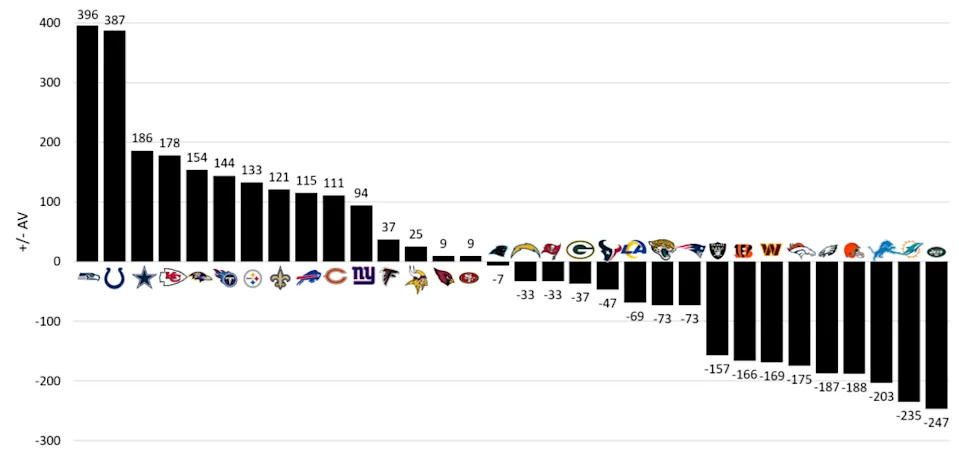
By PFR’s AV (again, grain of salt, but it’s going to get us a lot of the way there directionally), 15 teams have managed a cumulative positive return on their draft trade activity over the last decade:
|
Team |
Total AV Shift |
Team |
Total AV Shift |
|
|
Seattle Seahawks |
+396 |
Buffalo Bills |
+115 |
|
|
Indianapolis Colts |
+387 |
Chicago Bears |
+111 |
|
|
Dallas Cowboys |
+186 |
New York Giants |
+94 |
|
|
Kansas City Chiefs |
+178 |
Atlanta Falcons |
+37 |
|
|
Baltimore Ravens |
+154 |
Minnesota Vikings |
+25 |
|
|
Tennessee Titans |
+144 |
Arizona Cardinals |
+9 |
|
|
Pittsburgh Steelers |
+133 |
San Francisco 49ers |
+9 |
|
|
New Orleans Saints |
+121 |
|||
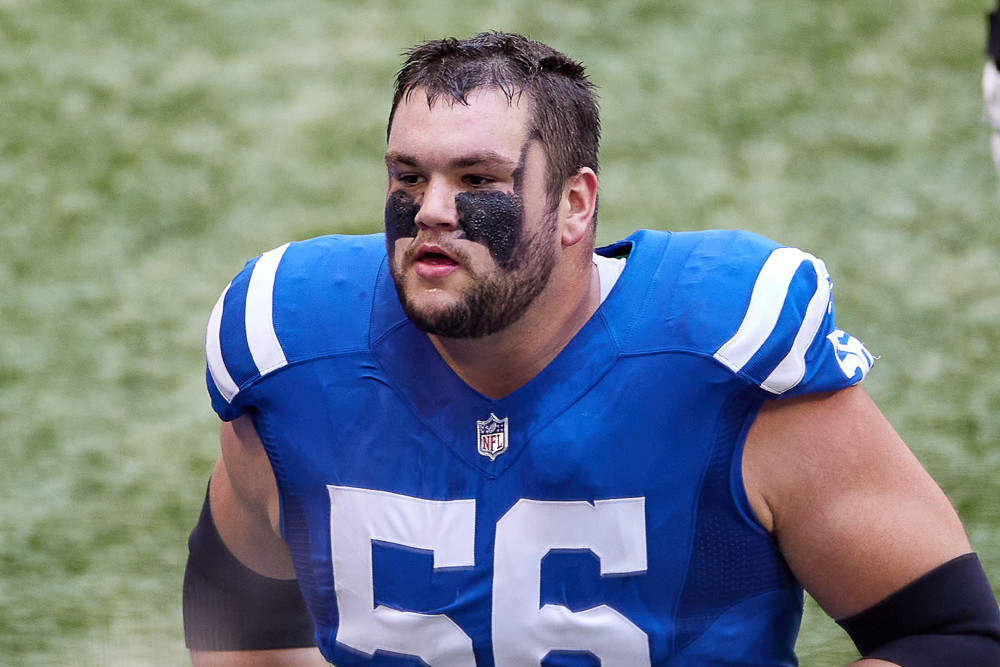
The Seahawks were steady, with positive scores in nine of 10 years, including a +1 in 2025. No team earned a positive return on trades every year; the Seahawks are the only one at 9/10. Meanwhile, the Colts trail the Seahawks by just a hair in overall score, and they only had two negative years, but it’s still very clear that the lion’s share of their results come from 2018. That was, for those who don’t recall, the year the Colts traded out of 1.03, giving up the pick that became Sam Darnold and getting back the picks that became Quenton Nelson, Braden Smith, Dallas Goedert and Rock Ya-Sin. That was the linchpin of a +170 overall score that year. The Seahawks and Colts nearly got to +400 over their last 10 years. No one else has even climbed above +200.
The Least Successful Traders
Of course, with 15 teams with a net positive score across the last decade, that leaves 17 with a net negative:
|
Team |
Total AV Shift |
Team |
Total AV Shift |
|
|
Carolina Panthers |
-7 |
Cincinnati Bengals |
-166 |
|
|
Los Angeles Chargers |
-33 |
Washington Commanders |
-169 |
|
|
Tampa Bay Buccaneers |
-33 |
Denver Broncos |
-175 |
|
|
Green Bay Packers |
-37 |
Philadelphia Eagles |
-187 |
|
|
Houston Texans |
-47 |
Cleveland Browns |
-188 |
|
|
Los Angeles Rams |
-69 |
Detroit Lions |
-203 |
|
|
Jacksonville Jaguars |
-73 |
Miami Dolphins |
-235 |
|
|
New England Patriots |
-73 |
New York Jets |
-247 |
|
|
Las Vegas Raiders |
-157 |
|||
In a true twist-the-knife scenario, it’s (of course) the Jets who come in at the bottom of the heap, a cool -247. Obviously, the Darnold/Colts trade is a big part of that, but the Jets scored at least a -60 three times (2017, 2018 and 2020) and never had a score better than +21.
EAST RUTHERFORD, NJ – DECEMBER 29: Philadelphia Eagles quarterback Carson Wentz (11) during the National Football League game between the New York Giants and the Philadelphia Eagles on December 29, 2019 at MetLife Stadium in East Rutherford, NJ. (Photo by Rich Graessle/Icon Sportswire)
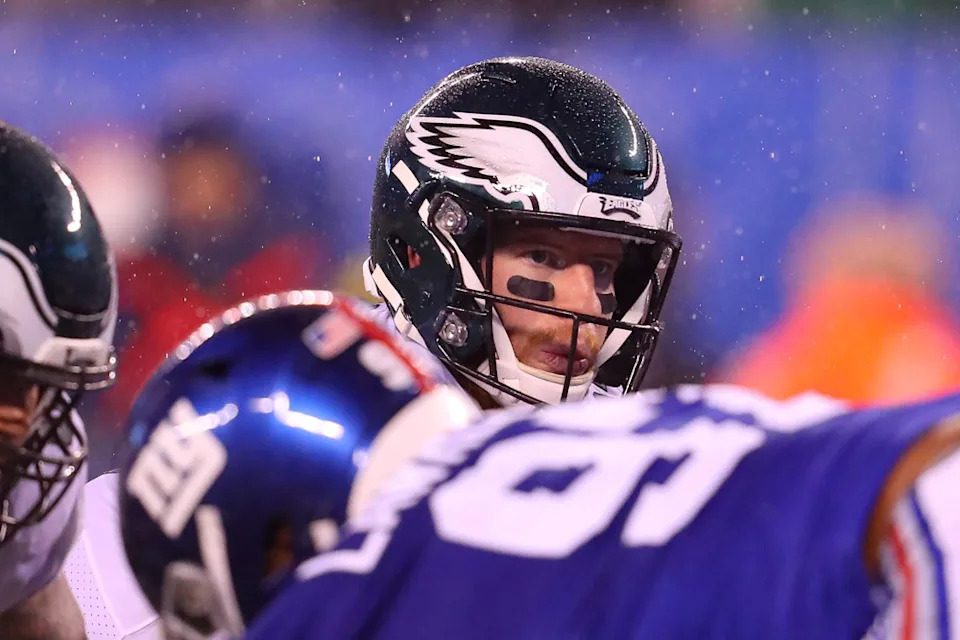
Meanwhile, the Eagles are near the bottom of the list at -187. That’s bad … except it’s almost all 2016. The Eagles made two trades involving top-13 picks in 2016 — trading Byron Maxwell, Kiko Alonso and the pick that became Laremy Tunsil to the Dolphins for 1.06 and then flipping that pick to the Browns to trade up to 1.02 to take Carson Wentz — and traded DeMarco Murray and the pick that became Nick Kwiatkoski for the pick that became Connor Cook (also included in the Wentz deal). By AV, they lost all three deals pretty handily. They scored a -175 in 2016 but then only -12 from 2017 to 2025.
The Best Single Years
32 teams, 10 years. That makes 320 single years of draft trade results. These are the top 10:
|
Team |
Year |
Total AV Shift |
|
Indianapolis Colts |
2018 |
+170 |
|
New Orleans Saints |
2017 |
+154 |
|
Tennessee Titans |
2016 |
+152 |
|
Kansas City Chiefs |
2016 |
+148 |
|
Buffalo Bills |
2018 |
+144 |
|
New England Patriots |
2018 |
+128 |
|
Chicago Bears |
2016 |
+126 |
|
Seattle Seahawks |
2019 |
+109 |
|
New England Patriots |
2016 |
+104 |
|
Los Angeles Rams |
2018 |
+104 |
We covered the Colts’ 2018 haul that was highlighted by the Sam Darnold/Quenton Nelson deal. They also flipped Henry Anderson for a seventh-round pick that became Zaire Franklin, accounting for most of the rest of the success. The Saints’ 2017 draft class is already the stuff of legend, but part of that involved them flipping Brandin Cooks to the Patriots for the picks that became Ryan Ramczyk and Trey Hendrickson, and trading the picks that became Adrian Colbert and Derrius Guice for the pick that became Alvin Kamara. It’s not just that they nailed their picks that year, it’s that they flipped away some picks that didn’t become much in the process. Also, worth noting the obvious, that all of the top 10 here came in 2016-2019. The highest score since 2020 is the 49ers’ +98 in 2020. The Ravens had a +88 in 2020. The Seahawks cracked +80 in 2022 and 2023. Some of those scores will rise as we get further from the years in question.
Advertisement
The Worst Single Years
The scores obviously have to cancel one another out, so if one team nails a trade, another has to suffer. Here are the bottom 10:
|
Team |
Year |
Total AV Shift |
|
Chicago Bears |
2017 |
-199 |
|
Philadelphia Eagles |
2016 |
-175 |
|
Miami Dolphins |
2020 |
-165 |
|
New York Jets |
2018 |
-164 |
|
Cleveland Browns |
2019 |
-139 |
|
Kansas City Chiefs |
2018 |
-120 |
|
San Francisco 49ers |
2016 |
-116 |
|
Detroit Lions |
2020 |
-114 |
|
Las Vegas Raiders |
2019 |
-108 |
|
San Francisco 49ers |
2021 |
-107 |
ARLINGTON, TX – JANUARY 16: San Francisco 49ers middle linebacker Fred Warner (54) looks on during the NFC Wild Card game between the San Francisco 49ers and the Dallas Cowboys on January 16, 2022 at AT&T Stadium in Arlington, TX. (Photo by Robin Alam/Icon Sportswire)
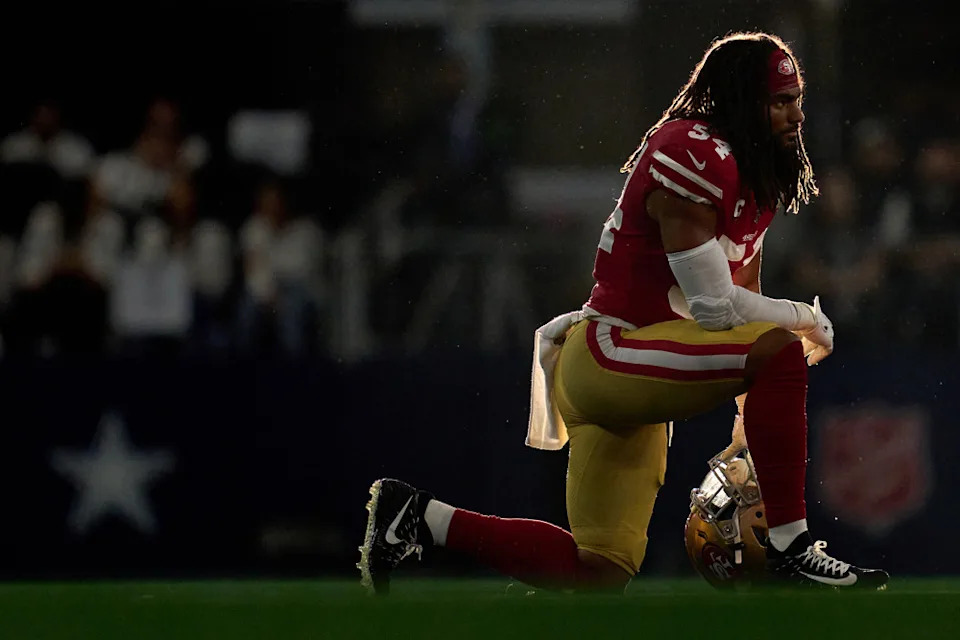
The Bears ended up at a +111 over the last 10 years. That’s good! Only nine teams did better! If they had just not made the Mitchell Trubisky trade in 2017 — sending away the picks that became Solomon Thomas, Alvin Kamara, Tedric Thompson and Fred Warner to move up one slot and draft the quarterback — they would be at +276, third only to the Seahawks and Colts. That one trade was a -175 by itself, the worst single trade in the last decade by a blue mile. We covered the Eagles’ -175 in 2016 and the Jets’ -164 in 2018 earlier. So let’s talk about the Dolphins of 2020. They came in with a cool -165. A big chunk of that came from dealing Minkah Fitzpatrick to the Steelers and getting no studs back, but this was a quantity year — they got a -76 for the Fitzpatrick deal, a -34 for trading the pick that became Jordan Love, a -44 for trading Ryan Tannehill, a -37 for trading the pick that became Darnell Mooney. It was a death-by-a-thousand-papercuts draft. And finally, the 49ers’ 2021 draft is the most recent entry here, the last one with a score worse than -100. That’s famously the draft when the 49ers traded up to draft Trey Lance. And it’s bad enough that Lance flamed out, but one of the picks they sent out for him became Micah Parsons.
Advertisement
Best Traders Per Deal
If a team makes a thousand trades and gets a +2 on each, it’s doing well. That’s impressive. But if another team makes 50 trades and gets a +100 on each, well, the aggregate is worse, but on a per-trade basis? That team’s nuts. So who did the best per deal?
|
Team |
Total AV Shift |
# Trades |
AV Shift Per Trade |
|
Indianapolis Colts |
387 |
34 |
+11.4 |
|
Dallas Cowboys |
186 |
27 |
+6.9 |
|
Seattle Seahawks |
396 |
58 |
+6.8 |
|
New Orleans Saints |
121 |
31 |
+3.9 |
|
Pittsburgh Steelers |
133 |
35 |
+3.8 |
|
Baltimore Ravens |
154 |
41 |
+3.8 |
|
Tennessee Titans |
144 |
42 |
+3.4 |
|
Kansas City Chiefs |
178 |
53 |
+3.4 |
|
New York Giants |
94 |
30 |
+3.1 |
|
Chicago Bears |
111 |
48 |
+2.3 |
|
Buffalo Bills |
115 |
53 |
+2.2 |
|
Atlanta Falcons |
37 |
32 |
+1.2 |
|
Minnesota Vikings |
25 |
56 |
+0.4 |
|
Arizona Cardinals |
9 |
36 |
+0.3 |
|
San Francisco 49ers |
9 |
49 |
+0.2 |
|
Carolina Panthers |
-7 |
45 |
-0.2 |
You remember above, how the Colts were just behind the Seahawks for overall +AV? Well, the Colts have made 34 draft pick trades in the last decade; the Seahawks have made 58. On a per-trade basis, the Colts smoke the field. They’re the only team above +7.0, and they are at +11.4.
Worst Traders Per Deal
Same idea: Who just can’t get any given deal right?
|
Team |
Total AV Shift |
# Trades |
AV Shift Per Trade |
|
Houston Texans |
-47 |
64 |
-0.7 |
|
New England Patriots |
-73 |
94 |
-0.8 |
|
Los Angeles Rams |
-69 |
60 |
-1.2 |
|
Green Bay Packers |
-37 |
32 |
-1.2 |
|
Tampa Bay Buccaneers |
-33 |
28 |
-1.2 |
|
Jacksonville Jaguars |
-73 |
46 |
-1.6 |
|
Philadelphia Eagles |
-187 |
75 |
-2.5 |
|
Las Vegas Raiders |
-157 |
59 |
-2.7 |
|
Cleveland Browns |
-188 |
68 |
-2.8 |
|
Denver Broncos |
-175 |
57 |
-3.1 |
|
Los Angeles Chargers |
-33 |
10 |
-3.3 |
|
New York Jets |
-247 |
61 |
-4.0 |
|
Miami Dolphins |
-235 |
56 |
-4.2 |
|
Detroit Lions |
-203 |
46 |
-4.4 |
|
Washington Commanders |
-169 |
34 |
-5.0 |
|
Cincinnati Bengals |
-166 |
20 |
-8.3 |
The Bengals haven’t had any single disaster draft from a trading perspective. But then, they’ve only made 20 draft pick trades in the last decade, fewer than anyone but the Chargers. They’ve been in the negative every year that they’ve actually made a trade but 2018, when they came out at a +21. In short, the Bengals lose most of their trades by a fair amount. Never a disaster, but almost always a negative. Might be good news for the Giants, given the Dexter Lawrence II deal.
Advertisement
Conclusions
If your favorite team is going to make a trade this weekend, you should hope it’s with the Jets and try to avoid the Seahawks and Colts. If there is a gun to your GM’s head and he has to make a trade with the next GM he calls, delete Joe Hortiz’s number from his phone. More seriously, the biggest swings in trade fortunes come from two places:
-
Early trades that are big swings, usually for a quarterback, and don’t pan out.
-
Day 3 trades that include picks that go on to become big-time contributors.
The reasons for these are pretty obvious, but I’ll still dive in. For the first one, the big trades that don’t pan out, you are obligated to package a whole lot of picks or players for one pick, sometimes two. That’s a lot of eggs in one basket. When the trade return becomes Patrick Mahomes, your AV value is fine, even if you traded away the picks that become Tre’Davious White, John Johnson and Rashaan Evans to get the Hall of Famer. But if you package up a load of future value for a bust pick a la Mitchell Trubisky or Josh Rosen, the odds that one or more of the picks you traded away becomes a star is that much higher.
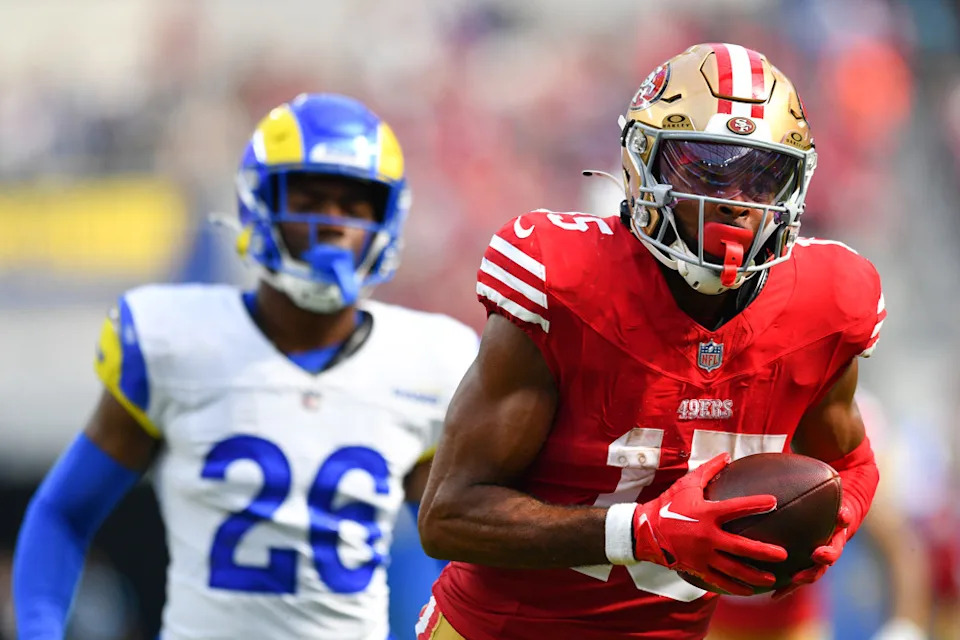
INGLEWOOD, CA – SEPTEMBER 22: San Francisco 49ers wide receiver Jauan Jennings (15) makes a touchdown catch during the NFL game between the San Francisco 49ers and the Los Angeles Rams on September 22, 2024, at SoFi Stadium in Inglewood, CA. (Photo by Brian Rothmuller/Icon Sportswire)
Meanwhile, trades for Day 3 picks, particularly seventh-rounders, usually don’t involve much. “We’ll give you our seventh-rounder next year for yours this year,” or “Will you give us a seventh for our crappy veteran we don’t want to pay anymore?” You generally aren’t getting a star for a seventh-round pick. But, when those seventh-rounders hit, like when the Colts drafted Zaire Franklin or the 49ers drafted Jauan Jennings, the return outclasses the trade package in a hurry. In other words, for the most part, mid-round trades don’t swing future value that significantly (this is clearly a shorthand — it does happen, but it’s rarer), but at either end of the draft, the swings can be dramatic.
Advertisement
Caveats, Fine Print
OK, let’s talk methodology. To reiterate, all of these trades were scored using PFR’s Approximate Value, which is a WAR-like attempt at gauging every player’s contribution to a season. But because this is football, and football really does not lend itself to WAR-like scaling, it has to be more approximate. If a trade has a +2 or -5 score, you can’t really say one team beat another, especially when we aren’t taking into account things like team needs or future injuries. But when a trade’s score is more like +65 or -70, we can be pretty sure the plus team won the trade and the minus team lost. That’s the same over the long run. If you have a -5 on one trade, well, we need to dive in more to see what happened. If you have a -5 on 50 straight trades, though, you’re probably giving up value. To score the trades, I counted every point of AV a player or a draft pick put up after the trade, regardless of future moves. So when the Jets traded 1.06, 2.37, 2.49 and the next year’s 2.34 for the Sam Darnold pick, the Colts used 1.06, 2.37 and 2.34. But that 2.49 pick was later flipped to the Eagles for picks that became Kemoko Turay and Jordan Wilkins. That 2.49 pick turned into Dallas Goedert. So the Colts got the 44 points for Goedert’s career to date in the Darnold trade, but they also lost 44 in the Turay/Wilkins trade. For other situations, where a player leaves as a free agent or is released and signs elsewhere, the receiving team still gets the value for the rest of his career. Basically, every trade creates its own little BC/AD split — everything before the trade is separate from everything after, and there are no more splits from there. Now, how to we define the years? After all, you can trade picks in future years. For this exercise, every trade is classified under the year of the first pick traded. In another words, if a trade was made in 2020 that involved a player in 2020 for a pick in 2021 and another in 2022, the trade was considered a 2021 trade for this exercise. There’s no perfect way to delineate such things, so that’s what I went with. You gotta have rules, you know? Obviously, this exercise doesn’t consider things like team needs or player demands. The Texans won the Deshaun Watson trade when they sent him to the Browns for a million picks, but it wasn’t a trade they set out to make. Before Watson’s off-field concerns, Houston had planned for him to be their quarterback for a long time. But they made the trade. That can sometimes mean a team has to settle for less than it wants, either because it has no leverage or because they have to scramble to make some deal before things get even worse. I can’t realistically account for that. In short, there are a lot of caveats here. This is not a science. It’s just an interesting exercise. If you read this and say “The Colts are the best, the Jets are the worst, and I know for that for a stone-cold fact,” I would invite you to reconsider — after all, probably the worst trade of the last year was the Colts sending two firsts to the Jets for Sauce Gardner. But if you see this and then notice the Seahawks and Bengals making a draft day trade, I’m OK if you use this as a tiebreaker that says “Hm. Well, the values seem the same, but I trust the Seahawks to do better with their return this weekend than I do the Bengals.”
Read the full article here