





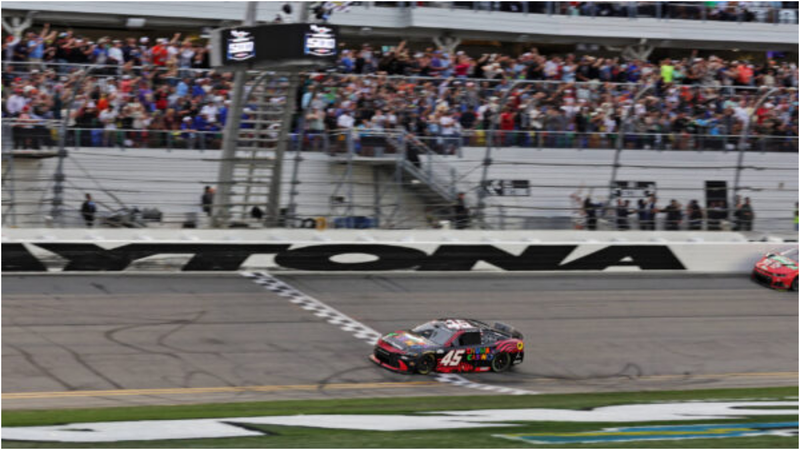
At Daytona and Talladega, the racing looks like controlled chaos, cars packed three-wide at nearly 200 miles per hour, inches apart, one wrong move away from a 20-car pileup. For fans, it is the most visually spectacular form of NASCAR there is. But behind that spectacle, something calculated is happening. And the people doing the calculating are not the drivers.
How Elite Crew Chiefs Turned Speed Into a Liability
As PRN’s Brad Gillie recently pointed out, the fuel-saving strategy at superspeedways was a problem long before the Gen 7 car’s arrival. “This is not just a Gen 7 problem,” Gillie said. “This is crew chiefs have figured out a lot, and the time you spend on pit road and needing that track position.”
Advertisement
What crew chiefs figured out was a simple but damaging piece of math. At superspeedways, the pack is drag-limited, meaning pushing harder does not actually help you go faster relative to everyone else. Run at 100% throttle, and you burn significantly more fuel while gaining nothing on track. Drop to 70-80%, stay in the draft, and you save enough fuel to shorten your pit stop by two to three seconds.
Two to three seconds on pit road translates to 10 to 15 positions of track position, something virtually impossible to gain back under green flag racing at a superspeedway. The choice became obvious: save fuel, protect track position, and let pit road do the work.
The Next Gen car made it worse. Its single-lug nut design allowed teams to change four tires in roughly the same time it takes to fill half a tank of gas, making fuel the primary time thief on pit road. Once crew chiefs recognized that, conserving fuel stopped being a tactic and became the dominant strategy.
The result is a race that looks exciting on the surface but is quietly being managed from the pit box.
Drivers are not really racing; they are waiting. The deeper irony, as Gillie noted, is that this “slow” style of racing is actually what produces the three-wide pack that fans love watching. “We saw a three-wide, 180-mile-per-hour bumper-to-bumper traffic jam,” he said. Fix the fuel saving, and you might end up with something far less entertaining: cars running single-file at 200 miles per hour, simply waiting out laps. “Be careful what you wish for,” Gillie warned.
That tension is exactly what NASCAR is trying to resolve. And the first move is already set for this weekend at Talladega.
Advertisement
The “Talladega Flip”: NASCAR’s 98-45-45 Tactical Strike
NASCAR has restructured the stage lengths for the April 26 race at Talladega, shifting from the previous 60-60-68 lap format to roughly 98-45-45. The logic becomes clear once you understand the fuel math.
A Cup car can travel approximately 42 to 46 laps on a full tank at full throttle. Under the old format, 60-lap stages created a dilemma: run hard and pit mid-stage, or save fuel and skip the stop entirely. Elite crew chiefs consistently chose the latter, and the rest of the field followed. That is how slow-speed pack racing became the norm.
With 45-lap final stages, that choice no longer exists. A car running at full throttle will complete the stage on one tank. There is no mathematical reward for saving fuel because saving it will not buy a skipped pit stop; the stage ends right when the tank runs dry anyway. NASCAR is not simply asking drivers to race harder; it is removing the option to do anything else.
Advertisement
If the Talladega flip works, officials have indicated it could become the permanent blueprint for all superspeedway races, including Daytona and Atlanta. Beyond that, NASCAR has confirmed it will revive the Preseason Thunder test at Daytona in January 2027, where the focus will be on adjusting spoiler heights and power levels to make leading the pack aerodynamically costly enough that dropping to 80% throttle stops makes sense.
The genie has been out of the bottle for years. Crew chiefs cracked the code, and the whole sport played along. Now, NASCAR is rewriting the rules of the game itself.
Read the full article here