





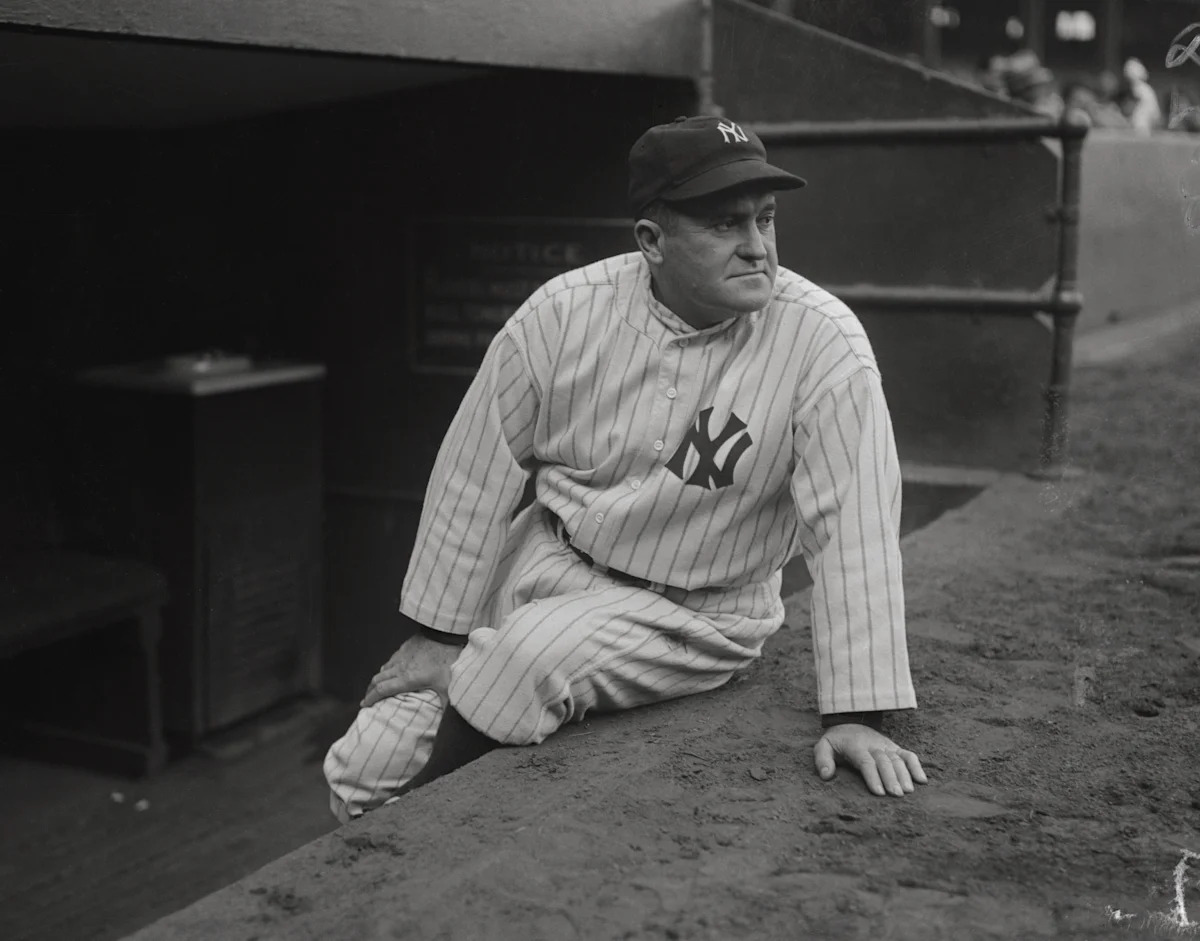
The 1929 Yankees were riding high. Coming off back-to-back World Series sweeps and with the heart of Murderers’ Row still intact, a team which had been an afterthought for most of its history appeared to be cresting a wave. Then, tragedy struck. Beloved manager Miller Huggins, who’d been at the helm for the Yankees’ turnaround and was the only skipper Babe Ruth had played under in New York, died unexpectedly on September 25th. His squad, while in mourning, ended up a distant 18 games behind Philadelphia for the pennant. The next year, under Bob Shawkey, the Yankees finished third as the A’s became a dynasty; it looked like the Yankees’ moment had passed.
That’s when the team’s owner, Jacob Ruppert, hired a new manager to right the ship, a man who’d one day join Huggins in Monument Park.
Advertisement
Joseph Vincent McCarthy
Born: April 21, 1887 (Philadelphia, PA)
Died: January 13, 1978 (Buffalo, NY)
Yankees Tenure: 1931-46 (manager)
Born on a Philly spring day in 1887, young Joe’s father died when he was just three in a cave-in, leaving his son to grow up in poverty. Baseball was a saving grace for McCarthy, netting him first a scholarship at Niagara University and then a long career in pro ball. He was a scrappy and versatile ballplayer, a decent enough hitter who never ran well due to a knee injury sustained in his youth. McCarthy’s determination and wiles kept him afloat in the minors for 15 seasons, throughout much of which he served as a player-manager.
McCarthy was first given the reins while playing in the New York State League for the Wilkes-Barre Barons—a long-ago predecessor of the Yankees’ modern Triple-A Scranton/Wilkes-Barre RailRiders. At the age of 25, he was the youngest manager in pro ball. He continued managing into his 30s with Double-A Louisville. Between 1921 (his final year as a player) and 1925, his Cardinals twice won the pennant and became a reliable contender.
It was on the strength of this track record that Cubs owner William Wrigley, Jr. hired McCarthy to lead his squad for the 1926 season. Chicago finished just seven games back of the pennant that year, their best finish since they’d won it in 1919, and would remain in regular contention throughout McCarthy’s tenure. The Cubs made it to the World Series in 1929 but were trounced by Connie Mack’s Athletics four games to one, a resounding defeat that was the beginning of the end for the team’s manager. “I have always wanted a world’s championship, and I am not sure that Joe McCarthy is the man to give me that kind of team,” Wrigley said after the ‘29 loss, a comment that wouldn’t take long to age poorly.
Despite finishing just two games back in the NL the following season, McCarthy was shown the door. The Yankees, still reeling from the loss of Huggins, jumped on the opportunity to recruit the former Cubs skipper, making him a more attractive offer than the rival Red Sox to secure his services — even going so far as dismissing the longtime pitcher Shawkey as their skipper after just one year. The response among the baseball press to the signing was exultant. “The coming of McCarthy to New York is one of the biggest achievements of the American League since Colonel Ruppert engaged the late lamented Miller Huggins 12 years ago,” one paper gushed. “McCarthy is a figure of national importance.”
Advertisement
McCarthy righted the ship in year one, leading his team to 94 wins and a second-place finish. He quickly became known for a reserved, cautious temperament, both with his team and with the press. This remove led to a contentious relationship with the New York media, who would give the manager his propers for the nuts-and-bolts management of his team but withheld the type of adulation they’d heap upon one of his successors, Casey Stengel, throughout the ‘50s. A representative back-handed compliment came from Arthur Daley of The New York Times. “Few men in baseball were ever as single-minded as he. That was to be both his strength and his weakness,” the columnist opined of McCarthy. “Baseball was his entire life and it never was lightened by laughter because he was a grim, humorless man with a brooding introspection which ate his heart out.”
Perhaps the fairest characterization of what made McCarthy great was his ability as a teacher of the game. “Never a day went by that you didn’t learn something from McCarthy,” said no less an authority than Joe DiMaggio of the man under whom he played for the first eight years of his career.
Whatever the reason, the Yankee behemoth was back in full force the following season. Led by Babe Ruth and Lou Gehrig, who combined for 75 homers, and a pitching staff that included future Hall of Famers Red Ruffing and Lefty Gomez, the 1932 Yankees became the third team in AL history to win 107 games, coasting to the pennant.
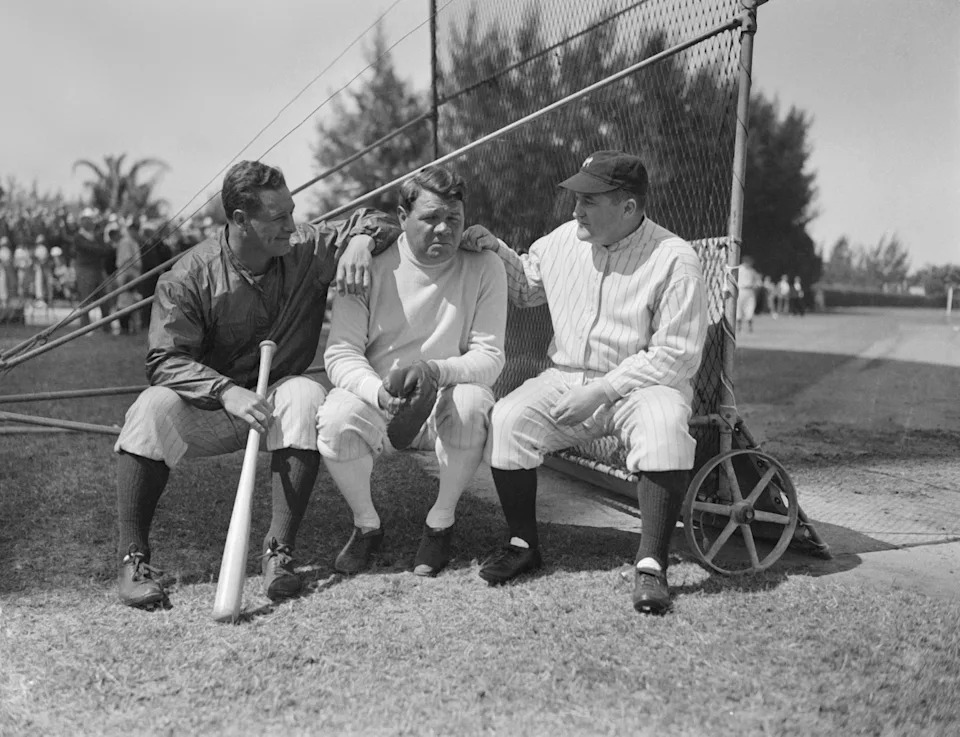
In a sweet twist of fate for McCarthy, his Bronx Bombers would face the Cubs team that had thrown him overboard just two years prior. It was to be a good, old-fashioned beatdown. Ruffing and Gomez hurled complete game victories in Games 1 and 2 and the five future Hall of Famers in the Yankees’ stacked lineup each posted an OPS of at least .900. Gehrig was the star of the show, hitting .519 with three homers to lead the Yankees to a sweep. The resounding victory was vindication for McCarthy, who later called it the greatest thrill of his career. “First, it was my first World Series winner,” he stated plainly. “Secondly, it was against the Cubs.”
Advertisement
The Yankees missed out on October the next couple years and McCarthy’s relationship with the biggest star in the sport waned. Ruth was unhappy that he wasn’t offered the opportunity to be a player/manager in any of the searches following Huggins’ death, and as such, he was not fond of McCarthy. The Bambino’s time as a Yankee was coming to a close anyway, but it was probably best for both sides when Ruth departed the Bronx after the 1934 campaign.
Soon, McCarthy had another star on his hands with DiMaggio joining Gehrig, and a new standard of excellence was set. They won a then-record four consecutive championships from 1936-39 and then two more in ’41 and ‘43. During this time, he not only shepherded his star-studded teams to success on the field but played a pivotal role in establishing the mythos of the “Yankee Way,” ensuring his players adhered to strict standards of dress and behavior, even when outside of the clubhouse. When one player tried to carry on the age-old, impish tradition of giving a teammate a hotfoot, his skipper told him simply, “You’re a Yankee now. We don’t do that.” George Steinbrenner would have been proud.
McCarthy’s teams excelled into the mid-’40s before their momentum was slowed by World War II, which cost them the likes of DiMaggio and Ruffing as well as fellow Hall of Famers Bill Dickey and Joe Gordon. Thirty-five games into the 1946 season, his 16th at the helm in New York, McCarthy resigned, citing a recurring gall-bladder condition (though he was also battling alcoholism). Many at the time assumed a rift with new general manager Larry MacPhail was the true culprit, a theory that gained more credibility when a 60-year-old McCarthy returned to manage the Red Sox two years later. His Boston squads won 96 games in each of his two full seasons there before he retired for good during the 1950 season, once again citing health concerns.
McCarthy enjoyed a long retirement, living on his farm in Tonawanda, New York until dying of pneumonia in 1979 at the age of 90, just a few years after the Yankees dedicated a plaque to him in Monument Park. Well before, he had the chance to travel to Cooperstown to be recognized in 1957 for his excellence with induction into the National Baseball Hall of Fame — an achievement well-earned for someone all over the all-time managerial leaderboard. “Little did I think when I was in the minor leagues I would ever make the Hall of Fame,” the normally reserved McCarthy said upon hearing of his induction. “I’m very, very happy.”
See more of the “Yankees Birthday of the Day” series here.
Read the full article here