





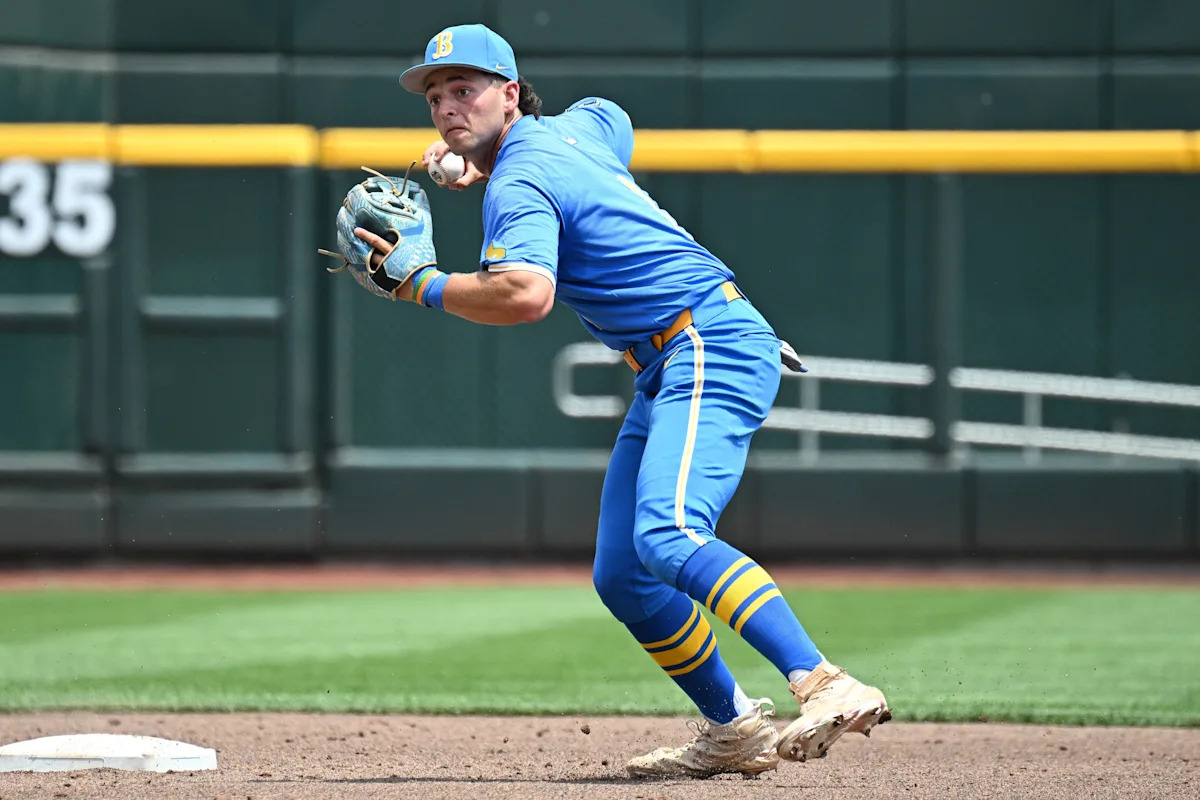
There’s just one Roch, and then a whole lot of fluidity.
That theme has only solidified for the 2026 Major League Baseball draft, where UCLA shortstop Roch Cholowsky has only distanced himself from the pack as the likely No. 1 overall pick thanks to a junior season as stellar as his previous two.
Advertisement
Beyond that, though, uncertainty will reign as college conferences and high schools hit the high gear of their regular seasons and into the playoffs all the way until draft day arrives July 11 from Philadelphia.
A dearth of pitching and a true mashup of collegiate and prep talent after one sector dominated the top of the past two drafts should ensure a fair amount of volatility. With that, USA TODAY Sports takes another crack at a mock draft:
UCLA shortstop Roch Cholowsky in 2025.
It is a junior season to remember for both Cholowsky and the No. 1 Bruins, who are overmatching most opponents in the Big Ten. Cholowsky has 46 hits in 36 games, including 13 homers, and represents the most sure-fire No. 1 in a while for a guy who may not necessarily be a franchise player.
Advertisement
2. Tampa Bay Rays: Grady Emerson, SS, Fort Worth Christian
OK, so maybe No. 2 is fairly well locked in, as well. Transferring to a new school has not slowed Emerson, who is putting together a massive senior year under the tutelage of former Texas Ranger Rusty Greer, who also mentored Bobby Witt Jr. a few years back. The 6-2, 180-pound lefty bat would represent the Rays’ highest draft pick since selecting Tim Beckham No. 1 overall in 2008.
3. Minnesota Twins: Jackson Flora, RHP, UC Santa Barbara
Many directions the Twins can go here, marking the “Choose Your Own Adventure” inflection point in this draft. For now, we roll with the healthiest and most productive college arm this spring, as Flora has given up just four earned runs in 57 innings and should make it back-to-back Gauchos as the first college arm off the board, following Tyler Bremner.
Advertisement
They have been linked to prep shortstops in several recent drafts yet haven’t chosen one since plucking Christian Arroyo out of a Florida high school in 2013. Lombard, brother of top Yankee prospect George Jr., will need to clean up contact issues but his elite athleticism would give the Giants the sort of high-upside, up-the-middle asset they must add to the organization.
5. Pittsburgh Pirates: Gio Rojas, LHP, Marjory Stoneman Douglas (Fla.) HS
Stacking, developing and shipping elite young arms to Pittsburgh has been working out OK for the Pirates. It might be too tough to pass on yet another one, a prep lefty who hits 97 mph with his fastball and is uber-athletic.
How high will he fly? Lackey’s solid 6-2, 215-pound frame, premium position and fantastic junior season (12 homers, a .364/.489/.721 line) will rocket the 20-year-old into the top five if he finishes as strongly as he started.
Advertisement
The Orioles’ “I can fix him” mentality makes the highly talented Lebron a perfect fit: He’s struggling through a .273, 19% K rate third season in the SEC, though he has hit 12 home runs and stolen 32 bases in as many attempts.
8. Athletics: A.J. Gracia, OF, Virginia
Their recent success of plucking players that are both quick to the majors yet possess high ceilings continues with Gracia, a lefty swinger who has 12 homers, a .477 OBP and 1.105 OPS after transferring from Duke.
9. Atlanta Braves: Eric Booth Jr., CF, Oak Grove (Miss.) HS
A strong and fast lefty-swinging center fielder, Booth’s skill set suggests potential 20-20 (30-30?) guy as he adds strength. A Vanderbilt commit, Booth would be Atlanta’s first top pick from Mississippi since Austin Riley in 2015.
Advertisement
The first pick of the new Rockies regime will be an interesting tell on the club’s future model. Feels like they might go with greater upside but settle on Hacopian, older and steadier and a solid bet to grow into a big league regular, even if his future position is uncertain.
11. Washington Nationals: Tyler Spangler, SS, De La Salle (Calif.) HS
A bit of spec here, as injury has kept Spangler off the field his senior year and the Nationals will need to see something in the final six weeks of his season to snag him this high. But Spangler, a 6-4 Stanford commit, represents a better high-upside play than the capable college hitters still available in this spot.
Advertisement
12. Los Angeles Angels: Cameron Flukey, RHP, Coastal Carolina
Hard for this college-oriented organization to pass on the preseason consensus No. 1 college arm even as Flukey has been slowed by a ribcage injury. When healthy the 6-foot-6 Flukey tops out at 98 mph and his curveball is also a pro-ready offering.
He’s been on a heater most of this season, with a pair of multi-homer games and 12 longballs overall, powering a 1.056 OPS. A strong arm behind the dish.
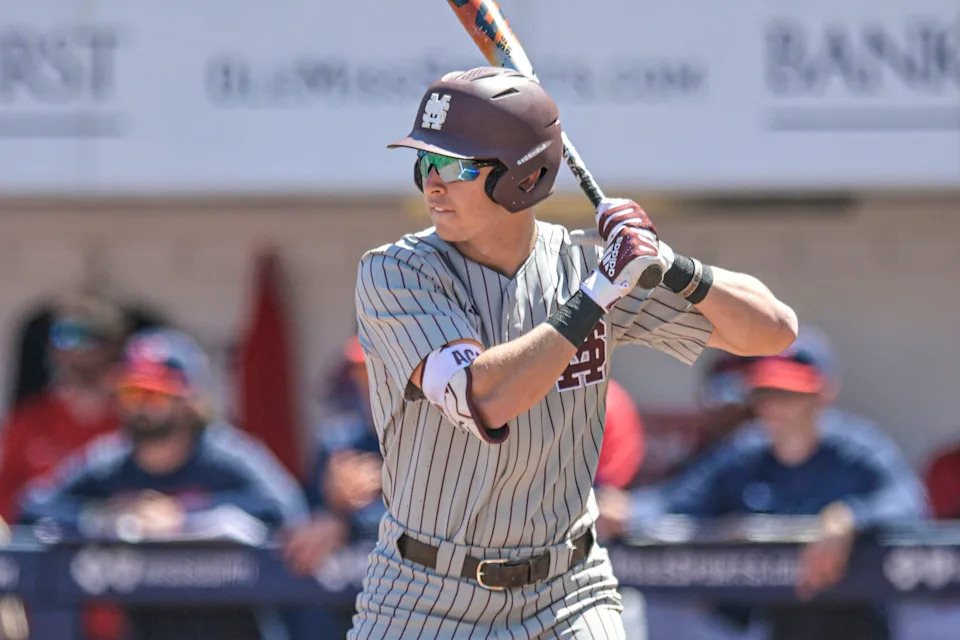
Mississippi State’s Ace Reese.
A weird year for Reese, who is hitting for power (six homers, 1.529 OPS) but not average (.214) in 17 SEC games. Yet his overall body of work remains strong, and he will have a pre-draft platform to slug his way into the top 10.
Advertisement
A remarkably steady player with surprising pop, Becker could help a big league team soon and for a long time, even if his upside doesn’t scream future All-Star.
16. Texas Rangers: Sawyer Strosnider, OF, TCU
Yet another volatile player to slot, Strosnider, a sophomore who turns 21 three weeks before the draft, is hitting for more power but less average than his Big 12 freshman of the year campaign a year ago. A nice power-speed combo becomes even more enticing if he can slot in as a center fielder in pro ball.
17. Houston Astros: Drew Burress, OF, Georgia Tech
He won’t come close to the 25-homer splash he made as a freshman in 2024, but Burress has elite offensive potential and a right-handed swing tailor-made for Houston’s Crawford Boxes.
Advertisement
The classic frame vs. performance quandary. At 6-5, 220 pounds with a fastball that sits at 95 mph, Peterson offers a high-upside arm. Yet his results have not yet matched his pedigree, with his walk rate rising and his WHIP 1.40 in the rugged SEC. That simply makes him available to the Reds.
The man who authored an 18-strikeout game against Rutgers has six more weeks to point his arrow further upward. But even if they stopped the count now, there’s so much to like: An 84-11 strikeout-walk ratio, a 2.87 ERA and 12.7 strikeouts per nine thanks to a fastball creeping into the mid-90s.
Advertisement
20. Boston Red Sox: James Clark, SS, St. John Bosco (Calif.) HS
A lefty bat with a 6-1, 195-pound frame, Clark’s speed is more the carrying tool but he can certainly add strength as he ages.
21. San Diego Padres: Brody Bumila, LHP, Bishop Feehan (Mass.) HS
A classic young big arm that the Padres will eventually trade, Bumila touches 100 mph from the left side and is athletic enough to have scored 36 points with 20 rebounds in a state championship basketball game.
A hit machine, Curiel, a draft-eligible sophomore, has banged out 56 hits in 40 games, a .354 average, though only 15 are for extra bases. Yet Curiel has the athleticism to play any of three outfield positions.
Advertisement
23. Chicago Cubs: Zion Rose, OF, Louisville
Just an absurd .494 OBP for Rose, who’s been limited to 18 games by an ankle injury. That shouldn’t matter too much: Rose had a solid Cape Cod League showing and a career 1.011 OPS in three seasons at Louisville, with another five weeks to display his wares and climb the board.
An elite 4.1 strikeout-walk ratio and 16 strikeouts per nine innings are Edwards’ calling cards, though UCLA’s talent-rich lineup wore him out for four walks and four runs in 4 2/3 innings of their L.A. showdown. Still, a lefty touching 94 mph with serviceable breaking stuff will play.
Advertisement
His first season in the SEC has not hindered Robbins, now slashing .378/.454/.757 with 15 home runs for the Longhorns. Faces mild questions of whether he’ll develop the power to support a corner outfield spot, or if he projects as a center fielder defensively.
26. Atlanta Braves: Jensen Hirschkorn, RHP, Kingsburg (Calif.) HS
At 6-7, with an athletic delivery and a fastball he runs up to 96 mph, the LSU commit is all kinds of projectable.
Limited to 23 games due to a shoulder injury, Bell has nonetheless slashed .361/.562/.569, an on-base machine in a 6-1, 190-pound package. Yet another player for which the final month-plus may prove significant.
Advertisement
28. Houston Astros: Jared Grindlinger, OF/LHP, Huntington Beach (Calif.) HS
A reclassified Class of 2027 prospect (a la No. 1 overall Eli Willits a season ago), Grindlinger should, like Nolan McLean, get a decent runway to play both ways as a pro, at least until the answer becomes apparent. ca
29. Cleveland Guardians: Caden Sorrell, OF, Texas A&M
A 24% K rate is about the only blemish on a resume that includes power (career-high 17 homers in 36 games) and elite on-base skills in a potential center fielder’s package.
30. Kansas City Royals: Cole Carlon, LHP, Arizona State
A big fastball and a hard slider from a 6-5, 230-pound lefty touting an 86-19 strikeout-walk split this season.
This article originally appeared on USA TODAY: 2026 MLB mock draft: Top prospects with White Sox on the clock
Read the full article here