





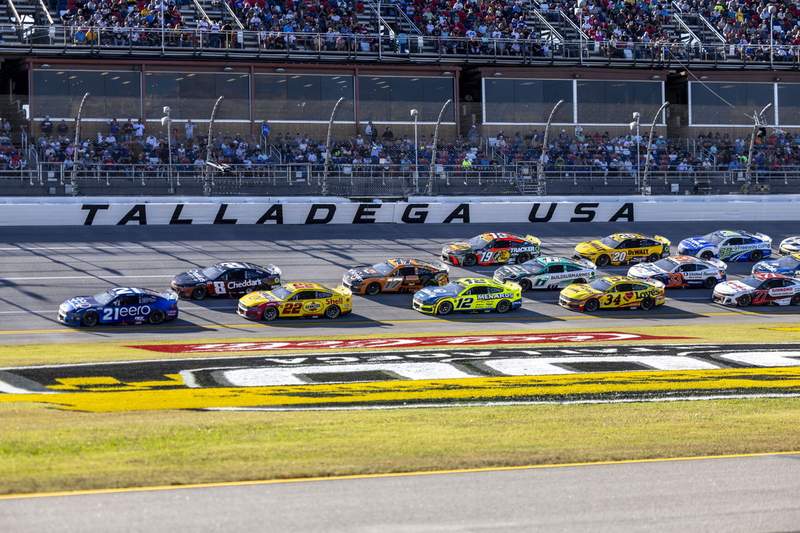
NASCAR’s latest attempt to save superspeedway racing might be dead on arrival, and the drivers already know it. The changes look good on paper but feel more like experiments than real solutions. Teams keep finding workarounds, and the question isn’t what NASCAR tries next but rather whether any of it will actually stick.
On Jeff Gluck’s podcast this week Front Row Motorsports’ Todd Gilliland raised some pointed questions about whether NASCAR’s Talladega changes will actually work.
Advertisement
“Yeah, I’m not actually sure about that… So if there’s a caution in that last stage, the guys that are leading not saving as much fuel compared to the back…The guys at the very back maybe gain a second, but under caution, you know, that only gets you maybe five to 10 spots, “Todd Gillilandpointed out. ” So I still think track position is going to be super important at the, you know, end of that.”
Ahead of the April 26 race at Talladega, NASCAR flipped its usual stage format. Instead of two short stages followed by a long run to the finish (the old 60-60-68 layout), the new structure front-loads the race. This makes it 98 laps in Stage 1, then 45-lap sprints in Stage 2 and the final stage. The idea is that 45 laps is short enough to run without a fuel stop, which should eliminate the need to save.
To force drivers’ hands, NASCAR overhauled the Talladega stage format for the April 26 race, ditching the old 60-60-68 lap structure for a front-loaded 98-lap opening stage followed by two 45-lap sprints designed to eliminate fuel-saving.’
On the surface, it is a bold push to get back to the flat-out racing fans have been begging for since theNext Gen car arrived. But Gilliland’s insight cut right through the idea. The real currency in superspeedway isn’t fuel, it is track position. And that’s something no rule tweak can erase.
Advertisement
Even if drivers don’t have to lift and save in the closing laps, the priority will be the same: control the front, avoid the chaos and strike when it matters. In that sense, NASCAR may have solved the symptom but not the problem.
And here’s where the dismantling starts. Even if teams don’t need to save fuel late, they will just shift the strategy earlier, short-pitting, managing runs, and positioning themselves for the final stage.
With NASCAR President Steve O’Donnell floating the idea of mandatory four-tire pit stops in the future, it is clear the sanctioning body knows this isn’t a silver bullet. Talladega then isn’t just another race, it’s a real times stress test.
If drivers like Gilliland are right, NASCAR’s fix could be figured out and neutralized before the checkered flag even drops. But this is just one phase. NASCAR’s obsession with getting superspeedway racing right is only growing
Advertisement
The fixes go deeper than stage lengths
Beyond the stage length shake up at Talladega Superspeedway, NASCAR has quietly rolled out several other superspeedway specific tweak in 2026, and they all pointed through the same goal: tighter control over pack racing. This only adds to NASCAR’s fixation to these types of speedways.
One of the biggest changes is a new role banning drivers from sticking their hands out of the window to manipulate airflow during qualifying at drafting tracks like Daytona and Talladega, a trick teams had started exploiting for extra speed.
At the same time, NASCAR has kept the reduced 510 hp superspeedway package in place to limit top speed and maintain safety in the draft. There are also broader safety upgrades, like mandating a post flag across all tracks in 2026, first introduce at superspeedways, to help keep cars grounded during high-speed spins.
Advertisement
It’s clear that NASCAR isn’t relying on just one fix, it is layering multiple small changes in an attempt to reshape superspeedway racing but as teams continued to adapt, whether these moves actually change the on-track product remains very much up for debate.
Read the full article here