





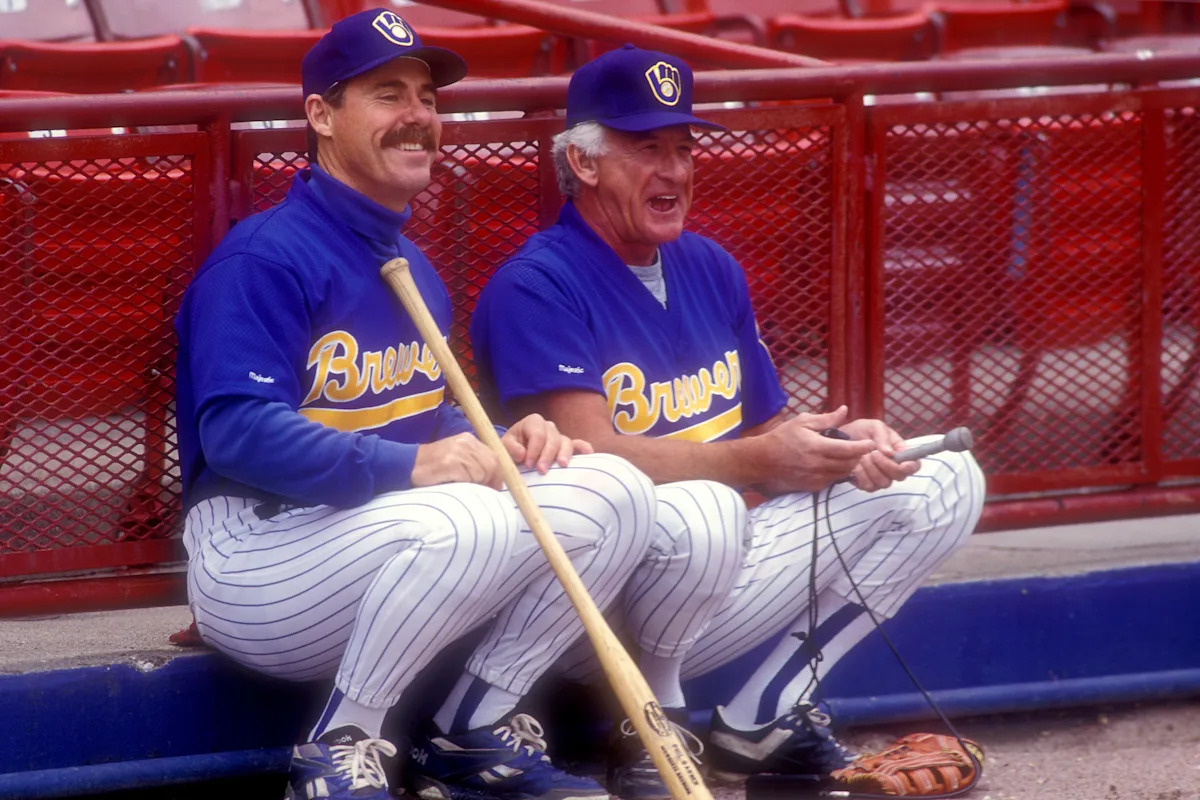
Phil Garner, a baseball lifer who was for a time the all-time winningest manager in Brewers history, died over the weekend at age 76.
Brewers fans will remember Garner as the team’s manager for most of the 1990s. He became the franchise’s all-time leader in wins when he passed Tom Trebelhorn during the 1997 season and remained in that spot until he was passed by Craig Counsell in 2022, just over 50 years after the team was founded. Garner’s 563 wins remain second in franchise history, more than 100 more than third-place Ned Yost.
Advertisement
Early Career
Before he managed, though, Garner had a long, notable career as a player, and given who he played for in the early stages of his career, it’s not a surprise that Garner went on to success in a leadership role. The 24-year-old Garner appeared in his first major league games in the midst of a dynasty: he made nine appearances late in the 1973 season for the Oakland Athletics, who were in year two of a back-to-back-to-back World Series run. Garner went 0-for-5 and mostly just played as a defensive substitute in those nine games, but he’d gotten that first game out of the way.
Garner appeared again in a (very) limited role for the Athletics in 1974, playing in 30 games mostly in the last two months of the season, but he was not included on the postseason roster that won Oakland’s third straight World Series. In 1975, though, Garner — who was already 26 — got his first regular job in the big leagues after the dynasty’s second baseman, Dick Green, was released and chose to retire. Garner jumped right into Green’s role and started 160 games as Oakland’s second baseman. He didn’t hit a whole lot, but played good defense, and got his first taste of the postseason (though Oakland was swept in the ALCS by the Red Sox).
Garner’s offense improved considerably in 1976 — he hit .261/.307/.400, had 29 doubles, 12 triples, and eight homers, and stole 35 bases, and earned an All-Star appearance. He also increased his trade value enough that the A’s included him in the type of wild trade that happened somewhat frequently in the 1970s: Oakland sent Garner, along with pitching prospect Chris Batton and veteran infielder Tommy Helms (the uncle of former Brewer Wes!) to Pittsburgh for six players, most notably outfielder Tony Armas (who’d played only four major league games at that point), former All-Star Dave Giusti, and outfielder Mitchell Page, who’d finish second in Rookie of the Year voting for the A’s in 1977.
Advertisement
Pittsburgh Years
It’s debatable whether the Pirates won that trade — Helms and Batton were basically zeroes, and the Athletics got good value from several of the players they’d received — but they did solidify the infield on what was an up-and-coming team. Garner played mostly third base in his first three seasons in Pittsburgh, and he played quite well: three of the four seasons between 1977 and 1980 were Garner’s best by WAR. The 1977 Pirates went 96-66, led by 26-year-old phenom Dave Parker, 23-year-old John Candelaria, and closer Goose Gossage, who had an absurdly good season out of the bullpen. But 96 wins wasn’t enough to get them into the postseason, as they finished second to the 101-win Phillies.
The Pirates were second again in 1978 at 88-73, even as Parker won the MVP award. But the team finally had its breakthrough in 1979: behind the veteran leadership of 39-year-old Willie “Pops” Stargell, who hit 32 homers and was voted as co-MVP in the National League. (This award does not hold up to any sort of modern statistical analysis — Parker was, again, the team’s clear best player, and Stargell was worth only 2.5 WAR via Baseball Reference — but the vibes of the “We Are Family” Pirates were immaculate, and Stargell was an old legend having a good season who was right in the middle of it all. I don’t mind it.)
Garner was central to that team. With Bill Madlock at third and Rennie Stennett often manning second base, Garner played a super utility role on the 1979 team, appearing almost equally split between second and third and occasionally at shortstop. He had what was his best offensive season to that point in his career: .293/.359/.441 with 32 doubles, eight triples, and 11 homers, and combined with his solid defense all over the infield, he had what is now viewed by WAR as his best season at 4.1.
Advertisement
In the postseason, Garner was absolutely on fire. In a three-game sweep of the Cincinnati Reds, Garner went 5-for-12 (.417) with a triple and a homer. In a classic seven-game World Series against the Baltimore Orioles, Garner hit .500 (12-for-24) with four doubles and five RBIs. In the top of the ninth of the decisive Game 7, Garner led off with a double, moved to third when Pirates closer Kent Tekulve bunted him over (imagine a reliever taking an at-bat in the ninth inning of Game 7 of the World Series), and he crossed the plate on an Omar Moreno single to increase Pittsburgh’s lead to 3-1. They scored another in the inning, and Tekulve came back out to finish Baltimore off in the bottom of the inning.
Later Playing Career
Garner made back-to-back All-Star Games in 1980 and 1981, though he may have been coasting a bit on reputation at this point; he took a significant step back offensively, though his defense was viewed as some of the best of his career in 1980. During the strike-shortened 1981 season, the Pirates were struggling, and at the trade deadline they sent Garner to Houston for second baseman Johnny Ray, who ended up having several good seasons for Pittsburgh.
Garner was 32 when he first played with Houston, and it would’ve been reasonable to think he was almost finished as a player. But he was not. Garner’s offense bounced back in a big way in 1982, and in the five full seasons Garner played with the Astros (1982-86) he hit .263/.326/.397 (106 OPS+) and averaged 2.3 WAR per season. Not bad for an infielder in his mid-to-late 30s.
Advertisement
Houston, who wasn’t very good in the ‘80s, traded Garner to the Dodgers 43 games in to the 1987 season, and he played 70 games with Los Angeles down the stretch. But Garner’s offense had almost complete dried up by this point, and while he could still work the glove a bit, the writing was on the wall. Garner played 15 games for the Giants in 1988 but retired at age 39 after the season.
Garner was never a superstar. He did make three All-Star Games, but he never earned more than 4.1 WAR in a season. He was, however, able to stretch his ability into a long, effective career — he played in parts 16 major league seasons, and had at least one WAR (a low bar, but a sign of being a contributor) in 11 of them. That added up: Garner earned 29.7 WAR over his career. He had a career 99 OPS+ and collected 1,594 hits, 299 doubles, 82 triples, 109 homers, and 225 stolen bases, and our best modern estimates see him as a solid defensive player.
Manager of the Brewers
After the 1991 season, three years after Garner’s last game as a player, Brewers general manager Sal Bando — who’d been Garner’s teammate in Oakland — hired him to succeed Tom Trebelhorn as manager of the Brewers.
Advertisement
Garner had immediate success. The 1992 Brewers were one of the more surprising teams in the league (and in the history of the franchise), and that was at least partly due to the aggressive baserunning style that Garner encouraged in his team. Ten Brewers players stole at least 11 bases in 1992, including 54 for Rookie of the Year Pat Listach and 41 (in just 128 games) for outfielder Darryl Hamilton. Their 256 steals as a team were 48 more, or 23% more, than any other team in the majors. The 1992 Brewers also benefitted from the shockingly good arrival of rookie pitcher Cal Eldred and a renaissance season at age 35 from designated hitter Paul Molitor (in what would be, unfortunately, his final season as a Brewer), and they won 92 games and finished second in the AL East.
Unfortunately, that was Garner’s high-water mark with the Brewers, and it was indeed the highest win total that the team would have between 1982 and 2011. While a lot of things went right for the ’92 Brewers, those things went wrong in 1993. Garner had the Brewers back up near .500 in 1996 and 1997, but after 1992 he never again fielded a Brewers team that won more than 80 games. Garner spent seven-plus years at the helm, though, and as mentioned at the start, he passed his predecessor, Trebelhorn, as the franchise’s all-time leader in wins in 1997.
One of the more notable moments of Garner’s later Brewer tenure was not exactly a bright one. In a 1995 game against the White Sox, Garner and Chicago manager Terry Bevington exchanged blows during a bench-clearing brawl, quite a rarity for managers. Both men were suspended four games. Check out the tape for some vintage Jim Paschke and Bill Schroeder.
Garner was let go when the Brewers were 52-60 in the 1999 season, his seventh straight losing season in Milwaukee. He finished his Brewers career with a record of 563-617, and only Counsell has managed more games in franchise history than his 1,180.
Advertisement
Later Managerial Career
Garner didn’t have to wait long to get another job. After less than a season out of work, he was hired to manage the Detroit Tigers in 2000. They were OK in his first season, but after they went 66-96 in 2001 and then started the 2002 season 0-6, Garner was fired. It turns out there’s not much anyone could’ve done with that Tigers team: they finished 55-106 in 2002, and then lost 119 games the following season, which at the time was the second-most losses by any team after 1900.
Garner sat out the 2003 season and was then hired by his former team, the Astros, in 2004. Garner engineered a dramatic turnaround for the Astros that year: they fired Jimy Williams when they were 44-44, and Garner went 48-26 down the stretch and earned the team a Wild Card spot. The Astros then upset the Atlanta Braves in a five-game NLDS victory before losing to the Cardinals in a classic NLCS.
Garner led the Astros to 89 wins and another Wild Card berth in 2005. Houston beat the Braves again in the NLDS, and in an NLCS rematch, they got revenge on the Cardinals — though Albert Pujols hit a home run off of Houston closer Brad Lidge so massive that it seemed to break him. That homer seemed to reverberate into the World Series, where a shellshocked Lidge struggled, the Astros’ bats went quiet, and Houston was swept by the White Sox. Lidge didn’t really recover from that homer until he left Houston two years later.
Advertisement
Garner’s Astros went 82-80 in 2006, and when they struggled in 2007, Garner was let go when he had a record of 58-73. He never managed in the majors again, and instead spent a little bit of time managing in college and with the Canadian national team. His last official work in baseball came as a special adviser in the Athletics’ front office, and he retired in 2012.
Coda
Garner’s career was long and varied. He appeared in his first games as a minor leaguer in 1971 and didn’t finish his pro baseball career until 2012, over 50 years later. He was a very good player who played on two of the most legendary teams of the second half of the 20th century. As the Brewers’ manager, he was tasked with overseeing what was ultimately the beginning of a dark period in the team’s history but also led the 1992 Brewers to one of the better and more surprising seasons the franchise has ever had.
He never won the big one as a manager, but Garner played on three World Series winners as a player, managed in the World Series, and finished his managerial career with 985 wins, which stands at 70th all time.
Read the full article here