





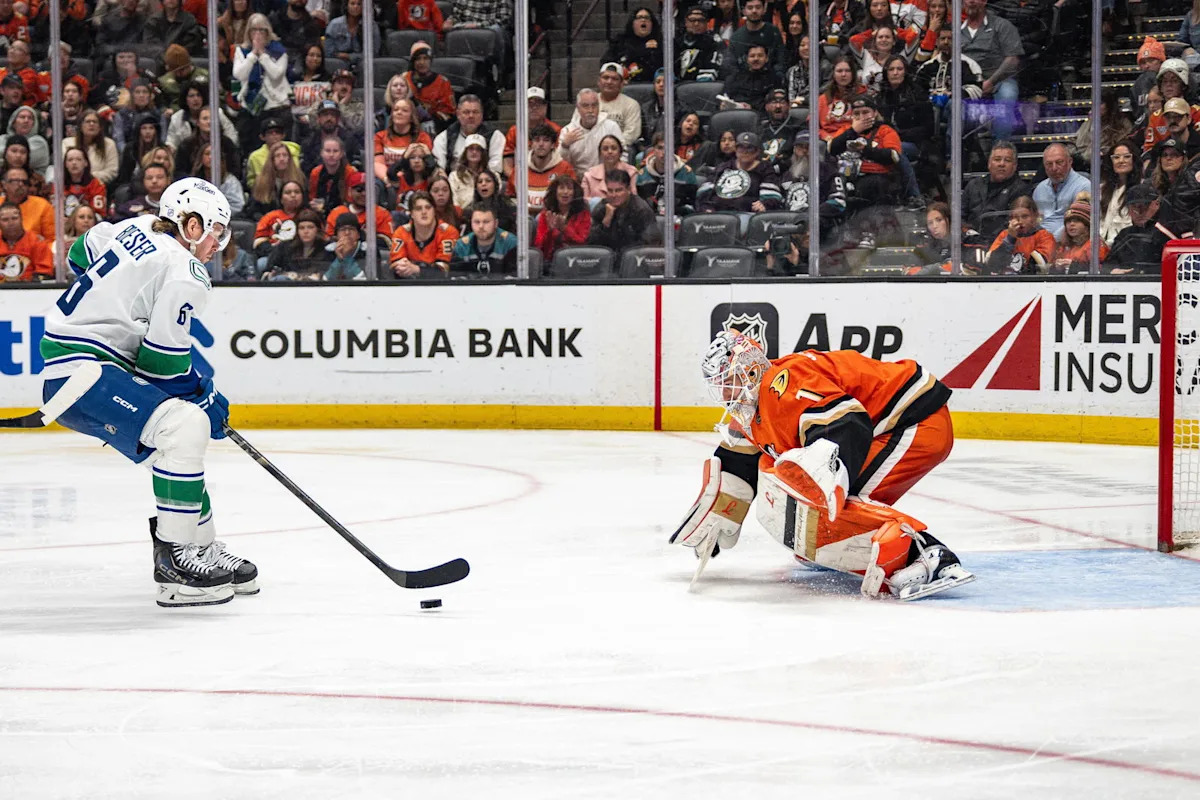
To wrap up their 2025-26 home schedule, the Anaheim Ducks hosted the Vancouver Canucks on Sunday evening at Honda Center. This home closer had more weight behind it than any in the last eight years, as a win would clinch the Ducks a playoff spot for the first time since the 2017-18 season.
The Ducks were coming off a get-right win on Thursday, as they defeated the San Jose Sharks 6-1 and snapped a six-game winless streak.
Advertisement
Anaheim Ducks Goaltender Lukas Dostal Nominated for King Clancy Memorial Trophy
Takeaways from the Ducks 6-1 Win over the Sharks
For Vancouver, this was their second game of a back-to-back, as they snapped their own four-game losing streak with a 4-3 shootout win against the Sharks on Saturday.
The Ducks saw the return of two prominent pieces in their lineup, as Cutter Gauthier returned after missing the Ducks’ previous five games with an upper-body injury. Captain Radko Gudas also returned to the blueline after missing six of their last seven games. Frank Vatrano, Olen Zellweger, and Drew Helleson served as healthy scratches in this one.
Advertisement
Here’s how the Ducks lined up to start:
Kreider-Carlsson-Terry
Killorn-Granlund-Sennecke
Viel-McTavish-Gauthier
Washe-Poehling-Moore
LaCombe-Trouba
Mintyukov-Carlson
Hinds-Gudas
Lukas Dostal got the start for the Ducks in this game, setting a career high for games in a season with 55. He stopped 22 of 26 shots in this one. In the Vancouver crease stood Nikita Tolopilo, who saved 24 of 27.
The Ducks got off to one of their better starts, dominating the shot count, manufacturing quality chances early, and getting out to a lead just three minutes in. Vancouver pushed back and got a goal off a net front battle and a power play goal to close out the first.
Advertisement
After a cycle-heavy second period didn’t amount to anything on the scoreboard, the Ducks allowed a shorthanded goal early in the third. In typical 2025-26 Anaheim Ducks fashion, led by their youngest and most talented players, they refused to let this game slip away, and notched two tallies in short succession, following Vancouver’s shorthanded goal.
In overtime, Beckett Sennecke tried to force a play, turned it over at his blueline, Chris Kreider took a penalty, and the Canucks won it on the ensuing power play in overtime. Special teams proved an issue again in this game, but at 5v5, they won every category decisively. They accounted for 58.67% of the shot attempts, 60.53% of the shots on goal, and 66.92% of the expected goals.
“Well, we fell short. I didn’t like the call at the end of the game,” Ducks head coach Joel Quenneville said after the game. “That didn’t help, certainly. We battled back there in that third period. I thought we played fine all game. We had good pace, good energy, and worked hard.”
Cutter Gauthier: Teams don’t want to be over-reliant on one player to contribute a sizable percentage of their offense. However, the Ducks were clearly missing Gauthier over the last five games. His finishing ability and knack for instant offense is something the Ducks always have in their back pocket whenever they need a go-ahead goal early or a goal to get them back into a game.
Advertisement
In this one, he did his damage on the power play (or when a power play had just expired) from his home on the right flank. Few players can beat NHL goaltenders from distance regularly, even with puck movement, but Gauthier is one of the few. His line with Viel and McTavish didn’t have their best defensive performance, but did well to pressure Vancouver’s defensemen and disrupt on the forecheck.
Cycle: The Ducks seemed keen to feed pucks to their defensemen at the points, perhaps to a fault. Point men weren’t forcing shots or funneling pucks to the net; instead, they prioritized keeping pucks moving down the wall, extending cycle sequences, and racking up offensive zone possession time.
However, at times when forwards were in trouble on the wall, they would try to feed covered point men, which led to several turnovers high in the offensive zone, one of the more dangerous areas on the ice to cough up pucks.
The cycle was at its best, especially with McTavish’s line, when the Ducks’ F3 would pop high between the defensemen along the blueline to draw the opposing center away from the low slot so they could get shots through easier or more easily win pucks back down low, as they had the numbers and positioning advantage.
Advertisement
Rush Defense: As has been the case for the entirety of this season, the Ducks played a high-risk, pressure game. Defensemen and F3s made some questionable pinches and pressures low in the offensive zone with the aim to maintain possession.
The difference in this game and why those sequences didn’t cost them can be attributed to two factors: 1. Quality of opponent. Vancouver is at the bottom of the NHL standings for several reasons, and one of them is their lack of team speed and firepower. 2. When Ducks players would pinch or pressure, as a team, they were able to recover well for their pressuring teammate or recover themselves after a failed pinch.
If that aspect of their pressure game can be relied on and fleshed out, it can become a more dangerous weapon while also limiting much of the risk involved.
The Ducks will look to finally, mercifully, clinch a playoff spot for the first time in eight seasons on Tuesday, when they’ll head to St. Paul to take on the Minnesota Wild.
Ducks Goaltender Ville Husso Nominated for Masterton Trophy
Takeaways from the Ducks 5-0 Loss to the Predators
Read the full article here