





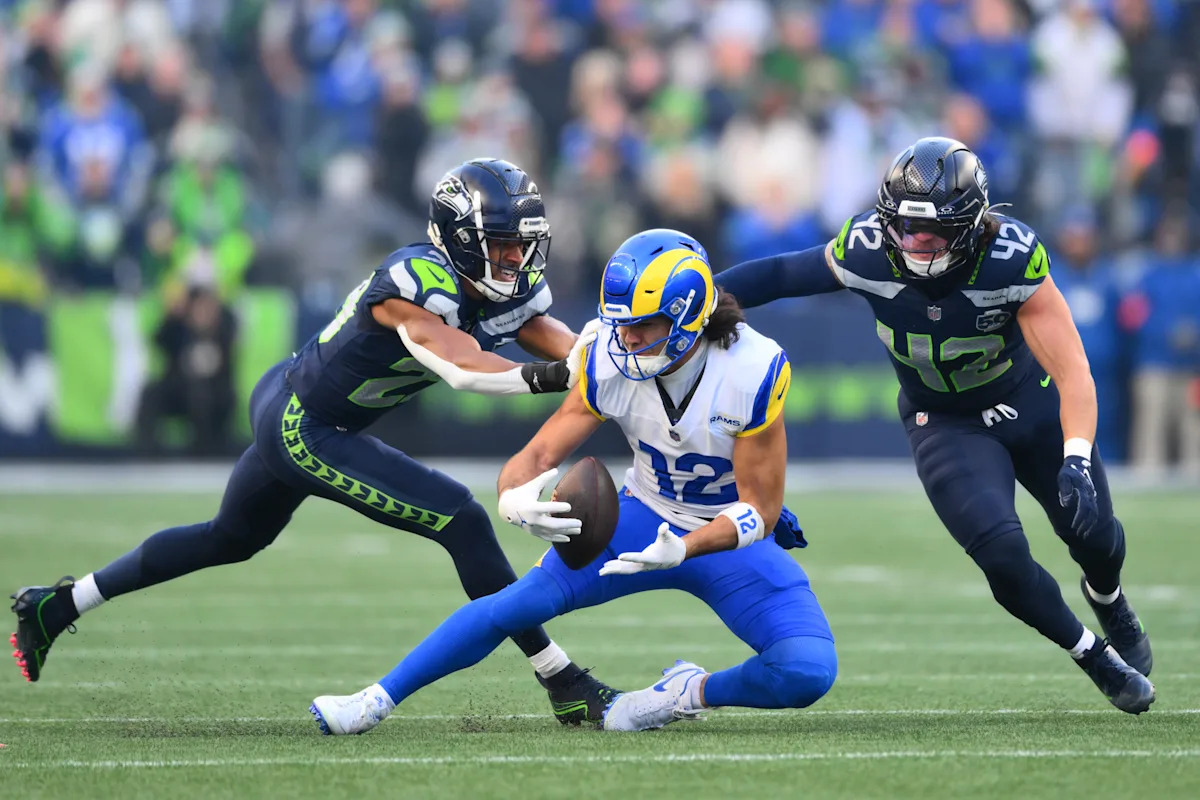
The Los Angeles Rams are rapidly approaching one of the most important financial decisions in their current roster build: what to do with superstar wide receiver Puka Nacua. After a historic start to his career, Nacua has outperformed his rookie contract to a degree rarely seen by a fifth rounder in the modern NFL. But the Rams must decide if Puka Nacua is worth a huge long term investment as other factors weigh in on the decision beyond finances.
Current Market Price
Nacua’s production alone makes this situation complicated. Through just a few seasons, he has already racked up over 4,000 receiving yards and multiple All-Pro selections, establishing himself as one of the league’s elite pass catchers. At the same time, the wide receiver market has exploded.
Advertisement
Recent deals have pushed top receivers into the $40–$45 million per year range, with contracts like Jaxon Smith-Njigba’s $42+ million annually resetting the market. Projections already suggest Nacua could command upwards of $44 million per year on a long-term deal.
That’s where the franchise tag becomes relevant.
Projecting the 2027 franchise tag cost
NFL franchise tag values are based on the average of the top five salaries at the receiver position over the last five years. Using current 2026 market trends where elite receivers are earning roughly $40M–$45M annually. The projected wide receiver franchise tag in 2027 would likely fall between $30 million and $36 million for one season.
Advertisement
That estimate reflects:
-
A top-tier salary range of ~$42M–$45M
-
A tag formula typically slightly below the very top APY
-
Continued cap growth across the league
For the Rams, that one-year number is expensive but still significantly less risky than a huge long-term deal with significant guarantees that would affect the Rams dead cap if a problem were to arise.
Case for the franchise tag
1. Off-field uncertainty raises hesitation
The biggest wild card is not on the field at all. Nacua’s name popped up in the news throughout the 2025 season with off-field controversy. This included an antisemitic gesture and an altercation with a woman. He entered a rehabilitation program and is facing legal scrutiny tied to the alleged incident.
Even if those issues are resolved, they introduce uncertainty for a front office considering a massive long-term investment. A franchise tag would allow the Rams to:
Advertisement
-
Evaluate his maturity and consistency for another full season
-
Protect themselves from long-term risk
-
Maintain leverage in negotiations
In short, the tag acts as a “prove-it-again” mechanism under a brighter spotlight.
2. Cap flexibility for a roster in transition
The Rams are no strangers to aggressive spending, but tying up $40+ million per year in one receiver has ripple effects across the roster. Tagging Nacua would:
-
Allow the team to prioritize other extensions or roster needs like Kobie Turner, Kevin Dotson, Steve Avila, and even Matthew Stafford
-
Keep financial flexibility during a competitive window with Matthew Stafford
3. Strategic leverage in negotiations
Franchise tags are often less about keeping a player long-term and more about controlling the timeline. By tagging Nacua, the Rams could:
-
Prevent him from hitting free agency
-
Continue negotiating without bidding against other teams
-
Even explore a tag-and-trade scenario if relations sour
Given his immense trade value, this option cannot be ruled out especially with reports suggesting internal concern about his long-term situation.
Advertisement
The case against tagging him
Of course, tagging a player like Nacua is not without risk. Elite receivers often prefer long-term security and using the tag could: a) Frustrate the player and lead to a holdout, b) damage long-term relationships, c) increase eventual contract costs, and d) deter players from joining the Rams because of the franchise tag use.
Final outlook
So, is Puka Nacua destined for the franchise tag in 2027? Not necessarily—but it’s becoming increasingly plausible. And I would place the odds as: 60% franchise tag, 35% long term deal, and 5% trade.
If the Los Angeles Rams feel confident in both his production and off-field stability, a record-setting extension is still likely. However, if uncertainty lingers, the franchise tag offers a strategic middle ground for the time being.
Advertisement
In today’s NFL, where elite receivers are pushing $45 million per year, the decision isn’t just about talent—it’s about timing, trust, and risk management.
And right now, Nacua sits at the center of all three.
Read the full article here