





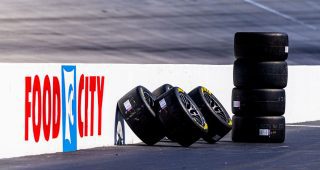
BRISTOL, Tenn. — Crew chiefs will have their eyes glued to two things in Sunday’s Food City 500 at Bristol Motor Speedway: tires and traction compound.
Goodyear brought a new tire combination to the 0.533-mile high-banked short track, one intended to be less dependent on varying weather conditions than previous iterations brought to the “World’s Fastest Half-Mile.” Additionally, PJ1 traction compound has been sprayed along the bottom of each set of corners, creating more grip along the yellow line.
Advertisement
MORE: Bristol starting lineup | At-track photos
Through Saturday’s practice session, that lower lane remained the dominant, preferred groove. The Goodyear rubber cooperated with the conditions, laying into the track’s concrete surface to create a visible black streak to reveal where drivers drove.
The question crew chiefs will ponder in Sunday’s race (3 p.m. ET, FS1, HBO Max, PRN Radio, SiriusXM NASCAR Radio) is how the trends of the track evolve over 500 laps of heart-pounding action.
“I think it’s more so what the PJ1’s gonna do,” No. 38 crew chief Ryan Bergenty told NASCAR.com Saturday. “If the PJ1 comes up, does the rubber on the right sides make it slicker at the bottom? And then it’s a matter of how many people migrate to the top. You can’t go up there by yourself because it’s still dirty, but if you get a handful of cars that go up there and there’s pace up there, then people go up there. For me, it’s (Saturday night), having a plan and adjustability in the car.
Advertisement
“It’s easiest for me to just say the track’s going to do two things and I come up with those two scenarios and have a game plan for either of them. To come up with one or 20 is not realistic. So I’ll look (Saturday) at some photos and how the track took rubber. There was a couple cautions between practice. See if it pulled any rubber up like a Dover style, and then you just kind of throw a dart at the wall of what the PJ1 is going to do after we put a couple hundred laps on it.”
Bergenty and driver Zane Smith were 13th-quickest in practice before qualifying 15th. Charles Denike, crew chief of the No. 23 23XI Racing Toyota, watched his driver Bubba Wallace practice fifth-fastest before qualifying 12th. Denike’s curiosity matched Bergenty’s: When will the top lane become the preferred lane?
“It’s how quickly the lane can move up, when the top takes some rubber, ” Denike told NASCAR.com. “The PJ1 will wear out over time on the bottom. We’ll go through a period where the two lanes are equal, and then who knows after that? So understanding what our balance is on the top versus the bottom, it’s definitely two different lanes that we’ve got to deal with.”
NASCAR Cup Series at Bristol.
Denike and the No. 23 team had the advantage of being one of three testers for both Goodyear and NASCAR last November, joining the No. 48 Hendrick Motorsports group and the No. 60 RFK Racing team in testing the right-side tire that was selected for this weekend’s competition, as well as the higher horsepower and short-track diffuser new to Bristol this year. The comparison from the test to this weekend isn’t exact — especially considering the cold conditions in late November — but it is enough to give the No. 23 team comfort in its learnings.
Advertisement
“It’s obviously different than the test,” Denike said. “Everything’s a little bit different, so trying to adapt to that. Good news is that we’re close, so encouraging for what we need to work on (Saturday) to go into (Sunday).”
The other unique feature of Bristol is dual pit roads — one pit lane on the frontstretch and another on the backstretch. Under green-flag conditions, drivers can simply enter and exit their respective pit lanes for service. But under caution, cars enter pit road on the backstretch and maintain pit speed all the way onto the frontstretch pits, exiting at the entry of Turn 1.
Bergenty chose pit stall No. 24 for Sunday’s race, which is the stall second from pit exit on the backstretch entering Turn 3. There is plenty of data to suggest which pit stalls to select. Bergenty prefers to go more by instinct.
“I put an emphasis on probably not so much analytics, the numbers of it, but I pay attention more to what makes it easier on the driver,” Bergenty said. “So I use more optics than analytics if that makes sense. And that’s just a style of mine. Everyone does something different, but I just put myself in his seat, knowing pit road is going to be tight — a mess in and out. What’s going to be the easiest for him to execute? And I feel like that’s kind of where our team’s at right now. We feel like we can run 10th to 15th any weekend so far this year, and we just need to operate like that on pit road. And so we don’t need to be chasing tenths of roll time on pit road. We need to be chasing optimizing our day.”
Read the full article here