





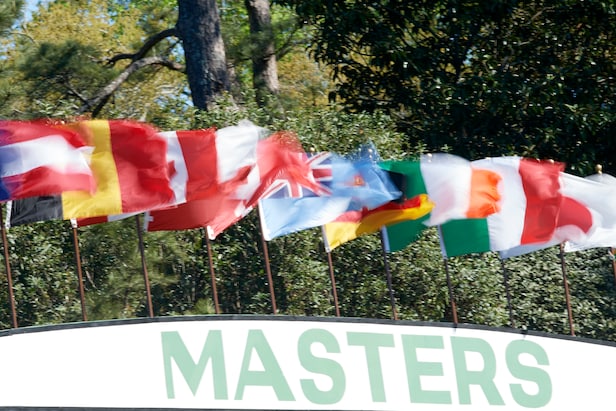
AUGUSTA, Ga. — Anybody who tuned into the first round of the 90th Masters on Thursday saw what looked to be a glorious day. Bright sunshine, wispy white clouds and a playing palette of impossibly green grass everywhere.
The men trying to control their golf balls would tell you it was all an illusion. To be sure, Augusta National Golf Club has played much harder at times than it did in this first round. Masters historians will recall that Bobby Jones called the 1956 edition as the hardest ever because of blustery, horrible weather that Jackie Burke overcame to win by three over amateur Ken Venturi, who shot 80 on that Sunday.
Advertisement
Seventy years later, this Masters is shaping up to be the firmest test in recent memory.
Rain in this region has been sparse, the humidity is low, and the wind picked up considerably the last two days. That not only makes it tricky to match yardage to a club, but it quickly dries out the putting surfaces. Already on Thursday afternoon, there were some greens that were taking on a tinge of brown—not a color you associate with Augusta other than the pine straw and squirrels.
“I think this could be the toughest Masters we’ve played in a while,” Shane Lowry said after shooting two-under-par 70 to be tied for seventh place. “You look at the forecast; they can do whatever they want with the golf course this weekend.”
Indeed, the predicted high temperatures in Augusta for the next three days, respectively, are 80, 80 and 87. The field will get a break on the wind, which is may only reach a light double-digits on Sunday.
Advertisement
As Lowry noted, how the course plays is now up to the competition committee for its watering and pin placement choices.
“The course is only going to get drier and firmer and faster as the week goes on,” said reigning Masters champion Rory McIlroy, who got off to a satisfying start with a five-under 67 that tied him at the top with Sam Burns.
McIlroy offered an expert’s analysis of how the course is shaping up to play.
“As it gets drier, the grass around the greens gets stickier, that ryegrass,” he said. “So it makes it more difficult to hit the bump and runs. It also makes the putting through that grass a little bit trickier as well.
Advertisement
“I think when the greens get that firm, you really have to think about where the best miss is, and distance control is very important, but also … missing it left, missing it right. … When the greens do get firm like this, it makes it a much more tactical test, and you really have to think about things.
“As you guys know, I’ve said for the last few years I’ve started to really relish that type of golf. I really want to excel at that type of golf.”
His competitors will love hearing that.
Xander Schauffele, who shot 70 while playing among the morning wave, was asked if he had thoughts of getting more aggressive in the next couple of rounds..
Advertisement
“Potentially attack it less, to be honest,” he said. “You know, less attack and a little more conservative. “There [are] some nice scores up there early from what I can see right. … You got to be driving it really far to have a shorter club in or got to be hitting your spots.”
As a result of the conditions, the 67s scored by McIlroy and Burns are two strokes higher than Justin Rose’s opening effort a year ago. The scoring average on Thursday was 74.71—nearly 1½ strokes higher than in ’25. There were five rounds in the 60s and 17 rounds under par this year against six and 26 last year. Ten players suffered scores in the 80s, while only one struggled that badly last year.
Imagine being thrown into this cauldron in your first-ever Masters appearance. Northern Ireland’s Tom McKibbin, in the tournament as the Hong Kong Open champion, handled himself decently with a 75 and felt like the course completely changed overnight from the practice round.
“The golf course is so difficult. It’s hard. I feel like every shot there is danger lurking around,” he said. “I think it’s hard to feel comfortable. Once I sort of got into the round today, it felt quite nice.”
Advertisement
Texas native and Oklahoma State player Ethan Fang, the reigning British Amateur champion, has seen his share of wind. But not in combination with a course as demanding as Augusta.
“This course is really tricky. These greens, they’re glass,” said Fang, who shot 74. “I had so many chip shots today that you barely get it on the green and it rolls all the way to the hole. I think it’s all about missing in the right spot, just giving yourself a good chance if you miss the green to get it close, and maybe make par and bogey.
“… Honestly, all the holes you got to stay mentally sharp. If you let loose, next thing you know you got a 25-, 30-footer down the hill and could roll all the way off the green.”
Welcome to the Masters.
Advertisement
MORE FROM GOLF DIGEST @ THE MASTERS
Masters 101: Answering all your frequently asked questions
How to watch the 2026 Masters
Power Rankings: Every player in the Masters field, ranked
Tee times for Round 1 and Round 2
50 defining Masters Moments, ranked
The most memorable Rules issues in Masters history
Every course change ever made at Augusta National
A brief history of Masters prize money payouts
15 people who ended up in the Masters penalty box
The Champions Dinner Tell-All, from those inside the room
Read the full article here