





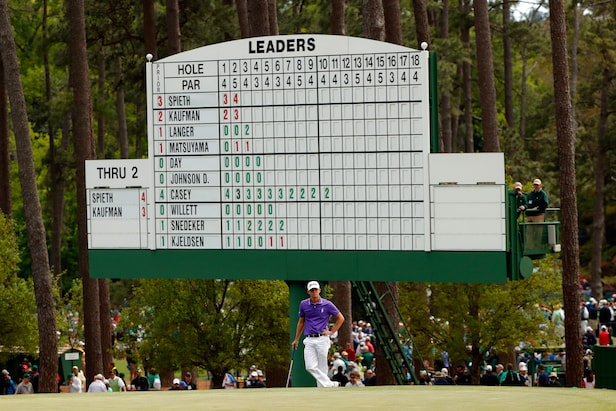
The competitor in him sees his one and only start in the Masters Tournament with a mixture of pride and regret. The television broadcaster and analyst he has become enables him the perspective to reconcile the conflicting emotions.
Ten years ago, Smylie Kaufman made his debut at Augusta National Golf Club, a dream fulfilled for a kid from Birmingham, Ala., who had attended the Masters as a youngster. He would not know that when the 80th Masters ended—after he had put himself in Sunday’s final pairing with defending champion Jordan Spieth with a real chance to win the green jacket but faded down the stretch—that he would be saying farewell.
Advertisement
The final round of the 2016 Masters is among the more confounding in the tournament’s annals as Spieth, seemingly in control and destined to join Jack Nicklaus, Nick Faldo and Tiger Woods as back-to-back champions, shockingly surrendered a five-stroke lead over the last nine holes. Danny Willett seized the opening, firing a five-under 67 to win by two shots over Spieth and fellow Englishman Lee Westwood.
Spieth’s collapse was every bit as surprising as Rory McIlroy’s back-nine disintegration five years earlier, but in a way, it was emotionally more agonizing. McIlroy faced the media music and departed; Spieth had to remain to fulfill the ceremonial responsibility of the previous champion by helping the new winner into the game’s most coveted apparel.
Overlooked in the wake of Spieth’s travails were the struggles of Kaufman, who saw a legitimate chance to become the fourth man to win in his Masters debut undone by putting troubles that he largely had kept in check for 54 holes.
520304500
Kevin C. Cox
Advertisement
“It didn’t quite come out as good as I hoped it would, but it was fun just to experience the Masters and always dreamed of playing there one day,” said Kaufman, 34, who has grown into a respected broadcaster for NBC Sports. “To show up with my first one and basically put myself in one of the coolest moments and experiences you could possibly have in Augusta, I think is a dream come true really. Unfortunately, I didn’t ever play good enough again to get to that position.”
Then 24 years old, Kaufman was a rookie on the PGA Tour and had earned a Masters invitation with his one-stroke victory the previous October at the Shriners Hospitals for Children Invitational in Las Vegas. Just a year removed from LSU, Kaufman emerged with the title in just his fifth career start thanks to a sizzling final-round 61.
Kaufman, who at the time was still living in his parents’ home in Birmingham, about four hours from Augusta, held his game together in breezy conditions to make the cut and then fired the low third-round score, a three-under 69, to post two-under 214. He stood one stroke behind Spieth, who played his final two holes in three over par but still set a tournament record by leading for the seventh consecutive round. One of just four players under par through 54 holes, Kaufman tallied four birdies against a lone bogey, with a late kick coming on the back nine with birdies at 13, 14 and 16.
Kaufman later would say that the pressure he felt in the final round was more “heat” than he’d ever experienced before. And the effects were evident immediately when he struck two solid shots to set up a four-footer for birdie on the par-4 opening hole but watched it rim out. “That would have been huge for me,” he said.
Advertisement
He shook that off, however, to sink and eight-foot birdie putt at the par-5 second. And for a few seconds, Kaufman was tied for the lead with Spieth.
“I remember thinking right then, before Jordan made his birdie, how cool that was, the position I was in,” said Smylie, who is named after his grandmother’s cousin, Smylie Gebhart, a 1971 All-American defensive end at Georgia Tech. “It’s literally a chance of a lifetime.”
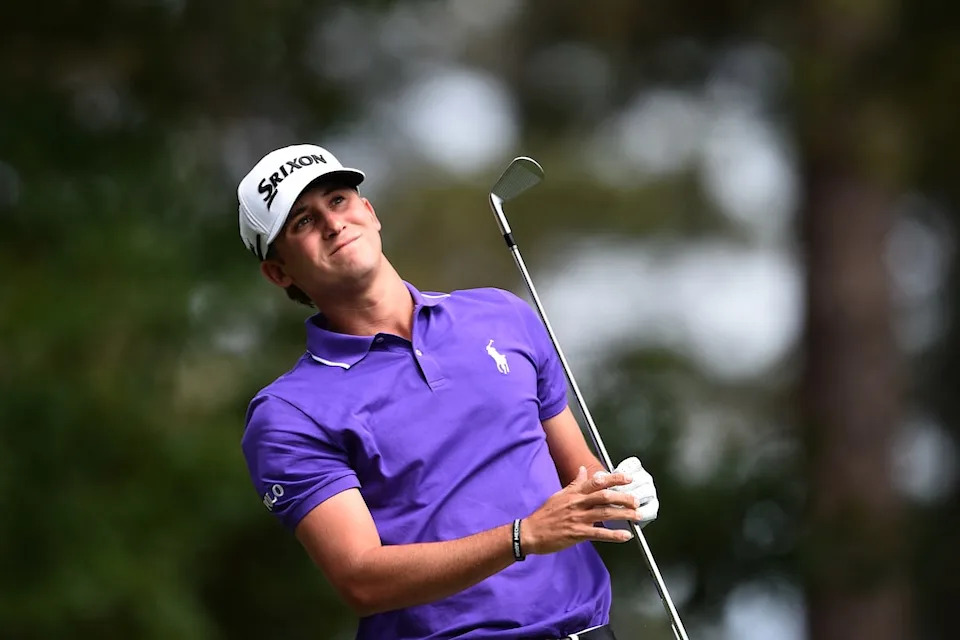
520267820
JIM WATSON
Bogeys at Nos. 3 and 4 weren’t necessarily fatal, but the fifth hole proved pivotal. Kaufman hit what he called, “one of the best shots of my career,” a 7-iron that he nearly holed for eagle. But he missed the eight-footer for birdie, and although he struck several quality shots throughout the round, he never got untracked with the putter. Spieth birdied holes six through nine and appeared well on his way to an easy victory, while Kaufman, after going out in 39, knew he was playing for a top-12 finish that would secure a berth in the field the following year.
Advertisement
“I was kind of fighting my putter a little bit that week,” he recalled. “And I think just on Sunday, missing some key putts early for me, I think it just kind of exposed that I was not quite comfortable with my putter, and it just kind of snowballed where I just really lost confidence with the putter throughout the day, which is a huge bummer because I do consider myself to be a very, very good putter.”
Each man would struggle coming home, starting with bogeys at 10 and 11. Then real disaster struck Spieth at the famed par-3 12th when he put two balls into Rae’s Creek on the way to a quadruple-bogey 7. Kaufman, meanwhile, birdied the hole after a 9-iron to 10 feet. He was not shocked by the reversal of fortune for his playing partner.
“I was kind of paying attention to what Jordan was doing early in the day. He didn’t really have his best stuff, ball striking, but I just was amazed at some of the up and downs that he was having,” Kaufman said. “I mean, the fact that he hit it in the water [at 12] didn’t necessarily surprise me at the time because I just played the first 11 holes with him, and he was kind of fighting his golf swing that day.
“You would have loved to have seen him hit some type of control shot out to the left, but sometimes it’s just not quite lining up technique-wise and your feels aren’t quite there, similar to me with the putter that day,” he continued. “I wish I could have made the ball go in the hole, but I can tell you that I was trying to make the ball go in the hole, but my technique and just the way I was stroking the putter that particular day, there was a lot of timing it felt like in my putting. And I kind of felt the same way about his ball striking that day. You notice what’s going on. But now I’m an analyst. Now I really would notice.”
Advertisement
The birdie at 12 gave Kaufman a lift, but he squandered a chance to build on it when he chipped into Rae’s Creek at the par-5 13th for another bogey. The putter then deserted him entirely the remainder of the day to come home in 42. His closing 81 dropped him into a tie for 29th at seven-over 295.
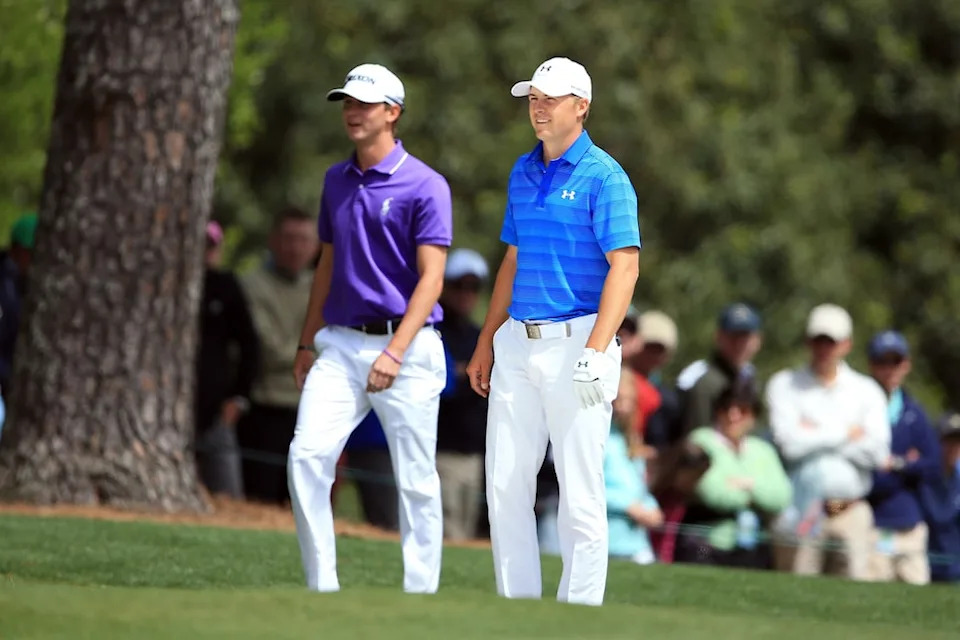
520263232
David Cannon
“I hit multiple shots that day that I just was really proud of because I felt like for me just to execute what I felt like to be the ball striking side of it [was key],” Kaufman said. “And you tell me now that the putter is a thing that caused me to shoot an 81, I would have told you you’re crazy, but that’s just how it rolled out that day.
Advertisement
“My biggest regret is just not being able just to do the things that I had done all season up to that point, to not just find those strokes to finish in the top 12, at least give me back for another crack at it,” he added.
But he can savor a few highlights, too. He claimed some crystal for having that low round on Saturday, and also for an ace at the eighth hole during the Par-3 Contest with Jack Nicklaus, Gary Player and Tom Watson watching from the group in front of him.
It’s worth noting that he is back at Augusta National this week appearing on coverage on Amazon Prime during the first two rounds. The good memories surely will come flooding back.
“I think looking back now, I just have so much pride in just getting into that position,” Kaufman said. “The way I was wired as a player is that I would have never been OK with not succeeding and not taking it to that next level and putting myself back into that same situation to go try to do it again. … But, you know, I have experiences of a lifetime for just somebody who got to experience it just one year.”
Read the full article here