





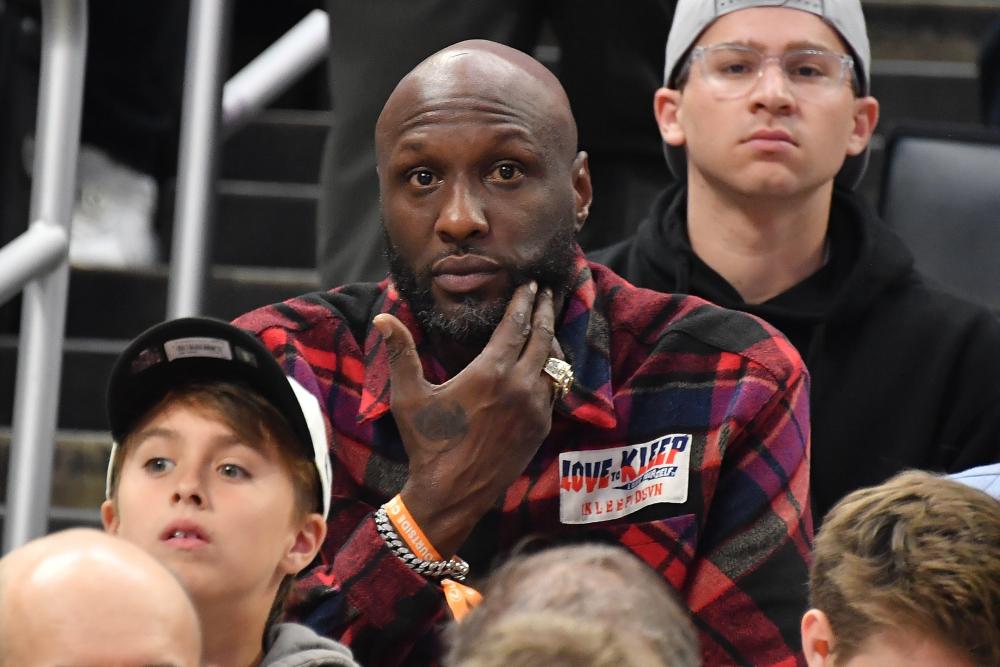
There’s a version of the Lamar Odom story that ends in a Nevada brothel. It’s not hard to imagine the grand finale – the TMZ bulletin relating his fatal drug overdose, followed by emotional tributes to what was lost: a radical basketball prodigy of the New York tradition, a two-time NBA champion with the Kobe Bryant Lakers, a glittering career that spanned coasts and eras before caving under the weight of addiction. A cautionary tale of incandescent fame, with Odom’s celebrity wife Khloé Kardashian cast as a man-eater to eclipse her more notorious older sister, would have been the epilogue cemented in a thousand think pieces.
But by living to tell the tale, Odom has instead become the latest fallen star to prove a core truism of Western mythmaking: heroes who don’t die young are doomed to live long enough to become the villain in their own tale
Advertisement
“There is a way of understanding Lamar where everything in his life is kind of in reaction to death hunting him since he was a kid,” says Ryan Duffy, executive producer of Netflix’s Untold sports docuseries. “Then it catches him, he somehow wiggles out of it and is still here. Shit, I’d be pretty sideways if that was the case for me, too.”
Related: NBA expansion explained: teams in Vegas and Seattle, LeBron’s role and hungry billionaires
For the latest installment of Untold, The Death & Life of Lamar Odom, Ryan Duffy (who previously chronicled the scandals of Manti Te’o and Johnny Manziel) returns to the director’s chair to revisit the moment in 2015 when Lamar Odom was found unresponsive at a Nevada brothel – a breaking-news jolt that marked the most spectacular sports downfall since Tiger Woods slammed into a fire hydrant. (You’d have to think the Untold team is strongly considering their own deep dive on the golfer in light of recent events.) That was the year Odom topped the Google Trends list for living people, a tidy measure of how fully his saga consumed the public.
Reportedly on a cocaine binge in the days before the brothel incident, Odom suffered kidney failure, multiple heart attacks and 12 strokes. He was placed in a medically induced coma for several days, with doctors initially giving him little chance of survival without significant and lasting brain damage. All the while, his stunning crash-out was framed in the tabloid press as the culmination of a mushrooming substance abuse problem. Odom had nearly wrapped up a three-year probation sentence following a 2013 DUI arrest, and Kardashian was waiting for a judge to sign off on her divorce request. That delay would turn out to be an extraordinarily lucky break for Odom.
Advertisement
Over the course of the documentary’s 90 minutes, Odom steers the conversation with charm and vulnerability. But before dismissing this sports biography as yet another exercise in self-guided legacy shaping, viewers should know that Odom bucks the athlete co-producer trend. Not only does he keep things unflinchingly real, he lets the uncomfortable truths lie without a positive spin. He accepts that he was a bad father, a worse partner.
“I know cocaine isn’t the way to go,” he explains in a wistful aside about his past drug use, “but it’s a high that feels so good, you wish you could capture it and put it in a bottle so you can have it the next day.”
As his daughter, Destiny, points out in the documentary, Odom would sooner move on with his life than spend too long considering his misfortunes and missteps before plotting a fresh course. It quickly becomes clear that this isn’t just a defense mechanism; it’s the survival instinct of a man who couldn’t afford to dwell on losses. His father, a heroin addict, has largely been a background character in Odom’s life, and his mother died of colon cancer when he was 10. His relationship with his high school sweetheart, Liza Morales, another prominent voice in the documentary, fell apart when their six-month-old son died of sudden infant death syndrome in 2006 while Odom was partying with friends.
Odom, now 46, processes these tragedies with deadpan candor, much like Rick James reflecting on his rock’n’roll past in those old Chappelle Show skits – unbowed and unrepentant. He doesn’t make excuses for throwing away what could have been an all-time great NBA career, one that surely would have earned him more credit for helping usher in the current era of positionless basketball. That lack of pretense is a quality hardcore fans have always respected about Odom, who agreed to come off the bench after LA acquired him in a blockbuster trade and went on to become the NBA’s top reserve.
Advertisement
In the documentary, Phil Jackson fondly remembers Odom as a selfless player who saw his teams as family – but then winces at his former player’s attraction to fame, as if Jackson wasn’t dating team owner Jeanie Buss when Odom’s whirlwind romance with Kardashian was in full bloom.
“Getting on that plane and going up to Montana to see him was personally thrilling,” Duffy says of meeting Jackson, the 13-time NBA champion that sportswriters dubbed the Zen Master. “Like, going to see the oracle at the road and have his wisdom bestowed upon me.”
Jackson, who has been out of basketball since his disappointing tenure as New York Knicks president, would have been the major get for this project if Kardashian hadn’t agreed to sit down at the last minute.
“It happened late enough in the doc that I was telling my editor [Freddie DeLaVega]: ‘We can probably plug her in here or there,’” Duffy says. “But after she gave us two hours of her time, I was like: ‘Freddie, I have bad news: we’re starting over.’”
Advertisement
The Kardashian interview is the element that separates Untold’s Odom treatment from the other docs he’s sat for over the years. She pulls back the curtain on their paparazzi romance – how she met Odom while working a $5,000 hosting gig for a party celebrating Ron Artest’s 2009 Lakers signing, how they married a month later, how he took an immediate interest in her family’s budding reality TV empire and pushed for a spin-off featuring just the two of them. She remembers Odom’s drug use and serial philandering quickly snowballing into a monstrous situation that had her searching for him in alleys, paying off hotel maids to keep stories out of the press and even frantically pumping his stomach when he overdosed.
“I felt such a responsibility to cover this up, hold it together and protect him,” she says, viewing herself as more of an enabler of Odom’s addiction in hindsight.
When an intervention in 2013 didn’t work, she filed for divorce, with both parties signing off in July 2015. Three months later, Odom was discovered unconscious at the Love Ranch – a legal brothel roughly equidistant between Las Vegas and the Mexican border.
“The drive itself was illuminating,” says Duffy, recalling how initial reporting of Odom’s medical emergency placed him in Las Vegas. “It was all double-wide trailers and fucking meth labs. Like, you are in dire straits if you find yourself out here. It gave me a better appreciation for the depths he had fallen to.”
Advertisement
Kardashian claims Odom’s estranged father would have pulled the plug on his son if she hadn’t intervened at the hospital – which still recognized her as his next of kin with their divorce unfinalized – and bought him off Odom Sr with $100, a pair of Nikes and a night’s hotel stay. She also suggests their marriage might have survived if Odom hadn’t kept using drugs behind her back – the final straw coming when she caught him smoking crack months after being discharged.
Odom neither pushes back against Kardashian’s version of events nor shows much appreciation for the considerable efforts she made to save his life and reputation, sealing a twist in the tale. She transitions from reality-TV foil to hero, while he flips from sympathetic protagonist to unmistakable villain. Or at least that’s before considering the grip of addiction and its role in this story. Odom jokes about partying in Vegas and “marrying somebody” as the documentary wraps. Earlier this year, he voluntarily entered a 30-day rehab program for marijuana use after pleading not guilty to a DUI. (His case is set for a July trial.) Odom still seems to think like a user. But that’s not to suggest he’s irredeemable.
Untold shows him attempting to repair his relationship with his adult children. His son Lamar Jr shares a heart-rending story about Odom jilting them for the Lakers’ 2009 championship parade while Destiny recalls a post-emergency tour that took Odom everywhere – most notably Bryant’s farewell game – but never to therapy. Odom often harkens back to a recurring dream in which he sees Bryant again and is told “the afterlife is not what people make it out to be.” Worryingly, Odom appears curious enough to test his late teammate’s “message” – again. “He just acted like the coma thing never really happened,” Destiny says.
In an alternate telling, Odom’s survival story would be a profile in courage and clarity. The version he offers through Untold – raw, rough and bracingly real – delivers a far more authentic lesson. “When you make these docs, especially with athletes who are pretty well media trained and have been in the spotlight, they understand documentaries,” Duffy says. “We’ve been in this sports documentary boom for the better part of a decade now, so they understand them and usually work really hard – whether it’s true or not – to tie things in a tidy bow: ‘Yeah, look, I did have these struggles, but they’re gone. I overcame them. Here I am, the fully realized version of me that you always wanted.’ Lamar, to his credit, didn’t do that. As much as I’m sure that is a tax on the people around him, I appreciated the sheer honesty and vulnerability of that.
Advertisement
“The guy’s perspective is: ‘I survived this night in Nevada – where, by all accounts, I should be dead. There was divine intervention involved in my survival. And that means I need to do something. I need to find some meaning.’ But he doesn’t know what the fuck that is. Where he is now is in a place of just searching. And he’s comfortable with that uncertainty.”
Read the full article here