





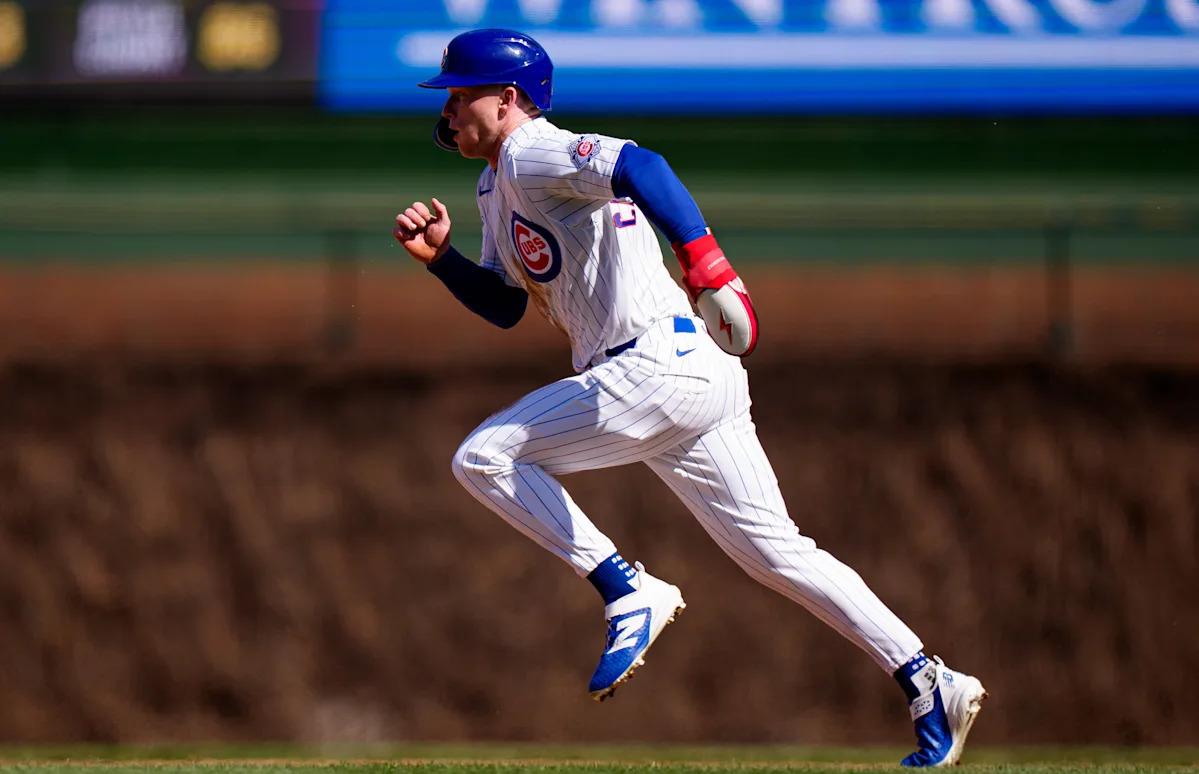
The Cubs wrapped up their first series against the Nationals at home over the weekend. It didn’t go as planned with the North iders dropping two of three games after both Matthew Boyd and Shōta Imanaga had some trouble with the long ball. But the big news last week wasn’t the opening series, it came in terms of contract extensions, with Jed Hoyer and company wrapping up one big deal on the eve of Opening Day extending centerfielder Pete Crow-Armstrong through the 2032 season and completing another with second baseman Nico Hoerner at the end of the week. Today, let’s take a closer look at the numbers behind PCA’s deal. You can see the basic structure of the deal by year per Jon Heyman below:
The deal does not include a team option which ESPN’s Senior MLB Insider, Jeff Passan noted is rare for an extension of a young player under team control:
Obviously the money matters a lot here. Buying out PCA’s arbitration years at $55 million, followed by $30 million a year guaranteed in free agency says that the Cubs believe PCA will be a star. The fact that this is a six year deal rather than a longer deal like the fully guaranteed 12-year contract Julio Rodríguez signed for a guaranteed $209 million or a pre-debut deal like eight year contract Jackson Chourio signed for a guaranteed $82 million tells you a little bit about where the Cubs see PCA relative to two other young, star outfielders. Unlike PCA’s deal, both of those deals have options. Like PCA’s deal, both of those deals have escalators that can push the value of the contract far higher than its guaranteed rate, in PCA’s case adding potentially $18 million to the deal.
Advertisement
Pete Crow-Armstrong gets the benefit of being assured he’ll hit free agency before his age-30 season. That’s an interesting nugget in this deal given that the biggest question mark in terms of PCA’s long-term value is his ability to control (or not) the the strike zone. A skill that he could continue to improve on marking last year’s gains or one that could fall apart entirely as he ages. From FanGraphs’ write-up of the extension:
That’s decent, but I don’t know if I’d call it plus power or anything; Crow-Armstrong’s EV90 in 2025 was 81st out of 145 qualified hitters. That’s where the other two changes come in. As a rookie, PCA had a 79.2% Z-Contact%. Anything below 80% in that mark is survivable, but it’s hard to thrive in that range without truly elite power. In 2025, he raised his in-zone contact rate to 83.8%.
Third: He is getting the absolute maximum out of what contact he makes. The most valuable batted balls, in general, are hit in the air and to the pull side. In 2024, Crow-Armstrong put 19.3% of his batted balls in that direction, which is above average, even good. In 2025, that number was 30.2%, which was the seventh-highest figure out of 251 players on Baseball Savant’s leaderboard.
Crow-Armstrong hit 31 home runs last year because he got the absolute maximum out of his plate discipline and quality-of-contact numbers. Add in the defense and the baserunning, and I think this might literally be the best all-around baseball player you could have with a 4.5% walk rate and a .247 batting average.
But he’s still a player with a .247 batting average and a 4.5% walk rate. Or, to use the more legible figure I mentioned above, a .287 OBP. Last year, Crow-Armstrong made more outs per plate appearance than Nick Castellanos, Lenyn Sosa, and Ke’Bryan Hayes. Is it possible to be a franchise player if that’s true? We’ll find out.
To put this slightly differently, there are question marks about whether PCA will age like Javy Báez or Castellanos — both players who had above average contact skills, right until time caught up to them and then they didn’t.
In that sense, this deal is timed perfectly for both the Cubs and PCA. The Cubs will get a chance to see how that contact tool develops (or doesn’t) over the next six years. If it looks like it will age poorly, they locked down the very best years of PCA in centerfield at Wrigley Field and he should still be a valuable enough player to command additional years of service with another team. If it looks like that tool has improved, they can attempt to negotiate another extension that would make PCA a Cub for life. You can get a sense of the variability in PCA’s hit tool from this 15-game rolling wOBA chart through the 2025 season:
Even with some concerns about a contact tool that may provide some high-highs and low-lows similar to last season, his defense should provide a floor that makes the deal well worth the guaranteed $115 million. PCA is already one of the best defenders in the league. According to Statcast, he saved 22 runs in centerfield during the 2025 season and was tied with Bobby Witt Jr. for the league lead in outs above average with 24. The value of his run-prevention in centerfield alone makes this a smart extension for a Cubs team that tends to sign pitchers who pitch to contact.
Advertisement
And then there’s the chance that PCA finds the level he hit in the first half of 2025 consistently and puts up multiple 30-30 seasons during the lifetime of his extension. If PCA can be a perennial 30-30 guy in addition to the value his glove provides, this deal could wind up being a steal for the Cubs.
Read the full article here