





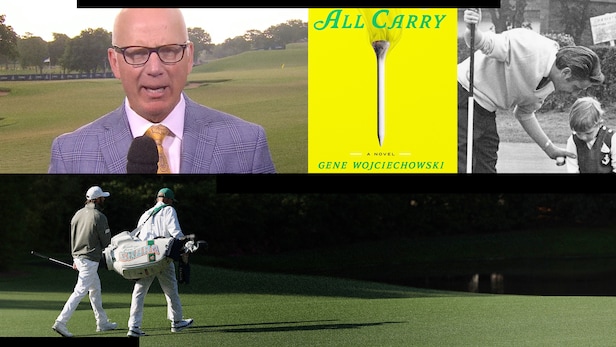
The golf novel is a rare breed. There are obviously a near-infinite number of historical deep dives, oral histories and unauthorized biographies of Tiger Woods. But the golf bookshelf shrinks dramatically when it comes to the world of fiction.
Former ESPN writer/reporter and now full-time University of Tennessee professor Gene Wojciechowski knows this, which is one of many reasons why he has spent the last handful of years working on All Carry, an entertaining read and historically laden golf inspection best described, perhaps, as a cross between “Tin Cup,” “The Natural” and “Like Mike.” It’s not often that a book delves into the Texas Open Monday qualifiers through the lens of a buddy comedy.
Advertisement
Let go as part of ESPN layoffs in 2023, Wojo bunkered down and crafted this otherworldly story of fathers and their sons (and players and their caddies) that centers on an outdated set of golf clubs that has a bit of magic to it. Next thing you know, Augusta National is involved, as are malicious tour pros and a budding romance, and everything really gets going.
We’ll let you find out what happens for yourself—the book officially drops March 31—but we couldn’t pass up the opportunity to chat with Wojciechowski about the novel, his experiences covering the Masters and why caddies are such good gossips.
The following interview has been edited for length and clarity.
You said you had been thinking about this idea for a while. But where did this book come from?
I wish I could give you a definitive answer. I’m kind of a romantic when it comes to movies and, I always loved “The Natural” and “Field of Dreams.” I loved the idea of second chances and the magical and mystical qualities of things.
Advertisement
So, I always had in the back of my mind, what if there was a set of clubs that were made for Jack Nicklaus that never made it into his hands and possessed some type of powers? And what if they were put into the hands of a mere mortal? What kind of mulligan does one get in life, especially because of those clubs? That was the main thought process. I’m not sure I could tell you exactly where it all came from.
As much as it is a book about fathers and sons, and family and found family, it’s also a history book. How do you balance the fun tangents with the historical deep dives?
Well, I covered golf for ESPN, for print and digital, plus on the broadcast side for over 10 years. I really wanted this all to be authentic. It was important to me that someone who knew golf could see that I’ve done my homework. And so I took from my own experiences.
I wanted the sense of humor, the playfulness, with the plotline and characters. But it wasn’t going to mean anything if the golf wasn’t authentic, and if you didn’t finish the book thinking, Alright, that’s how it actually is out there. So, that’s what I was striving for.
Advertisement
MORE: Stupid Golf Problems: Have caddie fees gotten out of control
Speaking of authenticity, the character of “My Guy” (Editor’s Note: he doesn’t have a name in the book … and is quite the creep) feels like a composite of a bunch of different golfers and athletes you’ve met or watched over the years. How do you build someone like that?
Well, you’ve covered the tour, so you know these characters. He’s made up of a bunch of different golfers and athletes we’ve met over the years. My guy. My Man. These guys lodge into the backs of our minds, and he was certainly a composite of the players I’ve covered over the years.
He embodied some of the worst of those players and a little teeny bit of the best of them. And then some of the golf part of them. He’s this guy who won’t sign autographs. He’s this guy who’s a bully. He’s this guy who was a hypocrite or felt entitled. He’s this guy who is spoiled. He was a martini mix of some of those players that we’ve all run into over the years.
Advertisement
His caddie for some of the book is nicknamed Hard Way and you really go into detail about that world. I was wondering how much research you did on caddies?
I’ve never caddied before. You’re out there long enough, though, and you realize caddies are more like us than the players. So I gravitated to them. I spent a lot of time with them walking, nine or 18 holes as they’re marking up their books. I would just shoot the bull with them, watching them and asking them questions, and trying to understand their craft. We think it’s just a guy who gives out yardages, but there’s really so much more to it than that. I really tried to learn what they did.
For a number of years, too, I was a member at a club that had a handful of caddies. That was another opportunity to listen to them and hear their stories and soak it in and use all that in the book. I had some formal interviews with some caddies to get a little more insight. I really wanted to get that right.
There’s a reason we’ve done all these Undercover Caddies over the years. They know all the dirt.
Learning caddieing is a language. It’s like taking a Portuguese class. You’ve got to learn it. We all have heard Jordan Spieth and Michael Greller. And the way they go back and forth, it’s brilliant. It’s a stream of consciousness, and I love hearing them talk. In the book, I use it as Hard Way educating someone else who’s sort of a novice about that language. That was a fun part to write.
Advertisement
Was there any worry about peeling back the curtain too much, especially when it came Augusta National? You really dive into the Chairman, pulling the strings behind the scenes. Did you think about what the club might think about the book?
Joe Reilly, who’s the TV reporter, who’s had a complicated history with Augusta National, he reflects my own feelings. If you’re going to write about the Masters, you have to be honest about its past. And I think Augusta National, in recent years, its leadership has tried to address that.
So if you’re gonna write about Augusta National and the Masters, which is an extraordinary event run by extraordinary people with the best intentions of golf and their love of golf … the history of Augusta National is that it has its share of warts. And, you can’t just ignore that.
Do I think Augusta National will be thrilled with every sentence that I wrote relative to its past? No. But I hope they respect the honesty.
Advertisement
MORE: Former ESPN anchor reveals ‘saucy’ comment that got him ‘banned for life’ from Augusta National
Perhaps the chapter most resonant to me was about sports media and the “efficiency expert.” There are layoffs across the board, and the book gets into that. How do you see sports media right now?
I can only speak to my time at ESPN. I owe everything to ESPN. They let me see the world. They let me cover sports that I love. They let me tell stories for years. They were patient with me. I was not a trained TV reporter.
There’s an anecdote in the book based on an experience that I had where I had a complete meltdown, like yellow police tape, around the set where I did it. And I put it in the book because I wanted people to see what happened afterward. I had an incredibly supportive coordinating producer who gave me another chance. And so, I tell people, it’s a profession of people who are dedicated to telling stories, bringing the viewers or listeners or readers into those worlds. And they’re all willing to work 20 hours a day, whatever it takes. Go wherever they need to go, do whatever they need to serve. My hope is that companies know that and the ones that own these companies, like ESPN, they understand all the good people that are there and what they mean and how important they are.
Advertisement
More From Golf Digest
Books The 50 Golf Books Every Golfer Should Read
Books The secrets to ranking the top 100 golfers of all time, from the writer who just wrote the book on it
PGA Tour vs. LIV Playing Dirty Q&A: Inside our writer’s book about the PGA Tour-LIV Golf battle and Scottish golf
So you had the story planned out. What was the actual writing/editing process like?
Painful. I knew the beginning. I knew the middle. I knew the end. And I’d had that for years. I’ve learned from some of the best guys, like Tom Rinaldi, how to structure a TV story and there are three-act plays. I wanted the reader to learn the characters’ voices as a writer. I just kinda let them go to where they were gonna go.
Advertisement
And so that was that part of it. But yes, there came a point where, alright, the manuscript’s this thick, I gotta get it down to this thick. So I did that part, and then I worked with a brilliant editor, Amy Einhorn, at Crown Publishing. She’s legendary in the business. If you look her up, she’s responsible for some of the great bestsellers out there. She didn’t know very much about golf. But she knew character and she knew plot line, and I knew golf and I knew something about character and plot line. We were a perfect ham and egg combination.
Is there anything else you want readers to know about this book and why people should pick it up?
Well, it’s about second chances. And in golf, we have this idea of a mulligan. And these characters get a mulligan in life, based partly on these magical clubs. The father-son dynamic and the mother-son story in there are huge parts of the book. It’s not just mysticism and magical, there’s a real authenticity. And I hope you close the book thinking, “Alright, he did a good job there.”
More From Golf Digest

Golf Digest Logo If you built a course today to test the world’s best players, what would it look like?

Golf Digest Logo Once you’ve played Augusta National, you’ll never watch the Masters the same

The big Snip The Masters and … vasectomies (?!?): An incision unlike any other
Read the full article here