





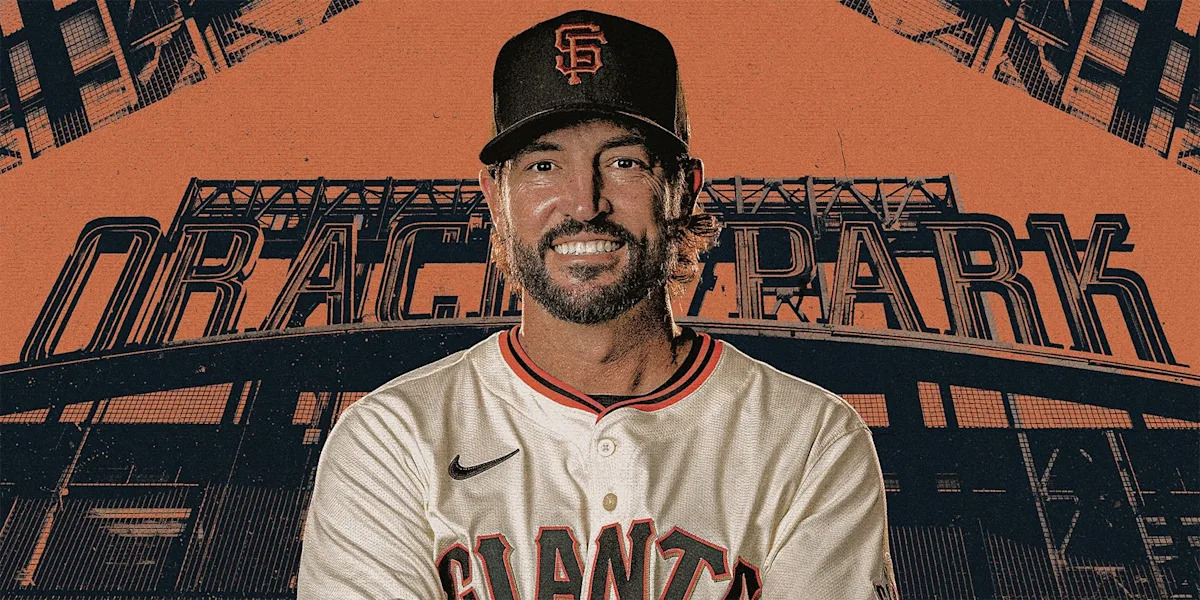
In a different timeline, Tony Vitello would be gearing up for another grueling weekend of SEC competition right now. Fresh off a walk-off win over USC-Upstate, his Tennessee Volunteers would have just a couple of days to regroup before trekking a few hours west to take on in-state rival Vanderbilt in the second week of conference play.
Instead, a different challenge awaits: the New York Yankees, Vitello’s first opponent as manager of the San Francisco Giants. If anything, facing a franchise that has epitomized the term “professional baseball” for generations is a fitting introduction to Vitello’s new surroundings. But for the former head baseball coach at Tennessee, this is just the beginning.
Advertisement
On Wednesday at Oracle Park, Vitello will make history as the first to make the leap from college head coach to major-league manager without any prior experience at the pro level. It’s a debut that has been in the making since his stunning hiring was announced in October, but it’s also the culmination of so much more: a gradual climb to the mountaintop of collegiate coaching, one that made a strong enough impression to earn Vitello an unprecedented opportunity in the big leagues.
Draft your Yahoo Fantasy Baseball team for the 2026 MLB Season
While nine major-league teams named new managers this past offseason, no hire stood out more than the Giants’ choice of Vitello, who spent the previous eight seasons building the University of Tennessee baseball program into a certified juggernaut. Vitello got the gig in Knoxville — his first as a head coach — after serving as an assistant first at his alma mater, Missouri, and then at TCU and Arkansas.
Advertisement
Never a player of particular repute as a walk-on infielder for the Tigers, Vitello found his niche in the coaching space, gaining a reputation as a relentless recruiter. At the time of his hire in 2017, Tennessee had sunk into irrelevance in the unforgiving SEC, a sad state of affairs after thriving in the mid-’90s. But in Vitello’s second season, the Volunteers won 40 games for the first time since 2005. Three years later, they were SEC champions for the first time since 1995. In 2024, they won it all, becoming national champions for the first time in program history.
As Vitello piled up victories and Tennessee started to produce pro prospects as reliably as any program nationwide, his status on Rocky Top rose exponentially. Opponents weren’t always thrilled to compete against his teams, unapologetic purveyors of bombastic celebrations and over-the-top on-field intensity, but his own players revered him. His postgame media conferences occasionally dissolved into rambling tornados of verbal chaos, contrasting with the more composed presentations of some of his coaching peers and highlighting his unwavering commitment to his players and passion for his position. There were speedbumps along the way, but Vitello’s standing within the college baseball ecosystem soared nevertheless; the talent he recruited and helped develop spoke for itself, as did his gaudy win-loss record.
But baseball is not football or basketball, in which high-profile head coaches regularly move between the collegiate and professional levels. Advances in player development have resulted in more specialists moving between college and pro ball; pitching minds, hitting savants and defensive gurus are routinely plucked from the collegiate levels by major-league organizations. But the top jobs have remained separate; the best college skippers have not been floated as realistic options to translate their leadership and coaching bona fides to the pro ranks. As such, gossip about head-coaching movement in college baseball tends to be centered on possible jumps among the top programs, not vaulting up and out of the Division I level.
So when reports surfaced last fall that Vitello was on the Giants’ radar for their managerial opening, the idea seemed outlandish on its face. But those rumors quickly became reality, shattering preconceived notions about the major-league managerial hiring cycle and expanding the scope of who could hold one of the 30 MLB positions. Vitello was introduced as the 40th manager in Giants franchise history on Oct. 30, sending a shockwave of intrigue through the industry.
Advertisement
The Giants’ stunning decision to hire Vitello — and Vitello’s agonizing decision to leave the program he built — rocked two different baseball worlds at once. In Knoxville, it shook up the status quo for one of the most prominent programs in college baseball midway through its fall practices. In San Francisco, it marked the latest bold maneuver by president of baseball operations Buster Posey in his quest to restore the San Francisco Giants to glory.
That Posey identified this season as the time for drastic change for San Francisco shouldn’t come as much surprise. The Giants, a staple atop the National League during the bulk of Posey’s playing career, have descended in recent years into a morass of mediocrity they can’t seem to escape. Since Posey’s final season on the roster — the memorable 107-win campaign in 2021 — San Francisco has arrived at win totals of 81, 79, 80 and 81 the past four years. Bob Melvin, the three-time Manager of the Year hired in 2024 in hopes of steering San Francisco back to contention, had his contract extended last July but was ultimately dismissed at the end of the season following a second straight middling finish.
It was time for something different. So after parting with the steady and stoic Melvin, who’d been there and done that, Posey swerved in the opposite direction, toward a much more animated alternative: Vitello, without a day of professional baseball as a player or coach on his résumé. It was an ambitious bet by Posey and general manager Zack Minasian that despite his lack of experience at the highest level, Vitello’s boundless energy and unfettered passion for winning and the game itself could provide the spark to return San Francisco to relevance.
“It’s the same as the college guys,” Vitello said of his new team. “They love baseball. They like the camaraderie factor. They want to have success.”
(Mallory Bielecki/Yahoo Sports)
‘Baseball is baseball’
Of course, Vitello will not be embarking on this journey alone, and his knack for recruiting came in handy when constructing his coaching staff. As it turns out, his ability to convince others to come along for the ride is not limited to his past pursuits of the best high school players around the country.
Advertisement
“To be honest with you, he’s a heck of a recruiter,” new Giants infield coach Ron Washington said in February, at the outset of his 56th big-league spring training. “He never mentioned about me coming on as one of his coaches. We talked on the phone. He called me every afternoon, and then he sent me a text and decided to fly me out to Nashville for lunch. So I went out there and had lunch with him, and he continued to call me for a few more days, and then the Monday after Thanksgiving, Zack Minasian got in touch with me and offered me a contract.”
Washington made his MLB debut as a player in 1977 — the year before Vitello was born — and has spent more than three decades coaching, including 10 seasons as a major-league manager. His most recent stint as manager of the Angels was cut short last season when he had to undergo quadruple-bypass heart surgery, but Washington has put that health scare behind him and is eager to contribute to yet another big-league coaching staff.
Washington had no personal connection to Vitello before fielding his calls, but those early conversations — and a little bit of digging — made a compelling first impression.
“I’ve heard all the things that people say — ‘How can you hire a college coach?’ — and then I did some studying, I did some research, and he’s done a lot,” Washington said. “Although it’s been in college, baseball is baseball.”
Advertisement
In preparing for his new role, Vitello has also leaned on Bruce Bochy and Dusty Baker, two managerial icons who held the same position in San Francisco, and Bochy has not been shy about endorsing Posey’s pick based on those early conversations. But having Washington, who has navigated the highs and lows of professional baseball for longer than Vitello has been alive, in the dugout alongside him on a daily basis adds another layer of comfort.
“He’s been through a lot,” Washington said. “Even though he was in college, he’s still been through a lot — won championships, then failed, had to bring people together. He did all of that. He led people. And that’s what it takes in baseball.”
Vitello’s bench coach in San Francisco will be Jayce Tingler, who arrives with substantial experience on major-league coaching staffs and ties to the new manager; the two were teammates at Missouri and have remained close in the years since. New hitting coach Hunter Mense — who also played at Missouri while Vitello’s coaching career was just getting started in Columbia — comes over from the reigning AL champion Toronto Blue Jays. New pitching coaches Justin Meccage and Christian Wonders joined from Pittsburgh and Tampa Bay, respectively. New bullpen coach Jesse Chavez just wrapped an 18-year career pitching for nine MLB organizations. If Vitello has any questions as the season gets underway, the answers are probably nearby.
“The thing about the major-league side of it,” Washington said, “[is] he’s got people to stand him up when he starts to fall.”
‘Being around people like that makes you better’
In addition to the wealth of knowledge he’s tapping into, Vitello rallied two familiar faces from his time in Knoxville to join him with the Giants. Frank Anderson, the father of former big-league left-hander Brett Anderson, will serve as director of pitching performance after decades in the college ranks, most recently as Vitello’s pitching coach at Tennessee. Anderson will be making his first foray into working with professional pitchers, but there’s optimism that his track record of developing impact arms in Knoxville can carry over, even in more of an oversight role.
Advertisement
More familiar with the pro experience is the Giants’ new director of sports performance, Quentin Eberhardt, another key figure during Vitello’s Vols tenure. Eberhardt’s roots are in the strength and conditioning sphere, as he spent eight years as a strength coach in the minor leagues with the Astros, Cardinals, Braves and Marlins. One of his minor-league players, Josh Elander, had starred at TCU when Vitello was on staff. When Elander went into coaching and joined Vitello’s staff in 2017, he reached out to Eberhardt, then in Triple-A with the Marlins, to gauge his interest in leaving pro ball to help revitalize the Vols’ program.
“At first I wasn’t too interested. And then he asked if I would be interested in having a conversation with, then, a guy who I’d never heard of, Tony Vitello. And I’m always down for a conversation, right?” Eberhardt said. “… And in business, you know, sometimes people say they’ll call you, and it usually ends up being weeks later. Tony said he’s gonna call me — he called three hours later. We talked for two hours. He and I are very similar, which is how we started to get close over the years. But hearing the vision he had and the vision that I had for success and for winning and for helping build something special, it was like, OK, and those conversations continued.”
As Tennessee blossomed into a premier program, Eberhardt became a crucial figure behind the scenes. His work elevated the Volunteers’ potential on both sides of the ball, achieving physical gains in the weight room and ensuring an edge in the mental part of the game as well. While Elander took over as head coach in Knoxville after Vitello departed last fall, Eberhardt jumped at a new chance to build something special alongside Vitello.
“Me and Q were very aligned, just the mentality, the way we think,” said outfielder Drew Gilbert. One of the faces of the Volunteers’ rise to relevance at the start of the decade, Gilbert is now looking to make his mark in the majors with the familiar support of Vitello and Eberhardt, having been acquired by the Giants last summer. “Being around people like that makes you better. I’m super grateful to have him back here again.”
Advertisement
Gilbert isn’t the only former Vol in the organization, as right-hander Blade Tidwell is also expected to contribute in the majors this year. And even before he was on their radar as a managerial candidate, the Giants corresponded with Vitello last summer about one of his best players, infielder Gavin Kilen, whom San Francisco selected 13th in the 2025 MLB Draft and who is now one of the organization’s top prospects.
‘You could tell he loved the game’
But Vitello’s connections run much deeper than just his former players. “He knows a lot of people,” Washington said.
For instance, Vitello chased hard after top Giants prospect Bryce Eldridge back when Eldridge was an elite high school player in Virginia, only to see him commit to conference rival Alabama (before forgoing college altogether). Reliever Sam Hentges, then the best prep pitcher in Minnesota, committed to Arkansas during Vitello’s Razorbacks tenure, though he ultimately signed with Cleveland instead. Once they teamed up this spring, Vitello didn’t hesitate to tease Hentges about what he missed out on.
Advertisement
“When we met up again here, he was like, ‘Now I don’t have to hate you anymore because we finally get to play together,’” Hentges said. “I was like, ‘You’ve done plenty. You didn’t need me to do what you did.’”
Having interacted with Vitello long before he was a household name, Hentges isn’t surprised by how his career has taken off.
“He was hungry. You could tell he loved the game,” he said. “He still has that same vibe. He loves the game of baseball. He loves competing. He’s very vocal about that and wants everybody to feel the same way. He was like that — what was that — 12 years ago? … [These days] he just has a little bit more experience and wisdom.”
That distant yet personal history affords Hentges a level of familiarity that is rare for a manager and player. “I know my family’s very excited that he’s here because he was up at our house a couple times when I was in high school, and my family loved him,” he said.
Advertisement
While the majority of Giants players don’t have past connections to Vitello, anyone in the clubhouse who played Division I baseball over the past decade likely began this year with some sense of what to expect.
“I heard how Tony was,” left-hander Carson Whisenhunt said with a smirk, having played with Gilbert and Tidwell on the 2021 collegiate national team. “They said he was a great coach. You could go to him for anything.”
Vitello has also made a point to connect with the Giants with zero ties to his previous world, those who signed out of high school or hail from other countries. That includes some of the most important players on the roster, so the new manager wasted no time reaching out to ace Logan Webb and spent time in the Dominican Republic with Rafael Devers and Willy Adames. In January, Vitello and Adames journeyed across the globe with a sizable front-office contingent to visit Jung Hoo Lee in his native South Korea.
These intentional, sometimes international offseason interactions marked important first steps as Vitello ingrained himself in the organization. But the real fun began once he could put on baseball pants and bounce around a more familiar environment on the field. In his new gig, practice, which used to be a time for teaching, is now an opportunity to witness excellence. Now entrenched with some of the best on the planet at their craft, Vitello’s experience with elite college players only heightens his appreciation for what the sport’s highest level looks like up close.
Advertisement
“It’s a higher level of skill, and you’re almost in awe of it sometimes, but also you’re excited about the fact that they approach everything like a pro … they know exactly how they’re going to come to work every day and get better,” Vitello said. “All these guys approach it like that because it is their job. Some people say that like a negative thing, like it’s a kid’s game, but to me, it’s a good thing it’s their job because they approach it in such a methodical fashion that, as a coach, you’re excited to watch, you’re excited to contribute, and sometimes you learn from what they’re doing.”
‘He’s gonna bring it every day’
No matter the depth of Vitello’s preparation, no matter the mentors surrounding him, no matter how smoothly spring training seems to have gone, the novelty of his first MLB season will be unavoidable. Division I baseball features a 56-game regular season starting in February, with the road to the College World Series stretching to mid-June. MLB demands six weeks of spring training before a 162-game regular season and a postseason that pushes into November.
Advertisement
“I think the thing that jumps off the page is obviously just the length of the season,” reliever Tristan Beck said. “A bad two weeks in college can kind of sink the season, versus, you know, a bad two weeks in pro ball — that’s just every year.”
“We’re just gonna have, hopefully, a little more passion,” Logan Webb told reporters earlier this week. “Tony is gonna bring that. He’s gonna bring it every day.”
As the season begins, gone for Vitello are the days of mining the transfer portal, balancing NIL budgets and chasing premium recruits; he must now navigate the usage and evolution of a 26-man roster over a marathon season, even if its construction is no longer under his primary purview. The Giants’ roster is not a group of 18-to-22-year-olds hand-picked by Vitello and his inner circle; it’s a much broader assortment of ages and backgrounds who found their way into San Francisco’s clubhouse for myriad reasons that have nothing to do with the word “recruit.” Working toward October with a vast range of well-paid professionals is a wildly different task than guiding a group of college-aged ballplayers to Omaha. But meshing these personalities is the job of any manager, and Vitello seems to have the interpersonal skills to make that happen.
“It’s the same as the college guys,” he said. “They love baseball. They like the camaraderie factor. They want to have success. They want to be helped. So, you know, as everyone harps on all these differences for my job or what’s going on, or people ask me, ‘What’s the biggest difference?’ … There’s a lot of similarities. And I kind of take comfort in that.”
Advertisement
Outside the clubhouse, Vitello will serve as a vibrant new voice as a near-daily public speaker, a significant change from his prior media responsibilities. Major-league managers are the unofficial spokespeople for their organizations, obligated to speak to reporters before and after every game. How Vitello’s authentic and often endearing yet unpolished presentation manifests in those settings through the highs and lows of a big-league season will be its own subplot to monitor.
And yet, with infinite questions looming over Vitello’s historic transition, optimism abounds. His infectious energy and genuine passion for his new job have injected life into an organization that sorely needed a jolt. Whether Vitello succeeds or fails will depend on much more than his own ability to adjust — after all, managers can control only so much — so as this fascinating, never-before-seen story airs its first official episode on Wednesday (on Netflix, appropriately enough) all we can do now is sit back and watch.
Read the full article here