





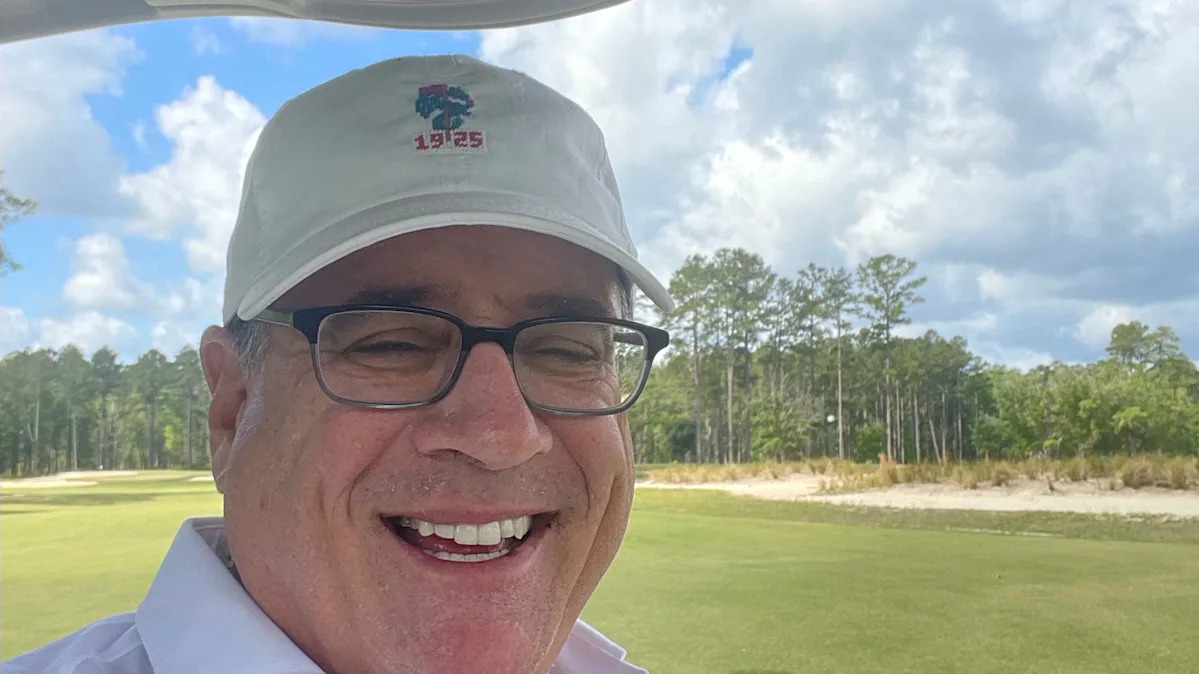
For Steve Lapper, golf was a lifelong passion and a side career.Courtesy of Sydney Lapper
Steve Lapper died in his sleep last week — a quiet passing for a beloved husband, father, unreformed golf junkie and friend to many in the game, none of whom would have described him as quiet.
I first met Steve some 15 years ago in the grill room of a hidebound Boston-area club. He was seated at the next table over, holding forth in a voluble stage whisper on the work of the Golden Age architect William Flynn. Someone made an introduction and we got to talking, first about courses, but soon about work and kids and where to get the best dim sum nearby. Within no time, he was giving me the kind of good-natured grief I only expect from people I have known and liked for years.
Advertisement
That was Steve. He made your acquaintance quickly. He was drawn to golf as an art form and a pastime, but even more as a catalyst for social connections, which he seemed to forge wherever he went. Busting chops was just one of his ways of expressing fondness. He relished his relationships in the game, with an understanding that the places golf took him and the people he met through it were its richest rewards.
Steve was born and raised in New Rochelle, N.Y., and grew up caddying at Wykagyl and Winged Foot. One of his cherished memories was walking Winged Foot as a standard bearer in the 1974 U.S. Open, an experience he’d happily recount to anyone who’d listen.
Both his parents played, his mother well enough to win her club championship. Steve could get his ball airborne, too. Sometimes, he even hit it with power and precision. But he never deluded himself into thinking he might do it for a living. Golf instead became a near-constant companion through a career that spanned trading floors in Chicago, San Francisco and New York.
It was in Manhattan where he met his wife, Melissa. They later moved to New Jersey, where they raised two daughters, Sydney and Whitney.
Advertisement
Like New York, Steve had an outsize personality and stories to match. Friends sometimes accused him of taking poetic license with his anecdotes, including the one about playing golf and poker with Michael Jordan when Jordan was a rookie. Steve’s pal, Mike Policano, was among the amiable doubters until a few years ago, when he wound up at dinner with Steve and two friends, one of whom mentioned he’d just bumped into Jordan in a hotel lobby. “He then described the two of them playing poker and golf with Jordan,” Policano told me. “I stammered, ‘You mean, that story was true?’”
Along with good yarns, Steve brimmed with interests and opinions. He read voraciously. He collected art. He could speak on high-brow topics without sounding pretentious and on low-brow matters without coming off as a knucklehead. Aside from his wife and daughters, few subjects delighted him more than golf design.
He was an early and forceful voice in online architecture forums. Debates on those platforms can be like academic feuds in which people care so much because the stakes are so small. At times, Steve ruffled feathers and had his ruffled back. But he never lost touch with the point of those exchanges, which was to swap ideas and insights with fellow obsessives, or their ultimate importance, which was minimal. He could disagree heatedly and laugh about it an hour later. And he was never too proud to admit when he was wrong.
“Steve could be a lot,” one of his friends told me, tenderly. I’ve always thought that’s better than being a little. To engage with Steve was to understand that he expected you to go all in. You could count on him to show you the same respect in return.
Advertisement
Steve served as a GOLF Magazine course rater for more than a decade. But his deepest involvement in the game was as a course operator and developer. He was president of Paramount Golf Club in New York and co-owner of Fox Hollow Golf Course in New Jersey, and he was working toward a real-estate project at nearby Spring Brook GC when he died.
Brandel Chamblee, the Golf Channel and NBC Sports analyst, first encountered Steve over lunch at Paramount under circumstances not unlike my own. Steve was seated nearby and “he was not inconspicuous,” Chamblee said. “He also knew more about architecture than anyone I’d ever met. It was like talking to George Thomas, Alister MacKenzie, Bill Coore and Gil Hanse all in one.”
Steve and Chamblee became friends, though not because they agreed on everything. “Politically, we couldn’t have been more opposite,” Chamblee said. “But with Steve, you could have an argument without animosity. He would listen to you. He was open to having his mind changed. Even on fraught topics, conversations with Steve were always civil. It reminded me of the way the world used to be. Of the way the world should be.”
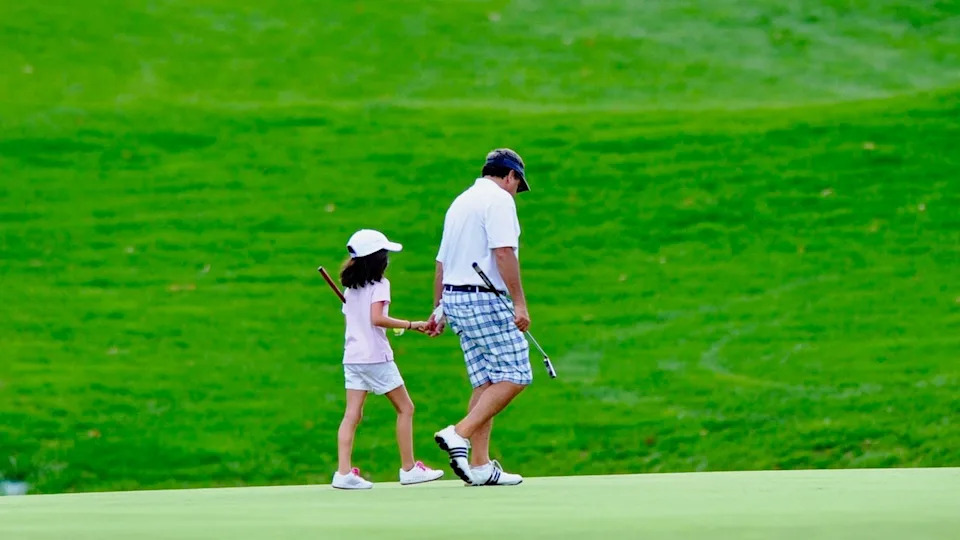
Golf was a Lapper family affair. Courtesy of Sydney Lapper
They eventually partnered on a golf development project that fell into limbo. The friendship didn’t.
Advertisement
Steve will be remembered for his gregariousness but also for his generosity. He was giving with his time as well as with his contacts. Whether I was writing about design, agronomy, the business of golf development or legal issues around the Tour-LIV war, he topped my call list. If I needed a source, he had a reference. The Kevin Bacon of the golf world, he was rarely more than a few degrees removed from a notable figure. Often that figure was someone he knew well enough to bust their chops.
The golf course photographer Jon Cavalier experienced this firsthand. Steve was a big booster in Cavalier’s launch of LinksGems, the now-prominent Instagram account he runs. “When I was starting out, I didn’t know much about great architecture or private clubs,” Cavalier told me. “I didn’t know who to contact or how to conduct myself.” Steve liked Cavalier’s work, reached out to say so, and became both a friend and mentor, educating him about design, showing him how to navigate the industry. “If I’ve got 1,000 great relationships in golf,” Cavalier said, “I probably owe 950 of them to Steve.”
Steve shared his love of golf at home. He inspired Melissa to take up the game and taught both daughters to play. Before his death, Whitney had been planning to host a tournament at her college in Wisconsin to raise money for one of the campus clubs. That event is in April. Steve and Sydney had planned to attend. Now, Sydney and her mom will go. “But my dad will be there in spirit,” Sydney said. “His idea of heaven was a golf course.”
Steve would have turned 69 this year. The last time we spoke, he’d been scraping it around. His game had seen better days and he was the first to say so but without complaint. He knew that was the bargain every lifelong golfer strikes. He had trips planned and a clear sense of how he hoped to spend his time. He had played 99 of GOLF’s Top 100 Courses in the World, Augusta National being the exception. He would have thrilled to play it, but he wasn’t going to break his back to try to make that happen. Getting out with friends and family was the main thing. The cachet of the course concerned him less than the company he kept.
Advertisement
In 2022, one of Steve’s close friends, a fellow course rater named David Baum, was killed in a car accident in New Jersey. In a tribute on GOLF.com, Steve wrote: “Like so many of us, David took lessons and worked on his swing, yet his goal wasn’t as much to shoot a lower score as it was to enjoy the walk. . . He also saw the game as a portal to adventure and discovery.”
I count myself among the many who feel similarly about golf, and whose world was widened because of Steve.
The post Remembering Steve Lapper, a design buff who lived and breathed the game appeared first on Golf.
Read the full article here