





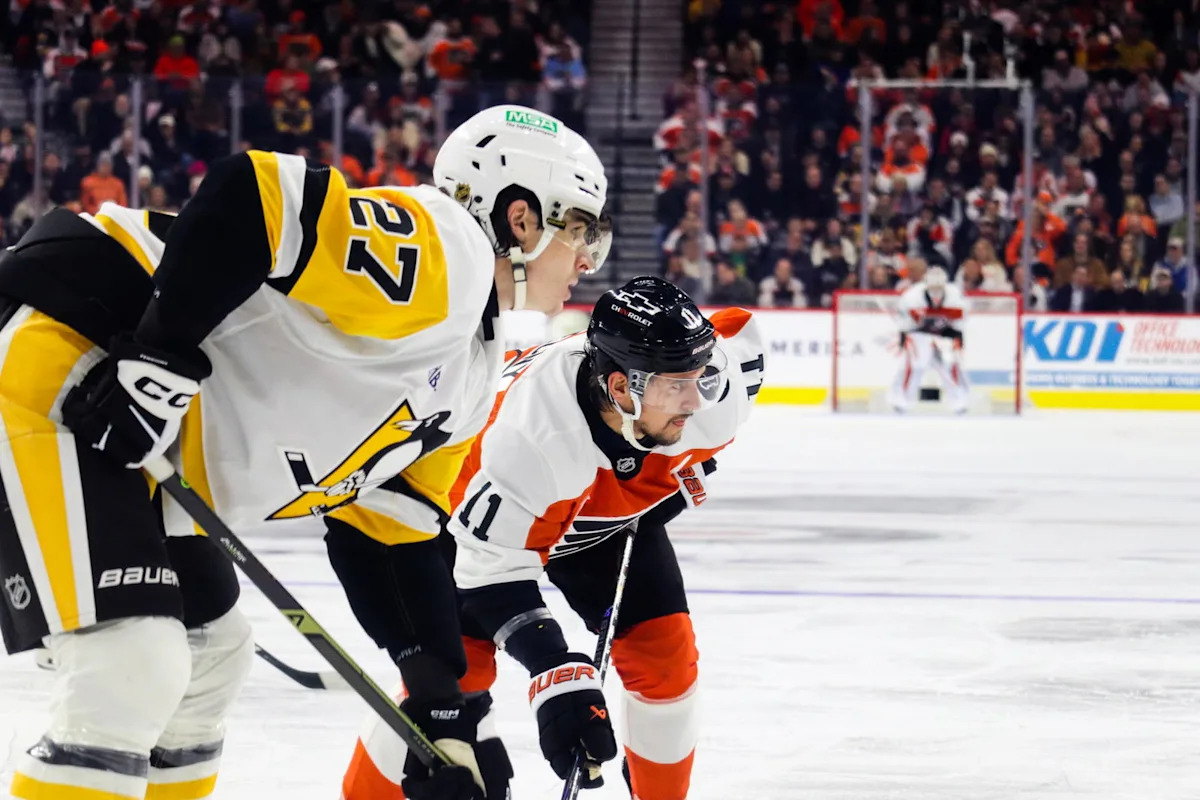
The final meeting of the season between the Philadelphia Flyers and Pittsburgh Penguins arrives under unusual circumstances for both teams.
Pittsburgh will take the ice without two of their superstars—Sidney Crosby and Evgeni Malkin—while Philadelphia arrives with a slightly altered lineup following the trade that sent Bobby Brink to Minnesota and a call-up from Lehigh Valley that will see Alex Bump make his NHL debut.
1. Pittsburgh Without Crosby and Malkin Changes the Dynamic
For nearly two decades, the identity of the Penguins has revolved around two names: Sidney Crosby and Evgeni Malkin.
Advertisement
Therefore, their absence dramatically alters the tactical landscape of this matchup.
Crosby, who is out of the lineup due to a lower-body injury sustained at the Olympics, has an undeniable influence that extends far beyond scoring totals. His puck protection, faceoff dominance, and ability to dictate pace through controlled offensive-zone possession have long forced opposing teams to adjust defensive matchups.
Malkin, who was suspended for five games after slashing Buffalo’s Rasmus Dahlin, meanwhile, has historically provided the Penguins with a second offensive engine—capable of generating offense through power and creativity in transition.
Without them, Pittsburgh’s attack becomes more distributed but less predictable. The Penguins may lean more heavily on speed through the neutral zone and a committee-style offensive approach rather than the familiar star-driven structure.
Advertisement
For Philadelphia, the challenge is psychological as much as tactical. Rivalry games can produce complacency when star players are absent. The Flyers must resist that temptation. Even without Crosby and Malkin, Pittsburgh remains a team capable of exploiting defensive lapses.
2. The Flyers’ Offensive Structure Must Adjust Without Bobby Brink
The trade sending Bobby Brink to the Minnesota Wild created both opportunity and disruption within Philadelphia’s forward group.
Brink had become an effective playmaking presence, particularly when deployed alongside Noah Cates and Tyson Foerster. His ability to maintain possession along the boards and distribute the puck under pressure allowed that line to sustain offensive-zone time.
Advertisement
Replacing that skill set is not as simple as just inserting another winger into the lineup.
Without Brink, the Flyers may rely more heavily on collective puck support rather than individual playmaking. Transition entries may need to be simpler, with an emphasis on speed and direct attacks rather than prolonged possession cycles.
3. Alex Bump’s NHL Debut Brings Opportunity
Tonight’s game will also mark the NHL debut of Alex Bump, a winger who has steadily climbed the Flyers’ prospect rankings.
Debuts rarely unfold predictably. Some players attempt to do too much, eager to justify the opportunity. Others play cautiously, prioritizing safe decisions over creative instincts.
Advertisement
The ideal outcome lies somewhere in between.
Bump’s offensive instincts and ability to find open ice made him an intriguing addition to the lineup, but his immediate role will likely be straightforward: forecheck aggressively, move the puck quickly, and avoid unnecessary risks.
If Bump channels that energy into disciplined play, he could provide the Flyers with a spark—particularly against a Penguins defense adjusting to new offensive patterns without its traditional stars.
4. Rivalry Games Demand Emotional Control
The Battle of Pennsylvania has historically produced moments of volatility. For the Flyers, emotional discipline will be crucial.
Advertisement
Rivalry intensity can either elevate a team’s focus or derail its structure. Philadelphia’s recent success has been built on controlled aggression: physical play within a system that prioritizes defensive positioning and puck management.
Maintaining that balance in Pittsburgh’s hostile environment will be essential. The Penguins, especially without Crosby and Malkin, may rely on physical engagement and pace to disrupt Philadelphia’s rhythm.
The Flyers must respond with composure rather than escalation.
Projected Lines
Philadelphia Flyers
Forwards:
Trevor Zegras – Christian Dvorak – Owen Tippett
Denver Barkey – Noah Cates – Matvei Michkov
Advertisement
Alex Bump – Sean Couturier – Nikita Grebenkin
Carl Grundstrom – Luke Glendening – Garnet Hathaway
Defense:
Travis Sanheim – Rasmus Ristolainen
Cam York – Jamie Drysdale
Emil Andrae – Noah Juulsen
Goalies:
Dan Vladar
Sam Ersson
Pittsburgh Penguins
Forwards:
Avery Hayes – Rickard Rakell – Bryan Rust
Egor Chinakhov – Tommy Novak – Ville Koivunen
Anthony Mantha – Ben Kindel – Justin Brazeau
Connor Dewar – Blake Lizotte – Noel Acciari
Defense:
Parker Wotherspoon – Erik Karlsson
Samuel Girard – Kris Letang
Ryan Shea – Connor Clifton
Goalies:
Stuart Skinner
Arturs Silovs
Read the full article here