





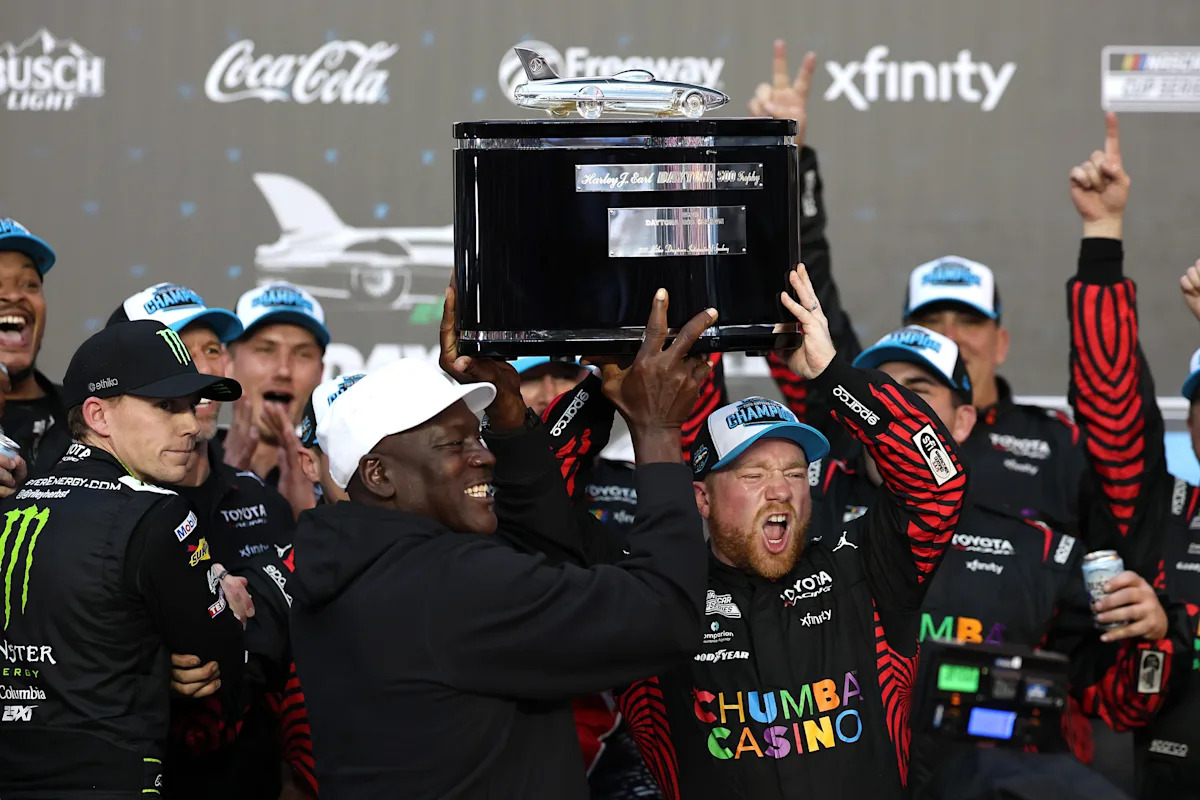
DAYTONA BEACH, Fla. — No matter who won Sunday’s Daytona 500 — even if it was Tyler Reddick boldly darting, dodging and diving through traffic and surging past Chase Elliott in a final lap blur of horsepower and hope — it wasn’t enough.
Even if Reddick was driving a car owned by the iconic Michael Jordan, it still wasn’t enough.
Advertisement
It wasn’t enough to undo the damage.
It wasn’t enough to restore what’s been missing for 25 years.
It wasn’t enough to make NASCAR whole again.
Because no matter how many breathtaking finishes, no matter how many drone shots of the beach at sunrise, no matter how many corporate taglines about “the future of the sport,” this weekend marked the 25th anniversary of the day the thunder died.
A quarter-century ago on the final lap of the 2001 Daytona 500, Dale Earnhardt hit the wall in Turn 4 and took something with him that NASCAR has never fully recovered: its center of gravity.
I still see it the way I saw it from the press box that afternoon. I remember glancing to my left and seeing the ashen look on legendary Orlando Sentinel racing writer Ed Hinton’s face. “This ain’t good,” Eddie muttered. It would be hours before NASCAR confirmed what some already knew, but the silence told the story before the words did. The tarp draped over the car. The frantic gestures from Kenny Schrader. The engines fading into something that felt like disbelief.
Advertisement
The Great American Race became the Great American Wake.
I remember the roar when Earnhardt wrecked; fans cheering, some in anger, some in joy. He was loved and hated in equal measure. That was his magic. Never before had a sport’s greatest figure been both its hero and its villain at the same time. He was John Wayne in a fire suit, spurs sparkling on a 3,000-pound steel horse.
And then he was gone.
The sport did something good in the aftermath. It mandated the HANS device. It invested in safety. Not a single driver in NASCAR’s top three series has died since. On that front, progress was real.
But culturally? Spiritually? Commercially?
Advertisement
That’s where the cracks began and they’ve been widening ever since.
Kevin Harvick, who drove Earnhardt’s car at Rockingham just days later, put it simply this week: “Twenty-five years later, the sport is still going on, but it’s just missing a big piece of what was so important to NASCAR .”
That piece wasn’t just talent. It was identity. Earnhardt didn’t just drive in NASCAR; he defined it. He was its gravitational pull. Fans aligned themselves for or against him. Television built narratives around him.
When he died, NASCAR lost its alpha.
Sunday’s race unfolded beneath that shadow — as all Daytona 500s have ever since. But this anniversary arrived at a particularly fragile moment.
Advertisement
NASCAR is coming off one of the most turbulent stretches in its modern history. Ratings and attendance have plunged. The sport has fought for cultural oxygen in a crowded entertainment landscape.
And at a time when it needed momentum, it found itself in a federal courtroom.
The lawsuit brought by 23XI Racing — co-owned by Jordan and Denny Hamlin — and Front Row Motorsports exposed an uncomfortable truth: the sport’s internal structure had calcified.
Jordan, arguably the most famous athlete in modern American sports history, entered NASCAR in 2021 with swagger, ambition and global brand power. He testified that he believed he had the strength to challenge the system. What followed was eight bruising days in federal court over charter agreements, revenue sharing and allegations that NASCAR behaved like a monopolistic bully.
Advertisement
In the end, NASCAR blinked.
And Jordan won.
Jordan and chairman Jim France stood shoulder to shoulder outside the courthouse announcing a settlement. Charters would become permanent. Revenue sharing would be restructured. The system, after 16 months of legal warfare, would change.
It should have happened without subpoenas.
It should have happened without a courtroom.
At a time when NASCAR officials should have been embracing a global icon who wanted to invest in their slumping organization, they inexplicably tried to run Jordan out of the sport.
Instead, NASCAR’s commissioner ran himself out of the sport by getting exposed on the witness stand. When private text messages surfaced showing that Commissioner Steve Phelps had referred to Hall of Fame team owner Richard Childress — Earnhardt’s longtime boss — as “a stupid redneck who needs to be taken out back and flogged,” the damage was seismic.
Advertisement
Phelps resigned weeks later.
Think about that. The commissioner of NASCAR was forced out after publicly disparaging one of the men most closely tied to its fallen icon.
It felt symbolic.
A sport still wrestling with its identity, now alienating its own legends. A league founded on Southern grit suddenly embarrassed by the very roots that built it.
The irony is that the settlement with Jordan might actually represent a turning point. Permanent charters bring stability. Revenue reform could ease long-simmering tensions. Perhaps the sport really can “get back to racing,” as France said.
Certainly, a victory by Reddick and the race team co-owned by Jordan on Sunday will help the visibility of the sport, but there is still much work to be done.
Advertisement
“I think (the court case) was a wakeup call for NASCAR,” Hamlin said. “We have to now figure out how to get the sport back to where it was decades ago.”
Twenty-five years ago, I walked out of Daytona into a black, moonless night and saw fans holding candles, weeping beside campers. A Jeff Gordon fan told me, “I cheered when he crashed. I cried when he died. This sport will never be the same.”
He was right.
Sunday delivered another champion, another fantastic finish, another trophy, another celebration in Victory Lane.
But no checkered flag can reverse what was lost in Turn 4 in 2001. No settlement agreement can instantly restore cultural authority. No commissioner’s resignation can fully cleanse embarrassment. Not even Jordan in victory lane on Sunday can overcome the enormous void left by The Intimidator.
Advertisement
You could see it in the commemorations this week — the vintage No. 3 flags, the tributes on the big screens, the interviews with drivers who weren’t even born when he raced but speak his name with reverence.
Yes, NASCAR survived Dale’s death.
It evolved.
It became safer, more corporate, more polished.
Yet a quarter-century later, as engines fired and the field roared toward the green, there was still the echo of the man who once made the ground shake.
The sport goes on.
But it can never, ever be the same.
____
Read the full article here